Coco's first drawing changes what magic means
Coco has spent her life watching magic from the outside, until a forbidden glimpse reveals that its mystery rests on a learnable craft. Her discovery makes wonder exhilarating—and immediately dangerous.
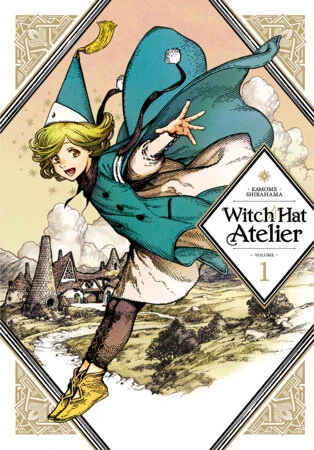
Coverage: Opening chapter, including Coco’s discovery of how magic is made and its immediate consequences.
A wonder kept at a distance
Before Coco learns the secret of magic, she knows it chiefly through its effects. Witches perform wonders; ordinary people watch. That divide is familiar enough to seem natural, but the opening chapter makes it personal: Coco has wanted to become a witch for as long as she can remember, and has been told that the wish cannot change who she is. Her longing is not abstract ambition. It is an attentive, practiced interest, fed by the visible results of magic and by the possibility that someone might make such things happen.
This arrangement gives the story’s first revelation its force. Coco is not simply granted a power she lacked. She discovers that the boundary she accepted was built on missing knowledge. Magic can be drawn, and the marks themselves matter. The idea is startling because it converts an unreachable performance into a process with materials and choices. Coco’s desire suddenly has a route forward, though not a safe one. The wonder remains; what changes is the distance between watching and doing.
A forbidden lesson in looking
Coco’s discovery comes through an encounter with a witch and a chance to see magic being made. She watches closely, then finds a way to reproduce what she has seen. The sequence turns observation into action without making the transition feel harmless. Coco’s curiosity is real work: she studies the act, remembers its shape, and tries to make the marks herself. Yet she lacks the knowledge that would let her judge the risks. Her first drawing is both evidence of her capacity to learn and a demonstration of how little understanding a copied gesture can contain.
That tension complicates the familiar story of a child whose dreams come true. Coco’s initiative deserves admiration, but the narrative does not equate eagerness with readiness. The danger follows from an imbalance: she has enough information to act, not enough to anticipate what the act might do. Magic’s secrecy has kept her ignorant, while secrecy also helps explain why learning its craft involves responsibility. The opening chapter places readers beside Coco’s wonder and beside the consequences of letting wonder outrun instruction.
Drawing makes desire answerable
The story’s choice to make magic depend on drawing gives desire a physical form. A wish cannot simply be willed into being; a hand must make marks with particular tools. This makes the craft legible without making it easy. Coco’s first attempt changes the meaning of her long fascination because she now has to participate in the making, rather than only cherish its results. The distinction is small in appearance and large in consequence: wanting a wonder is not the same as understanding how to produce it.
Drawing also makes mistakes visible. A spell’s form can be examined as something made, which suggests that skill must include attention to process as well as imagination. Coco has approached magic with the appetite of a fan, absorbing its spectacle. The new task asks more of her: patience, precision, and an awareness that a beautiful result can carry risks. The manga’s visual emphasis on lines and hands supports that shift. Magic becomes intimate enough to touch, but tangible work brings obligations along with it.
The first step is not the answer
Coco’s discovery does not resolve her desire; it gives that desire a difficult shape. Her first drawing proves that the old division between witch and non-witch is not what she assumed, but it does not make her an experienced practitioner. The immediate consequences of her attempt insist on that gap. A new possibility can be genuine while the means of pursuing it remain perilous. That is a more demanding kind of hope than the simple assurance that persistence will be rewarded.
The opening chapter therefore changes what magic means in two directions at once. It is no longer an unknowable gift reserved for someone else, and it is not merely a fantasy that Coco can enter without preparation. It is a craft whose accessibility makes learning possible and whose consequences make learning necessary. Coco’s curiosity opens the door; what follows must teach her how to approach it. Her first drawing is a beginning precisely because it cannot yet serve as a complete understanding.
Primary work & further reading
Primary work: Witch Hat Atelier. Character and story readings are editorial interpretations. The publisher reference below identifies the work and its premise.