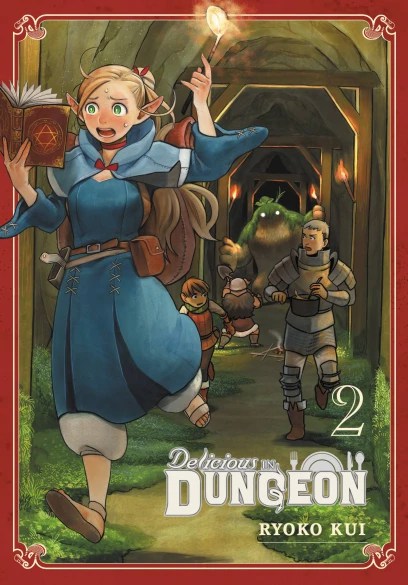
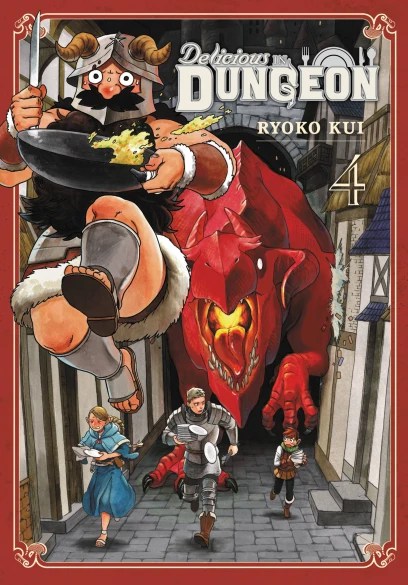
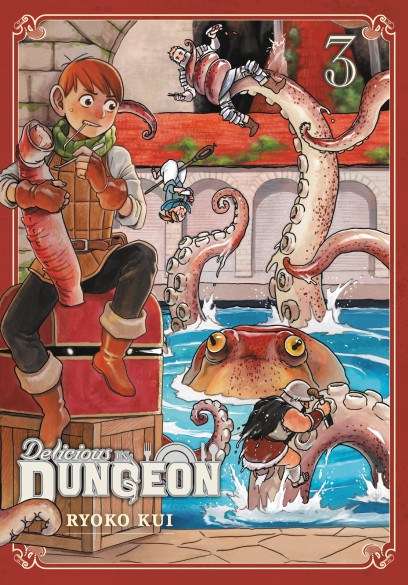
Laios knows what might be for dinner
A rescue mission becomes a lesson in how attention can keep a party alive. Laios’s fascination with monsters supplies practical knowledge, while the need to eat turns curiosity into a shared method of survival.
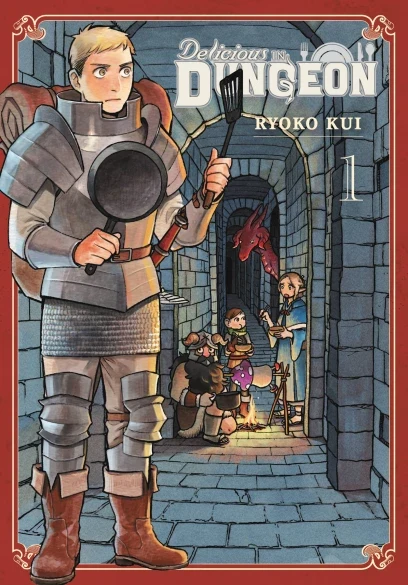
Coverage: Opening volume only; covers the decision to rescue Falin and the party’s early monster-based meals, without revealing Falin’s transformation.
A rescue measured against an empty stomach
The party’s decision to return for Falin is urgent, but it is also constrained by a plain fact: the group has lost its supplies and cannot simply march back into the dungeon as it was. Laios accepts a solution that sounds absurd to his companions—eat the monsters they encounter—because he treats hunger as part of the rescue problem rather than a reason to abandon it. His appetite gives the proposal its comic edge, yet the underlying choice is practical. If the party is to reach Falin, it needs to remain capable of moving and fighting.
That framing makes the opening volume’s food more than a novelty. Each meal answers a logistical question: how can these adventurers keep going without carrying provisions from the surface? Laios’s enthusiasm pushes the question forward, but necessity gives it stakes. A monster is at once an obstacle, a possible meal, and a subject to understand. The rescue premise therefore ties appetite to attention: the party cannot afford to treat the dungeon as scenery when its inhabitants may determine whether they can continue.
Curiosity becomes a field skill
Laios’s interest is unusually specific. He wants to know what monsters are like, how they behave, and whether they can be eaten. That fascination can make him seem oblivious to the unease of his companions, especially when he speaks about creatures as food while danger is still close. But the story gives his curiosity a practical consequence. He watches the dungeon’s life with an intensity that helps turn unfamiliar encounters into questions the group can act on.
The distinction matters because monster knowledge is not presented as a tidy encyclopedia detached from experience. It emerges while the party is hungry, exposed, and making decisions together. Laios’s attention may begin in personal fascination, but it becomes useful when others need to know what they are facing and how to respond. His appetite invites him to look closely; the peril of the dungeon makes looking closely worthwhile. The same trait that irritates his friends can also supply the party with options it would otherwise overlook.
Eating changes the meaning of an encounter
The meals make the party’s relationship to monsters stranger and more intimate than a simple cycle of defeating enemies. To eat something is to acknowledge its material place in the dungeon: it can threaten you, but it can also sustain you. That does not erase the danger or make every creature harmless. Instead, food complicates the boundary between the living world of the dungeon and the needs of the people traveling through it. Laios is drawn to that complication, while the rest of the group has to decide how much of it they can accept.
This approach also gives survival a communal shape. The party cannot live on Laios’s enthusiasm alone; an idea becomes a meal only when the others participate in judging, preparing, and eating it. Their hesitation keeps the story from treating his curiosity as an automatic virtue. The group has to negotiate what counts as tolerable, useful, or too risky. In that sense, eating monsters is not only a clever substitute for provisions. It is a test of whether the party can turn one member’s unusual way of seeing into a shared practice.
An appetite pointed toward the rescue
Laios’s fascination works because the rescue remains the reason the party is moving. Without that urgent destination, his monster talk could become a collection of eccentric observations. With Falin missing, every experiment sits beside a harder question: will this help them keep going? The story lets the curiosity be funny without losing sight of the cost of delay, and that tension makes Laios’s manner more revealing. He has a way of meeting danger by wanting to understand it, even when other people first experience that same danger as something to flee.
The result is a portrait of appetite as a kind of attention. Laios wants to eat, certainly, but his interest in food keeps pulling him toward knowledge of the world that might feed or harm him. The dungeon is not reduced to a pantry, and the rescue is not reduced to an excuse for meals. Rather, the two needs press on each other: the party must understand its surroundings to survive, and it must survive to reach Falin. Laios’s appetite becomes useful at precisely that junction, where curiosity has to serve care and forward motion.
Primary work & further reading
Primary work: Delicious in Dungeon. Character and story readings are editorial interpretations. The publisher reference below identifies the work and its premise.