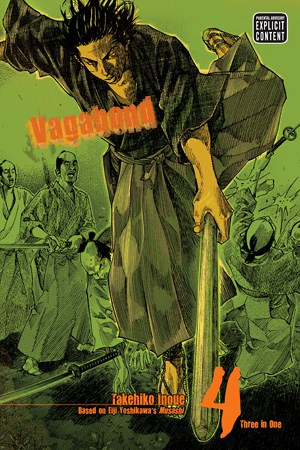
Matahachi gives Vagabond a second account of ambition
Matahachi’s path alongside Takezo complicates the idea that only fearlessness counts as ambition. In their early lives after Sekigahara, the friends’ contrasting choices reveal two different ways to imagine what survival might make possible.

Coverage: Covers Matahachi and Takezo’s early contrast and choices after Sekigahara; no later identity schemes or outcomes.
The same defeat opens different questions
Matahachi and Takezo emerge from the aftermath of Sekigahara sharing a history but not a temperament. Their common position as survivors might suggest that they will respond to danger in parallel. Instead, the story begins to distinguish what each man wants from the narrow task of getting out alive. Takezo is readily associated with force and forward motion; Matahachi is more visibly unsettled by the prospect of what comes next. That contrast introduces ambition as a personal question, not a single heroic standard.
A defeated army leaves its members with little reason to trust that old plans will hold. For Takezo, movement and toughness offer an immediate answer to uncertainty. Matahachi’s hesitation makes another concern legible: survival might be valuable because it leaves room for a life not governed by battle. Neither response simply cancels the other. The manga uses their shared circumstances to show that the meaning of escape depends on what a person hopes to escape toward.
Matahachi’s uncertainty is a choice with stakes
It is tempting to read Matahachi’s less forceful manner as a verdict on his character. But the early contrast becomes more interesting when uncertainty is treated as an active pressure rather than a comic weakness. He has to face the fact that the identity of a capable warrior may not fit him as naturally as it fits Takezo. Wanting a different life can require choices too, especially when the people around him measure worth through courage, physical command, and willingness to risk everything.
His response does not make him automatically wiser than Takezo. A wish for safety can become evasive, just as a willingness to fight can become reckless. The point is that Matahachi’s desire for an ordinary future gives the story a scale of value that combat alone cannot supply. A person may want companionship, shelter, or the ability to live without constantly proving himself. Those desires may be less spectacular than martial ambition, yet they still shape which risks seem worthwhile and which costs feel unbearable.
Takezo’s force makes the contrast sharper
Takezo serves as a vivid foil because his power appears to answer questions that leave Matahachi uncertain. He can meet danger head-on; he seems to have fewer doubts about whether he can survive a confrontation. But an advantage in immediate danger does not guarantee a clearer vision of the future. Takezo’s strength can propel him beyond a moment without showing him where he wants to arrive. Against that forward drive, Matahachi’s reluctance exposes the difference between being able to act and knowing what an action is for.
Their friendship prevents the contrast from becoming a simple chart of opposites. These are not two abstract philosophies neatly assigned to two figures; they are young men whose shared experiences make their divergences consequential. Matahachi can see the appeal of the formidable friend he has known, while Takezo’s presence makes the ordinary life Matahachi imagines harder to secure. Each becomes a measure of what the other lacks or fears. Ambition is therefore relational: the future one person wants is shaped by the possibilities another person makes visible.
Two ambitions refuse an easy ranking
The early story does not need Matahachi to match Takezo’s appetite for danger in order to make him matter. His role is to keep another conception of a life in view. If Takezo’s example makes strength and daring feel like powerful tools, Matahachi reminds the reader that those tools are not the only desirable outcome. Wanting peace or belonging is not the same as having no ambition. It is a claim about what a person hopes survival will finally protect.
This second account gives the friendship its thematic weight. Their paths after battle show that courage has more than one possible object: one man may face an immediate threat, while another must confront the pressure to become someone he is not. Neither aim can be reduced to a tidy judgment of bravery. Matahachi’s uncertainty matters because it unsettles Takezo’s apparent certainty, while Takezo’s strength makes Matahachi’s hopes feel exposed to real danger. Together they show that ambition begins not with a grand destination, but with the difficult choice of which kind of life seems worth pursuing.
Primary work & further reading
Primary work: Vagabond. Character and story readings are editorial interpretations. The publisher reference below identifies the work and its premise.