Mementos turns anonymous requests into a pattern
Mementos gives Persona 5 Royal a shared space for grievances that do not belong to one imposing Palace. Its recurring train imagery and ordinary targets shift attention from a single ruler’s world to the habits that shape public life.

Coverage: Mementos and its ordinary requests, without late-game revelations or outcomes.
One dungeon holds many small problems
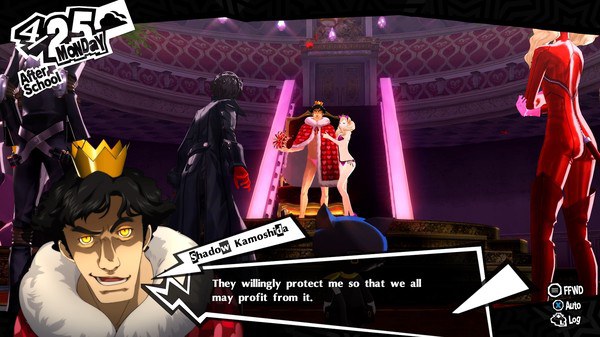
A Palace is tied to a particular person’s distorted view of the world. Mementos offers a different scale: it is a shared dungeon connected to ordinary requests and people whose troubles do not receive a Palace of their own. That contrast changes what the player is being asked to notice. Instead of entering one ruler’s private kingdom, the thieves encounter a wider landscape where grievances arrive from many corners of everyday life.
The shared setting makes those requests feel connected without making them identical. Each person has a particular problem, but the dungeon gives the group a place to respond to cases that otherwise would remain scattered. Mementos therefore acts as more than an extra destination. It gives the story a way to ask what the thieves owe people outside the dramatic, singular conflicts that define a Palace.
Train imagery puts the public in motion
Mementos’s train and subway imagery draws on a familiar part of daily life: people moving through a public system, often surrounded by strangers. That visual frame differs from the castlelike space of a Palace. It suggests a world shaped by shared routines rather than one person’s grand self-image. The public setting helps ordinary grievances feel like part of a common environment, even when the people involved remain anonymous to the player.
The train motif also carries a sense of movement without promising that society is moving toward justice on its own. A route can be orderly and still carry people through conditions they have little power to change. Mementos makes that unease playable: the thieves travel through a connected space to address requests that emerge from daily life. The setting links the small scale of an individual complaint with the larger scale of the public world it inhabits.
Anonymity makes a pattern visible
The requests in Mementos often concern people who are not presented with the elaborate identity and stronghold of a Palace ruler. That difference matters. An individual’s complaint can be easy to dismiss as a private misfortune, especially when the person is not powerful enough to dominate the story. By gathering such requests in one dungeon, the game invites the player to see how apparently small harms can recur across different lives.
A pattern is not the same as proof that every case has one cause. Mementos does not erase the differences among the people who need help. Instead, its shared structure gives those differences a common frame and makes repetition harder to overlook. The thieves’ work there asks the player to hold both scales at once: attend to a specific request, then consider why similar forms of harm keep appearing in the public world.
Intervention has a limit
The thieves’ ability to act can be appealing because it offers a direct response to a request. Yet the setup also places a limit on what their intervention means. Addressing a person’s distorted thinking is not the same as redesigning every circumstance around that person. The game gives the group a way to respond to individual grievances, but it does not make their role equivalent to a public institution that can resolve every underlying condition.
That limitation keeps Mementos from being a simple answer to social problems. The shared dungeon can reveal that ordinary grievances form a pattern, and the thieves can choose to act on particular requests. Neither fact guarantees that the wider world will become fair. Mementos’s purpose is more modest and more unsettling: it makes separate complaints visible beside one another, then asks whether responding case by case is enough. The question remains part of the dungeon’s meaning.
Primary work & further reading
Primary work: Persona 5 Royal. Character and story readings are editorial interpretations. The publisher reference below identifies the work and its premise.