Why dorm evenings matter in Persona 3 Reload
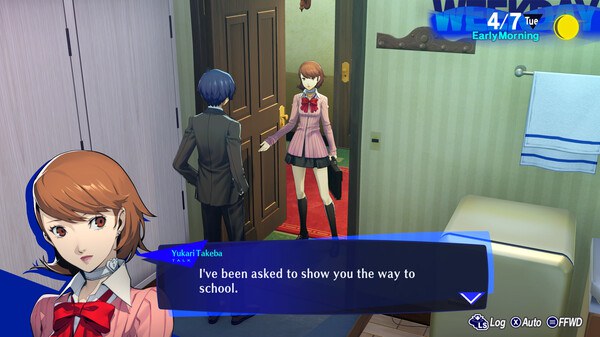
The dorm gives Persona 3 Reload a place where SEES members exist outside the demands of combat. Shared activities and casual conversation reveal the small work of living together between the story’s larger pressures.

Coverage: Discusses dorm life, shared meals and conversations, and Reload’s group activities without revealing later story developments.
A home is made through repetition
The dorm is important because it gives the members of SEES a shared address before it gives them a shared emotional language. They return to the same building after school and after dangerous nights, moving through spaces that make cohabitation visible. Meals, brief exchanges, and ordinary routines establish that these characters do not meet only when the plot needs a team. They have to occupy the same everyday world.
Repetition does much of the characterization. A group that eats together or crosses paths in familiar rooms begins to feel like a group through accumulated presence, not a formal speech about loyalty. Such scenes give the player a sense of how people behave when they are not under direct pressure. Someone may be sociable one evening and withdrawn another; a familiar setting allows those changes to register without requiring a dramatic explanation.
Conversation happens at a human scale
Dorm conversations often work by remaining small. They can address moods, habits, or the immediate texture of a day rather than advancing the central mystery. That modest scale is useful: it makes the characters feel like people whose concerns do not vanish whenever the supernatural plot pauses. The story can then return to danger without implying that danger is the only thing any of them think about.
There is also a difference between being near someone and understanding them. Sharing a home gives the characters chances to notice one another, but proximity does not make every private feeling transparent. Reload’s quieter moments preserve that gap. A remark can suggest familiarity without resolving a disagreement, and a comfortable evening can sit beside an unsettled one. Cohabitation creates conditions for understanding; it does not guarantee instant harmony.
Group activities show attention in action
Reload adds group activities that make the dorm’s relationships more participatory. Joining a shared pastime lets the protagonist spend time with other SEES members in a context that is not simply a mission briefing. The activity itself matters less than the attention it requires: showing up, responding to another person, and encountering a side of them that may not be foregrounded during combat.
These moments should not be confused with Social Links. They contribute to characterization and companionship, but their form and function differ from the game’s formal relationship arcs. That distinction helps the dorm feel like a social environment rather than a menu of interchangeable rewards. Some encounters build a specific bond through a structured route; others make the ensemble more present by showing members sharing time in the same place.
Ordinary life gives duty a reason
The dorm’s quiet scenes also change the emotional scale of SEES’s work. The group’s responsibilities can feel abstract when described only as a mission, but a shared dinner or casual exchange makes the people behind that duty concrete. Their routines are not a simple reward after danger; they are part of the life the characters are trying to maintain. Domestic calm therefore carries narrative weight without needing to become solemn.
Persona 3 Reload uses dorm evenings to show that a team is built in the hours when no one is being tested by an enemy. Shared space creates chances for patience, friction, and small acts of attention. Those moments do not solve every tension, and they need not. They make the group’s larger responsibilities feel personal by giving its members a life together that is worth returning to.
Primary work & further reading
Primary work: Persona 3 Reload. Character and story readings are editorial interpretations. The publisher reference below identifies the work and its premise.