Inside Kamoshida's castle: a school remade around its ruler
Persona 5 Royal turns a school’s unequal relationships into a castle you can explore. Its first Palace makes authority look grand and theatrical, then asks the player to notice what that spectacle conceals.
Coverage: Opening Palace only; discusses its setting and heist design without graphic abuse detail.
A school becomes a ruler’s stage
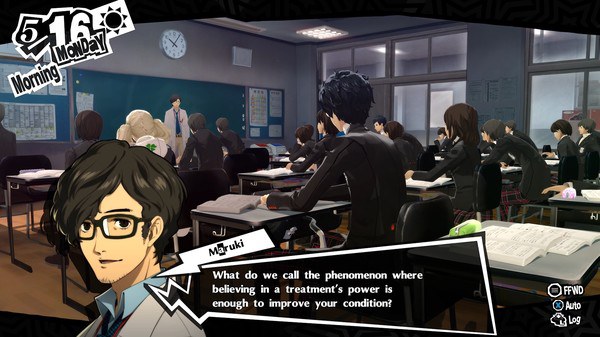
Kamoshida’s Palace does not place its castle in a distant fantasy kingdom. It grows from the school that Joker and his classmates actually attend, making the shift from corridors and classrooms to battlements feel like a claim about who controls that familiar space. The castle gives one person’s authority a physical scale. What looks like a school to its students can look, in the Palace, like a domain organized around its ruler.
That transformation gives the first heist a clear visual problem. The students are not merely entering an unfamiliar dungeon; they are moving through a distorted version of an institution where their place has already been assigned. The castle’s walls, doors and guarded rooms turn social exclusion into obstacles the player can read. Space itself seems to insist that the ruler belongs at the center and everyone else must find a way in.
The crown makes authority theatrical
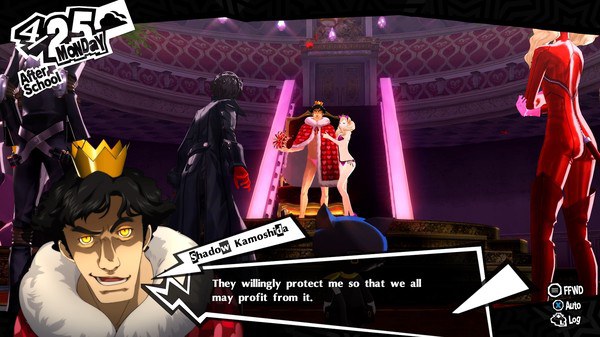
The castle presents Kamoshida’s status as something regal. A crown and royal bearing translate his position at school into the language of a monarch, suggesting that he sees ordinary limits as rules for other people. The imagery is broad and deliberately legible: a school authority figure becomes a sovereign, and the students around him become subjects in a private kingdom.
That grandness is part of the criticism. A crown makes power appear natural, even splendid, by dressing it in symbols that command attention. The Palace’s design lets the player see how self-importance can alter a person’s picture of the world. Its spectacle is not evidence that the ruler deserves his status. It is evidence that his distorted view has made status feel like a birthright.
Guards turn hierarchy into movement
The Palace’s guards and locked passages make its hierarchy practical. They do not simply decorate a threatening setting: they regulate where the thieves may go and how much of the castle they can see. Stealth, cover and careful movement give the player a way to feel the imbalance. The ruler’s domain is open to those who serve its order, while intruders must watch for danger and use the architecture against itself.
This design also links exploration with interpretation. A room that requires caution asks the player to consider whose safety the castle is built to protect. The thieves learn to treat walls, sightlines and patrols as parts of one system. That does not make their task a simple contest of strength. The space favors its owner, so progress depends on noticing how its controls work and choosing when to challenge them.
The first heist teaches a way of seeing
Because this is the game’s first Palace, its visual language doubles as instruction. The player learns to distinguish an ordinary setting from the ruler’s version of it, to look for routes through imposing rooms and to understand why a target’s idea of power can shape a dungeon. The lesson is delivered through architecture rather than a detached explanation. The castle is both a place to navigate and an argument made visible.
The result is a focused opening: an everyday school can contain a social order that feels inescapable, but translating that order into a castle reveals that it is constructed. The Palace’s size and royal imagery show how power magnifies itself; its passages and defenses show how that power keeps others at a distance. The first heist matters because it teaches the player to look at authority as a design—and therefore as something that can be challenged.
Primary work & further reading
Primary work: Persona 5 Royal. Character and story readings are editorial interpretations. The publisher reference below identifies the work and its premise.