Everyone knows someone in Persona 4 Golden's Inaba
Inaba’s close-knit routines turn a string of unsettling events into a disturbance felt across ordinary life. The town’s school, shops, homes, and uncanny television world make the mystery intimate before it becomes explainable.
Coverage: Covers the game’s setting, early investigation, and general Midnight Channel premise; does not identify the culprit or reveal the ending.
A town measured in familiar routes
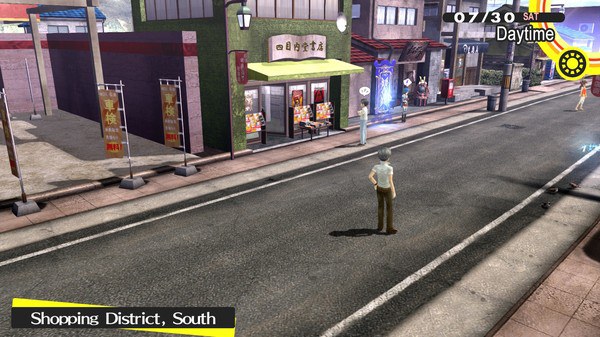
Inaba gives the investigation a human scale. Its shopping district, school, homes, and other everyday destinations are close enough to become part of a student’s regular orbit. Moving between them is not travel through an anonymous map; it is a sequence of returns to places where someone may recognize you, need your help, or have heard what happened. The town’s compactness makes the mystery feel less like a distant emergency than a change in the shared life of people you keep meeting.
The routine matters because the game makes ordinary time visible. Classes, errands, and conversations continue alongside the investigation, and the player chooses how to spend the spaces between major events. That rhythm gives the setting social texture: a day is not simply a gap before the next clue, but a chance to maintain ties and learn how people inhabit the same small community differently. Inaba becomes personal through repeated contact, not through a grand tour of its landmarks.
Junes complicates the idea of local belonging
Junes is a practical destination and a conspicuous sign of change. Its large store draws people into a shared public space, while its presence sits uneasily beside the older shopping district’s local businesses. That contrast gives Inaba’s scale an economic dimension: the question of who belongs is not only about friendship or reputation, but about which places sustain the town and which seem to be reshaping it.
Because characters return to familiar spots, these tensions do not stay abstract. A shopping trip can place neighboring habits side by side, and the store’s everyday usefulness does not erase what it represents to people who feel their community changing. The game does not need a sweeping account of rural decline to make the conflict legible. It lets the player encounter competing claims to local life while moving through the same town for unrelated reasons.
School life keeps the mystery among peers
The high school is another of Inaba’s shared spaces, but its routines place the investigation inside a tightly observed social world. Students meet under the same institutional schedule, carry rumors between one another, and see familiar faces again after the day’s events. That repetition makes information feel socially charged: a report is never just a clue when it may affect how classmates see someone or what they believe about the town.
School also gives the protagonist a role beyond detective work. He is a student with a place among peers, which means building trust and paying attention to everyday concerns remain part of the story’s movement. Those interactions make investigation less solitary. Knowledge comes through conversation and connection, and the people who share Inaba’s routines become as important to understanding the atmosphere as any isolated piece of evidence.
The television world makes familiar spaces uncanny
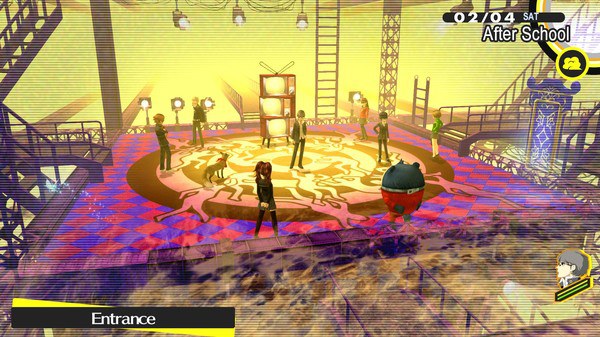
The TV world unsettles the distinction between public routine and private danger. The Midnight Channel begins with an image encountered through an ordinary household television, an object associated with staying in and watching rather than entering an unknown place. The shift from screen to destination binds the uncanny to domestic life. A familiar room can become the threshold to a world whose rules the characters must discover together.
That connection also prevents the other world from feeling like a separate fantasy adventure pasted onto a small-town mystery. The characters carry their Inaba relationships into the danger, and the consequences return to a community where everyone must continue living beside one another. The setting’s central effect is intimacy: school, shops, homes, and the television world all lead back to the same network of people. By keeping the map close, Persona 4 Golden makes its mystery feel like a disruption of shared life rather than a puzzle happening somewhere else.
Primary work & further reading
Primary work: Persona 4 Golden. Character and story readings are editorial interpretations. The publisher reference below identifies the work and its premise.