Getting past Yukari Takeba's practiced distance
Yukari Takeba can seem open, brisk, and socially at ease while keeping important parts of herself out of reach. Persona 3 Reload uses that gap to make her confidence feel like a practiced boundary rather than simple ease.
Coverage: Covers Yukari’s early school interactions, her guardedness, and her response to the Dark Hour; avoids later family revelations and treats romance as optional player content.
A social ease with edges
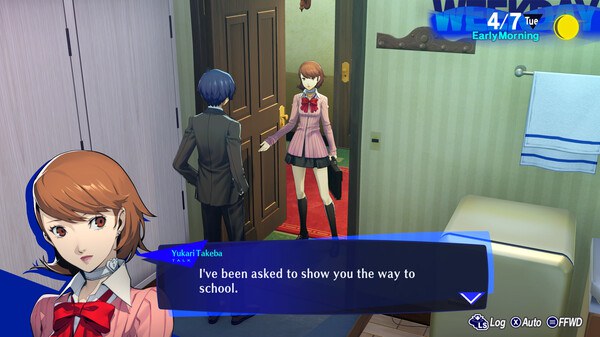
At school, Yukari often appears more comfortable in the ordinary social world than the protagonist. She knows how to speak casually, respond to classmates, and move through familiar settings without making every interaction solemn. That surface ease matters because it is not the same as openness. Her sharpness can cut off a question or keep a conversation on manageable ground. The game lets friendliness and reserve occupy the same moment.
This makes her early characterization more specific than a simple “tough girl” mask. Yukari is not constantly hostile, nor does she need to perform aloofness in every scene. Instead, she controls how close a conversation gets. A quick joke or pointed remark can establish that she is present while also limiting what another person may assume about her. The boundary is part of her social skill.
Guardedness as a way of choosing
Yukari’s distance reads as deliberate because she is observant about the people around her. She does not offer trust automatically just because she is in the same group, and her questions about the strange events around her are not signs of passive acceptance. She wants explanations and evaluates what she is told. That insistence gives her skepticism a practical purpose: she is trying to understand what she has entered before surrendering control to it.
The player encounters this reserve through interaction rather than a single declaration. Conversation can move forward, but warmth does not arrive as an instant reward for showing up. Yukari’s stance asks the player to distinguish access from intimacy. Being able to speak with her at school does not mean every personal subject is now available. The slow pace gives her boundaries a presence of their own instead of presenting them as obstacles the protagonist is entitled to overcome.
The Dark Hour changes the terms
Yukari’s response to the Dark Hour shows another side of the same caution. She is not defined only by how she handles classmates; the danger gives her a reason to act alongside others, even while uncertainty remains. Her participation in SEES places her in situations where composure and fear can meet. The game does not need to make her suddenly unguarded for her to matter in those moments. Resolve can coexist with questions.
That distinction keeps her from reading as a stock contrast between a cheerful schoolgirl and a secret fighter. She carries the same alertness into both settings, adjusting her manner to what the situation allows. At school, a pointed response can preserve privacy. In the Dark Hour, attention and preparation help her face a threat. The contexts differ, but both reveal a young person trying to stay an active participant rather than being carried along by events.
Trust is not a prize
Yukari’s guardedness works best when read as characterization, not as a lock waiting for the player to pick it. Her interactions may grow more personal through the game’s relationship systems, but an optional romance route is one possible player path, not a universal account of her feelings. That distinction matters: her personality exists beyond the protagonist’s chance to become important to her. She can be a teammate, a student, and a friend without every facet resolving into romantic availability.
Persona 3 Reload gives Yukari dimension by allowing her to keep some control over how she is known. Her social fluency does not cancel her caution, and her involvement in SEES does not erase her need to question what is happening. The result is a character whose distance has meaning: it protects the space in which trust can become a choice.
Primary work & further reading
Primary work: Persona 3 Reload. Character and story readings are editorial interpretations. The publisher reference below identifies the work and its premise.