One More floor? Managing a Tartarus expedition
In Persona 3 Reload, Tartarus fights spend SP as well as HP. Learn enemy weaknesses, use One More and Shift to control encounters, and decide when low SP makes it wiser to head back than to risk another unknown Shadow.
Coverage: Covers Tartarus exploration, weakness discovery, One More, Shift, All-Out Attacks, Shuffle Time, and resource management. Avoids story revelations and late-game details.
Use known weaknesses to shorten exchanges
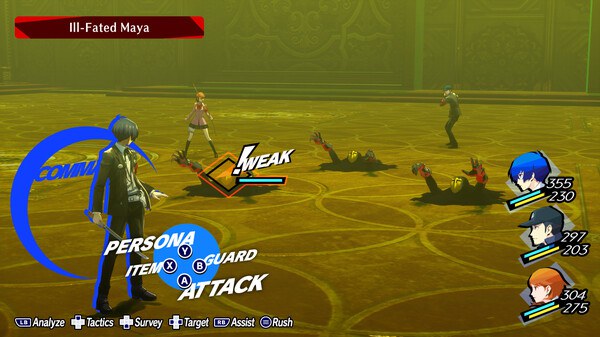
In Tartarus, Persona skills cost SP, so choosing an attack is also choosing how much energy to carry into the next encounter. When a Shadow has a weakness you have already discovered, hitting it can knock the enemy down and grant One More: the acting character gets another opportunity before the enemy can answer. That can save the party from a longer exchange of attacks and incoming damage. The weakness information persists once discovered, so you can use it to make a more informed choice when you meet that Shadow again.
A weakness is useful information, not a rule to apply by appearance alone. Similar-looking Shadows can have different vulnerabilities, so avoid spending SP on an unconfirmed guess. If you know a Shadow is weak to ice, for example, an ice skill can create an opening; if you do not know its weakness, a basic attack or another sensible move may be the better first choice. Spending a skill on every routine enemy may end those fights quickly, but it leaves less SP for a tougher encounter later in the climb.
Pass the extra turn with Shift
One More gives the character who struck the weakness another action, but Reload also lets that character use Shift to pass the opportunity to an ally. This gives you a tactical choice: keep acting with the current character, or hand the opening to someone better placed to exploit it. If the enemy is weak to ice and the current character has exposed that weakness, shifting to an ally with a known effective attack can help keep the party’s momentum without treating every character’s turn as interchangeable.
Knocking down enemies can set up an All-Out Attack, but that group assault is available only when all enemies are knocked down. If one Shadow remains standing, the condition is not met; use the extra action to address that threat or make another useful move. When the whole group is down, an All-Out Attack can turn the sequence of weakness hits into a decisive finish. The practical aim is to build the opening deliberately, rather than assuming that one successful hit automatically ends the encounter.
Balance Tartarus progress against SP
A long Tartarus visit is a series of fights, and SP is what lets Personas use their skills throughout that series. Yukari Takeba can serve as the party’s healer, but healing and attacks still draw on the same limited resource pool. If she has spent much of her SP keeping the group on its feet, that matters when you consider whether to continue. A party can have enough HP to survive another battle while lacking the skill resources that make an unknown fight manageable.
Imagine you have cleared several encounters, used skills to exploit known weaknesses, and found that Yukari has little SP left. Taking another stairway may yield more progress, but the next Shadow’s weakness is unknown and the party may need healing after the fight. Returning now preserves the team for a later trip; continuing risks spending the remaining SP before a more demanding battle. There is no universal floor marker that makes the choice for you. Check the party’s actual condition and decide what you can afford to meet next.
Make Shuffle Time part of the route
After a battle, Shuffle Time gives you a reward choice that can shape the rest of the excursion. Read the available cards in light of the party’s current needs: a benefit that supports the team now may be more useful than one that sounds attractive in isolation. The reward comes after the cost of the fight, so consider both what the party gained and what it spent. If SP is already running low, that should influence how you judge the value of continuing to collect rewards deeper in the tower.
The systems fit together as practical decisions. Use a discovered weakness to earn One More, Shift the opportunity when an ally can use it better, and aim for an All-Out Attack only after every enemy is down. Then use Shuffle Time to choose a reward with the next stretch in mind. If the party’s SP is too low for an unknown encounter, head back even if another fight might offer a reward. A return trip is part of the plan: it leaves you able to prepare and climb again with the information and resources you have gathered.
Primary work & further reading
Primary work: Persona 3 Reload. Character and story readings are editorial interpretations. The publisher reference below identifies the work and its premise.