Persona 3 Reload’s Theurgy rewards a deliberate battle rhythm
A spoiler-light guide to treating Theurgy as a planned burst of power: build toward it while managing weaknesses, party roles and the changing flow of a Tartarus fight.

Coverage: Spoiler-light: focuses on systems and broad story framing, avoiding later plot turns.
Think of Theurgy as a changing opportunity
Persona 3 Reload adds Theurgy as a way to unleash powerful techniques, according to the official site. That description makes it tempting to treat the move as a button to press as soon as it lights up. A more useful approach is to think of it as a temporary advantage: the fight has reached a point where a strong action can change its pace. [1] [2]
This is especially valuable when a battle has several steps left. Spending the attack immediately may be correct if it prevents danger or ends the encounter. Saving it can be better when the enemy is close to a vulnerable phase or when a larger threat is about to appear. The right choice comes from the battle in front of you, not from a fixed rule that every charged gauge must be spent instantly.
Create the opening before spending the payoff
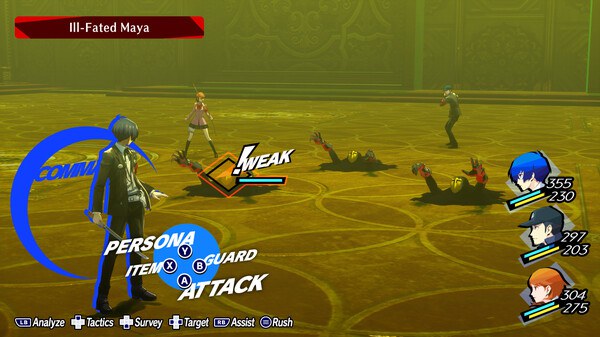
Reload’s combat rewards exploiting enemy weaknesses: a successful weakness hit can create an additional action, and the official game description emphasizes using those openings to turn a fight. Theurgy fits naturally after the party has established control, rather than replacing the work of discovering what the enemy resists. [1]
A practical sequence is to use early turns to test elements and read the encounter, then decide whether Theurgy should secure an advantage or conserve resources for a later turn. If an enemy is already down or the party has a safe chain of actions, a high-impact move may capitalize on the opening. If the team is scattered or a dangerous enemy remains active, first restore control. This makes the gauge part of tactical sequencing instead of an isolated special effect.
Let each character’s role shape the timing
The game’s official materials frame S.E.E.S. as a group of allies with different abilities and describe social bonds as a source of advantages. In practical terms, a special attack is most valuable when it complements what the party is already doing. A damage-focused opportunity, a recovery need, and a moment to stabilize the team are not interchangeable situations. [1]
Before using a charged skill, take a quick look at the party’s condition: who needs support, who can exploit a weakness, and whether the next action will leave the group safer. This small pause prevents a powerful move from feeling disconnected from the rest of the turn. It also helps you learn the encounter’s rhythm because you notice the conditions under which your team performs best.
Use a repeatable decision test
Ask three questions when Theurgy becomes available: will using it remove an immediate threat; does the current opening make its effect more valuable; and will holding it make the next turn meaningfully safer or stronger? If the first answer is yes, acting now may be the clearest choice. If the second is yes, arrange the party’s actions to take advantage of the opening. If the third is yes, patience has a concrete purpose.
This is a decision aid, not an exact damage guide. The official sources establish Theurgy as a powerful battle feature, but a single universal timing rule would flatten the differences between fights and party setups. Use the test to focus attention, then adapt to the enemy and the skills your current team has available.
Make the special move part of the encounter story
Persona 3 Reload’s battles are at their most readable when a move has a reason: the party discovers a weakness, turns that information into momentum, and commits a major resource when it can matter. Theurgy can be the climax of that sequence rather than a detached animation. [1]
On the next Tartarus trip, try holding the first available Theurgy for one turn while you study the battlefield. Notice whether waiting creates a better setup or only prolongs a safe fight. That small comparison teaches more than following a rigid “always save” or “always spend” rule, and it keeps the system connected to the tactical choices around it.
Primary work & further reading
Primary work: Persona 3 Reload. Character and story readings are editorial interpretations. The publisher reference below identifies the work and its premise.