An uneasy visit to NieR:Automata's amusement park
An early visit to the amusement park changes the scale of what the androids encounter. Its spectacle, sound, and noncombat behavior make machine life difficult to reduce to a field of targets, even while danger remains close.
Coverage: Early Route A amusement park sequence only; no boss backstory or later-route developments.
A battlefield dressed for celebration
The amusement park arrives as a sharp change in visual register. After the stark industrial and ruined spaces of the early journey, its decorative forms and festive atmosphere seem to belong to another kind of game. The place is built to attract attention, to suggest movement and pleasure, and to make visitors look around. That appearance does not erase the danger of the setting, but it changes how danger is perceived. The player is no longer looking only at a hostile landscape; the landscape itself seems to have been designed for an audience.
This contrast makes the park more than a picturesque detour. Its bright spectacle sits uneasily beside the androids’ military purpose, which encourages them to classify what they see in terms of threat and response. The environment resists that narrow frame by offering images associated with play and performance. It can still contain enemies, yet the visual language around them asks the player to register something other than tactical usefulness. The park makes combat feel like an interruption of an already strange social space.
Performance gives the machines a public face
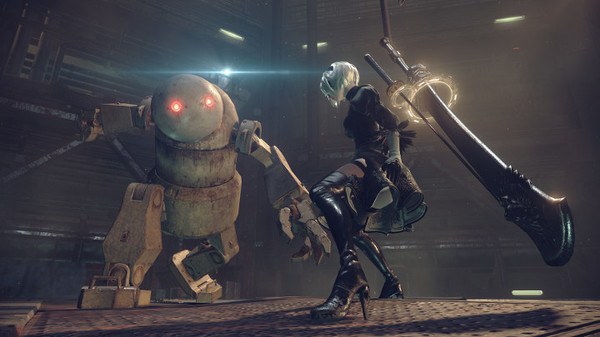
The machines encountered in the park participate in behavior that reads as performance. They do not appear only as isolated bodies advancing on the player. Their activity takes on a staged or ritual quality, as though actions are being repeated for others to witness. That impression is unsettling because performance normally presumes an audience, shared expectations, or some account of why the action should be seen. The park’s setting supplies the suggestion of an audience even when the scene does not explain the behavior in human terms.
The effect is not that the machines suddenly become familiar. Their behavior remains strange, and the gap between recognizable gestures and uncertain motives is the point. A performance can be observed without being understood. By making the machines seem engaged in activities that have a social shape, the game complicates the player’s habit of reading them as obstacles whose meaning ends at combat. The park grants them a public presence. They seem to occupy a place together, even if the rules of that place remain opaque.
Noncombat behavior interrupts classification
The sequence’s quieter behavior matters because it interrupts a combat-first interpretation. When machine lifeforms appear to do something besides attack, the player must decide what kind of attention to give them. A target invites action; a performer, a gathering, or a figure behaving within the space invites observation as well. Those categories can overlap, which is precisely why the scene feels unsettled. The park does not promise safety, so the player cannot simply relax into spectatorship. But continuing to treat every machine as interchangeable also becomes harder.
That friction is created through play as much as through visual design. The player is still responsible for controlling 2B, moving through the environment, and responding to immediate threats. Yet the surroundings encourage looking beyond the next combat encounter. The mismatch between what the player is asked to do and what the scene seems to mean produces a useful hesitation. It is not a demand to spare every machine or an instruction that the androids’ mission is invalid. It is an invitation to notice that the world contains behaviors the mission’s categories may not adequately describe.
Spectacle leaves the question open
The amusement park’s unusual tone works because it does not settle into either whimsy or horror. Its festive presentation can make the machines seem almost playful, while the violence surrounding the androids keeps that impression from becoming comforting. A space associated with leisure becomes a place the player must cross under pressure. The contradiction gives the park a particular mood: spectacle is present, but the player cannot safely assume that spectacle is meant for them or that it explains what is happening.
By the end of the sequence, machine life is harder to dismiss as mere scenery for combat. The park has shown the player activity with a social or theatrical appearance and made it difficult to ignore how little those appearances explain. That is enough to change the encounter without giving the machines a tidy human meaning. The setting’s achievement is not to prove that they are harmless or fully understood. It is to make the act of dismissal feel premature, leaving the player with a more attentive way of seeing the world ahead.
Primary work & further reading
Primary work: NieR:Automata. Character and story readings are editorial interpretations. The publisher reference below identifies the work and its premise.