Serial Experiments Lain makes connection look physically uncomfortable
In Serial Experiments Lain, communication rarely feels weightless. Sound, wires, gaps between people, and the bodies framed around machines give connection a physical unease that complicates the promise of effortless contact.

Coverage: Opening episodes only; discusses recurring audiovisual and spatial choices without revealing later developments.
Contact has a sound and a weight
Serial Experiments Lain gives communication an audible presence. The hum of machinery, electrical noise, and abrupt shifts in the soundscape can make a quiet room feel occupied before another person appears. These sounds do not merely decorate scenes of computer use. They make attention feel like labor: listening becomes something Lain and the viewer must do, with no guarantee that the signal will resolve into a clear message. Connection is presented as an experience that can intrude on the body, even when the people involved are not sharing the same physical place.
That emphasis differs from the comforting image of a device that disappears into everyday life. Here, electronic sound is often hard to ignore. It can thicken silence rather than break it, leaving the viewer aware of a system in operation. The result is not a claim about how networks technically work. It is a dramatic texture: communication may be available, but it arrives with a sensory pressure that makes availability feel less like ease than exposure.
Wires make the invisible visible
Cables and computer equipment give the series a concrete vocabulary for connection. A network can sound immense and abstract, but a cable is an object with a direction and a place in the room. It leads the eye toward a machine, and the machine leads attention toward whoever is using it. The visual path suggests that a connection must pass through material surroundings, however much the information itself seems to escape them. Rather than treating digital communication as pure disembodied thought, the series keeps returning to bodies seated, leaning, watching, or waiting in front of equipment.
The wires also complicate the idea that connection automatically brings people closer. They can bind a person to a screen as readily as they can link one person to another. In Lain’s home, computer use can look less like an open doorway to society than a private ritual shaped by hardware. That image leaves a useful ambiguity. A cable may be a route outward, yet the person at its end remains in a room, apart from anyone whose presence cannot be reduced to a message.
Empty space keeps company at a distance
The series makes social separation visible through the spaces between people. Conversations can feel awkwardly sparse, with pauses and framing that refuse the warmth of an easy exchange. At school, Lain’s quietness is not softened simply because classmates are nearby. Their presence can sharpen her isolation: bodies share a room while attention and understanding remain divided. In the home, too, the distance between family members can feel more significant than the fact that they occupy the same household.
Empty space works alongside the electronic sounds. A pause in conversation may feel charged by what is not being said, while a room’s stillness leaves room for the hum of equipment to take over. The viewer is encouraged to notice two forms of distance at once: the physical gap between people and the less visible gap between what they experience. The series does not need to announce that communication has failed. It lets a scene feel socially incomplete even when someone is speaking or a device is active.
Connection as an uneasy arrangement
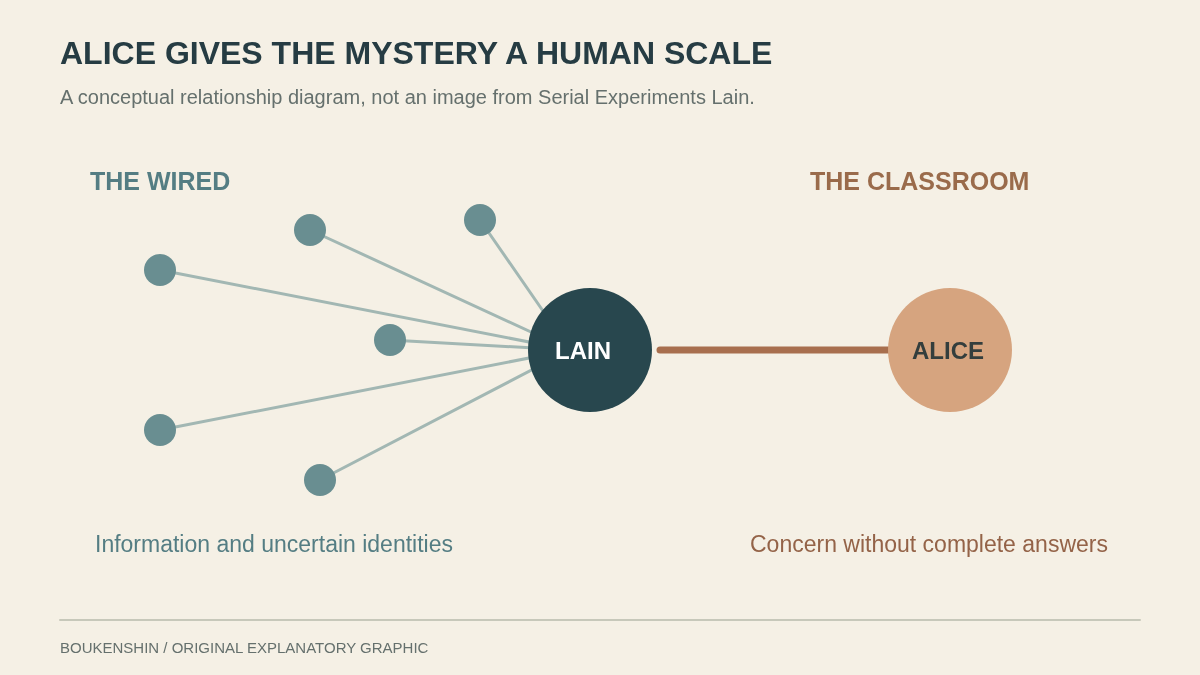
Sound, cables, and spatial separation converge on a view of connection that is neither purely sinister nor reassuring. Lain’s growing contact with the Wired can offer a way beyond the narrow circle of face-to-face life, but the show keeps its costs in the foreground. A person can reach an unseen other while remaining isolated in a room; a message can occupy the senses without settling into understanding. The image of connection therefore carries both invitation and discomfort.
That tension is the point of the series’ physical style. The Wired may be an expansive network, but the viewer encounters it through small rooms, noisy machines, and people who struggle to meet one another’s attention. Those details prevent the idea of connection from floating free of lived experience. In this early stretch, being linked does not guarantee intimacy. It means becoming available to signals and presences that can unsettle the body, the room, and the ordinary distance between people.
Primary work & further reading
Primary work: Serial Experiments Lain. Character and story readings are editorial interpretations. The publisher reference below identifies the work and its premise.