2B has a mission, and emotions are not part of it
The first hours place 2B inside a role that demands precision and emotional control. Her composed partnership with 9S gives the opening its tension: duty keeps the mission moving, while small signs of feeling make that discipline look costly.

Coverage: Route A opening only; covers 2B and 9S’s initial mission and partnership, with no later identities or ending revelations.
A voice trained to stay level
2B enters the opening mission with the bearing of someone who has already decided what matters. The operation is dangerous, the machines are armed, and the flight through hostile territory leaves little room for hesitation. She answers these pressures with clipped focus. Her attention stays on the immediate task, and her performance gives the impression that fear and uncertainty have been pushed out of view. That composure is useful: it makes her seem dependable in a crisis. It is also uneasy, because the game surrounds her with conditions that would make any person feel exposed.
The opening does not need 2B to announce that she is suppressing emotion. Restraint registers through the distance between what the mission asks of her and what her circumstances invite her to feel. She is isolated in a lethal environment, then reunited with another android who brings a more openly responsive presence. The contrast makes her stillness legible as a practiced mode of behavior rather than a lack of inner life. She does not look untouched by danger; she looks committed to not letting danger dictate how she acts.
Discipline as a working method
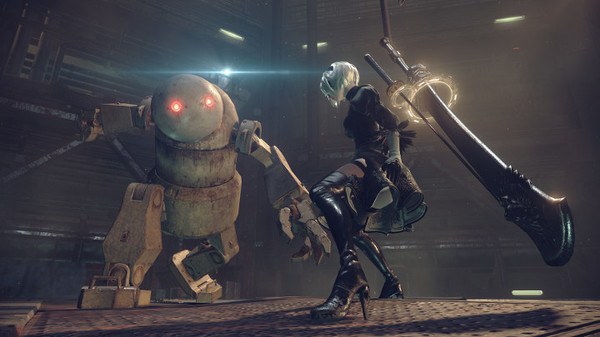
The combat teaches the same discipline in physical terms. 2B must move through fast attacks, evade danger, and keep her attention on enemies that can punish a lapse. The player learns to make quick decisions, but her presentation remains controlled even when the screen fills with motion. This separation matters: action can be frantic while the character’s manner remains measured. 2B’s calm is not an absence of effort. It is the visible result of directing effort toward survival and mission progress.
That working method also makes duty feel like a narrowing force. In the opening, success means completing the operation and preserving the team’s ability to continue. A broader response to the violence around her would take attention away from those demands. The game does not have to tell us that 2B has weighed every feeling and rejected it. Instead, her operational focus suggests a habit of setting aside what cannot help in the next moment. The habit makes her effective, while leaving open the question of what that constant postponement costs.
9S brings another rhythm
9S changes the emotional temperature of the scenes he shares with 2B. He is capable and useful, but his way of engaging with events feels more curious and conversational. Their partnership is therefore not simply a pairing of two fighters. It puts two styles of attention beside each other: 2B concentrates on what must be done, while 9S is more likely to respond to the space around the task. That difference gives the opening room for interpersonal tension without making either character incompetent.
2B’s reserve becomes most revealing through this relationship. If she were alone, her limited expression might seem like a design choice for a stoic action hero. With 9S present, it reads more specifically as a boundary she maintains between herself and the people she works beside. She can cooperate with him and rely on his abilities without adopting his ease. Her control protects the mission, but it also keeps their connection at a measured distance. The opening’s unease grows from that gap: partnership is present, yet warmth does not arrive automatically.
What composure cannot settle
A restrained character can be mistaken for a character without conflict. The opening pushes against that reading by giving 2B reasons to remain alert and a companion whose manner invites a response. Her behavior suggests an active choice—or at least an established habit—of keeping reactions subordinate to duty. That choice is meaningful precisely because the story does not insist that it is effortless. A calm surface, placed over peril and companionship, can feel more fragile than a visible outburst.
The result is a protagonist whose discipline carries both practical force and emotional weight. 2B is not defined only by obedience, since her careful conduct also involves judgment, attention, and responsibility for the person beside her. Yet the same discipline limits what she permits herself to show. The opening leaves that contradiction alive rather than resolving it into a simple virtue. Her restraint helps the mission proceed, but it makes the human—or humanlike—cost of proceeding harder to ignore.
Primary work & further reading
Primary work: NieR:Automata. Character and story readings are editorial interpretations. The publisher reference below identifies the work and its premise.