Hornet's challenge changes the direction of exploration
Hornet’s early Greenpath encounter gives pursuit a purpose beyond reaching the next room. The duel tests whether the player can read an agile opponent, then makes movement itself newly valuable, reshaping how routes invite exploration.
Coverage: Covers the early Greenpath encounter and the movement reward it leads to; no late identity revelations.
A figure who makes the landscape personal
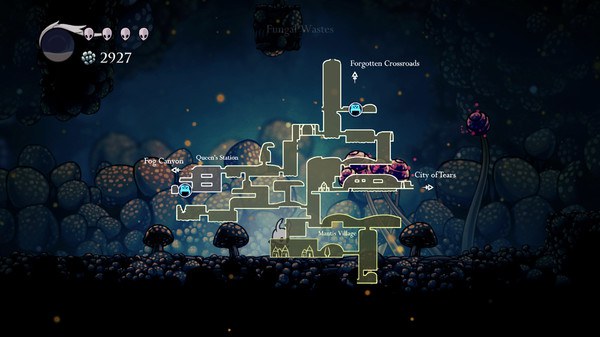
Greenpath changes the texture of travel with its overgrown passages and softer, more organic scenery. In that environment, Hornet’s appearances give the player a moving point of focus. She does not simply stand at a destination waiting to be reached; she is glimpsed, pursued, and encountered as an opponent. The landscape remains open to exploration, but the player’s attention acquires a direction: follow the figure who keeps passing through it.
That pursuit alters the emotional shape of early exploration. Before Hornet enters the player’s immediate path, a branching passage can feel like an invitation to wander. Once she has made herself visible, a route also becomes a chance to close distance. The player is still free to explore, yet the world now has a local question that feels more specific than “what is in the next room?” Greenpath’s paths become part of a chase, even when they do not lead straight to her.
The duel asks for observation, not just persistence
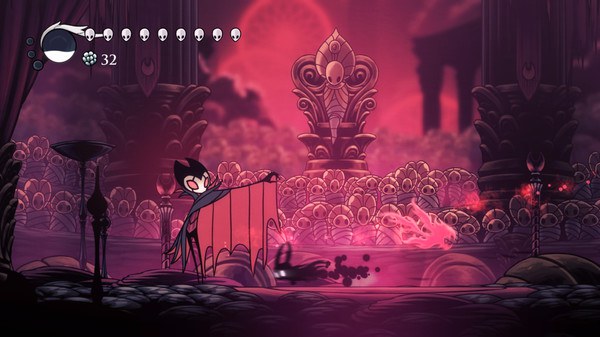
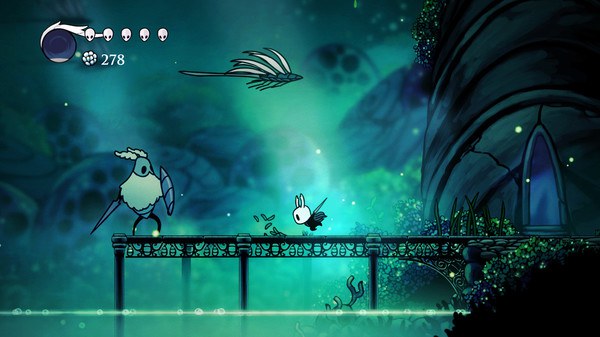
When Hornet confronts the Knight, her quick movement makes the encounter feel different from simply clearing a corridor. Her attacks and changes of position create brief openings that the player must recognize. The important test is not to produce a fixed sequence of inputs but to notice what the opponent is doing, make room for it, and act when the pressure shifts. This gives the duel a conversational rhythm: Hornet commits to an action, and the player answers with movement or a strike.
Because the fight arrives during exploration, it also interrupts the assumption that forward progress means uninterrupted travel. The route has brought the Knight to a person who actively resists being followed. That resistance gives the chase consequence: the player cannot treat Hornet as scenery or a marker on a map. She is a presence with the ability to stop the journey and demand attention. The encounter makes Greenpath’s invitation to move feel earned rather than automatic.
A new movement ability makes old space legible differently
The reward that follows the encounter changes more than the Knight’s animation. A dash expands what movement can mean, letting the player cross gaps or dangerous intervals with a burst of speed. Earlier passages do not disappear, but they acquire new possibilities. Places that once seemed to ask for a careful walk can now invite a sharper crossing; visible distances become questions about whether the Knight can cover them safely.
This is why the ability feels like a change in the direction of exploration. The player’s mental map gains a new verb. Instead of seeing only a door, ledge, or enemy in the way, the player can consider how a dash might connect one side to the other. The world’s interconnected design becomes more apparent as movement makes routes relate to one another. The reward does not reduce exploration to a checklist of newly accessible barriers; it changes the player’s sense of what moving through a room can accomplish.
The chase becomes a lesson in agency
Hornet’s role in this early sequence is powerful because she links challenge with possibility. The duel asks the player to read a threatening opponent, while the movement reward turns that encounter into a practical expansion of the Knight’s agency. The new ability is not an unrelated prize placed after a fight. It answers the player’s immediate experience of being required to position carefully and respond under pressure, then carries that attention back into the wider world.
Afterward, exploration can feel more deliberate. A route is not merely something the player follows; it is space whose distances and hazards can be approached in new ways. Hornet has redirected the player’s attention first by drawing it toward her, then by changing how the Knight travels. Greenpath’s early encounter therefore marks a shift from pursuing a figure through the landscape to seeing the landscape as a set of choices in motion. The chase ends, but its lesson travels with the player.
Primary work & further reading
Primary work: Hollow Knight. Character and story readings are editorial interpretations. The publisher reference below identifies the work and its premise.