Exploring Liyue means reading the landscape vertically
Liyue’s dramatic height changes turn exploration into a question of route choice. Cliffs, stamina, gliding, and distant landmarks ask the player to judge not just where to go, but how the terrain can be crossed.
Coverage: Covers exploration through Liyue’s visible terrain and basic climbing, stamina, and gliding decisions; excludes specific reward claims.
A landmark is a direction, not a route
Liyue’s landscape often makes its destinations visible from a distance. A mountain or settlement can act as a clear point of orientation, giving the player a reason to move across a broad view. Yet seeing a landmark does not settle how to reach it. Ridges, cliffs, and changes in elevation interrupt the straight line that the eye first imagines. Exploration begins with a distinction between knowing where something is and finding a route that the terrain permits.
That distinction gives the region’s scenery a practical role. A distant peak is both an image to admire and a question about approach. The player has to read the intervening ground: which slope looks climbable, where a ridge might provide a path, and whether a longer route could be easier than a direct ascent. The landscape is not merely a backdrop around navigation. Its visible shapes supply clues, while their height and spacing make those clues uncertain until the player acts on them.
Stamina makes elevation a decision
Climbing turns height into a resource question. The player can begin ascending a cliff, but stamina limits how long that effort can continue. This makes the choice of face important: a steep line may appear efficient, yet a ledge or gentler slope could offer a more manageable way up. The terrain asks for judgment before and during the climb. When stamina becomes a concern, the player must decide whether to continue, find a place to rest, or rethink the route.
That pressure makes vertical exploration feel different from following a road across level ground. The player is not simply holding toward a destination; they are judging the cost of each section of the ascent. Stamina gives the cliff a kind of resistance that is legible without any dialogue. A climb can be possible but still poorly planned. By asking the player to notice the slope and measure the remaining effort, Liyue turns topography into an active part of play rather than a decorative obstacle.
Gliding converts height into distance
A successful ascent can change the journey from climbing to gliding. From an elevated point, the player can use height to travel across open space, turning an earlier climb into forward momentum. Gliding does not erase the need to plan: the player still has to consider where they are headed and how the terrain beneath the flight will shape the landing. But it gives elevation a second purpose. A ridge is not only something to overcome; it can become a launch point toward another part of the landscape.
This alternation between climbing and gliding is central to how Liyue’s space reads. Climbing is deliberate and effortful, while gliding makes movement feel broad and exposed. The two modes make the same terrain seem different depending on the player’s position. From below, a cliff is an obstacle; from above, it can open a view and a route. The pleasure comes partly from that change in perspective, as the player’s own movement alters what the landscape affords.
Choose routes by reading what the terrain offers
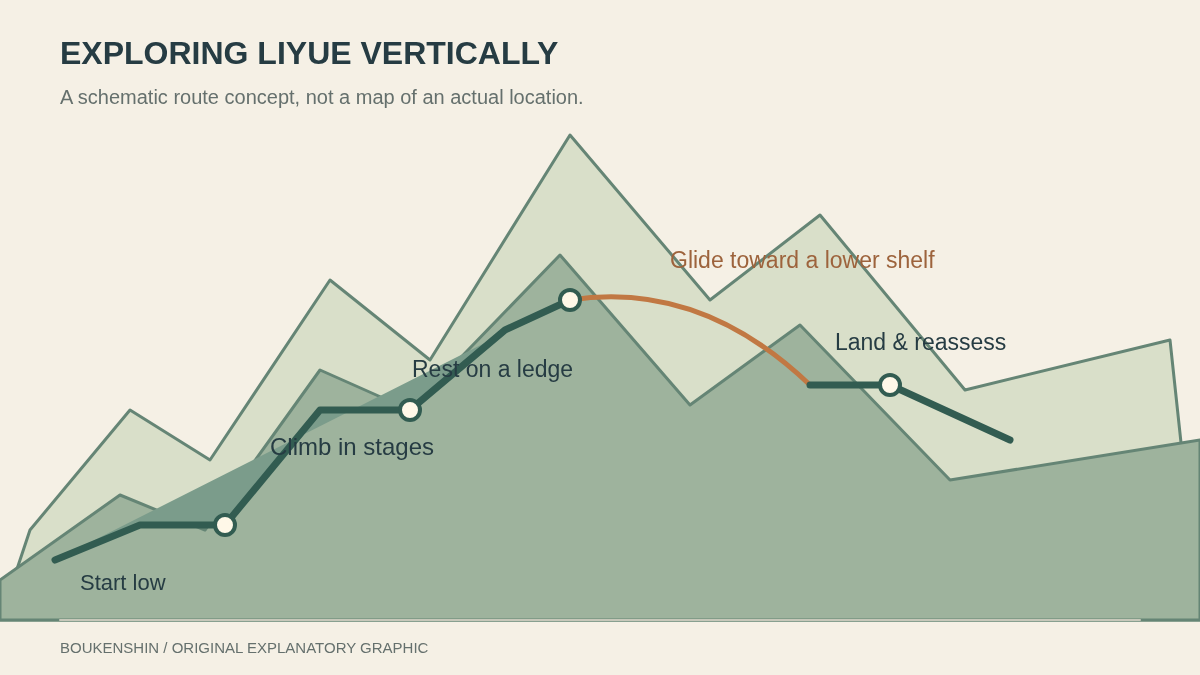
A practical route toward a visible landmark can involve several smaller decisions: approach a slope instead of a sheer face, climb only as far as the available stamina allows, and use a suitable height to glide toward the next section. These are not guaranteed shortcuts, because the landscape and the player’s position vary. They are ways to translate a large destination into readable stages. The player can revise the plan as new ridges and openings come into view.
Liyue’s verticality therefore rewards attention more than a single ideal path. The landmark gives direction, stamina gives the climb a limit, and gliding makes height useful once it has been gained. Together, these elements make exploration a conversation with the terrain: look ahead, test an approach, and let the route change when the ground demands it. Reaching a destination feels earned because the player has interpreted the landscape along the way, turning distance into a series of choices rather than a straight line.
Primary work & further reading
Primary work: Genshin Impact. Character and story readings are editorial interpretations. The publisher reference below identifies the work and its premise.