A quiet town above Hallownest: arriving in Dirtmouth
Before Hallownest opens into its underground maze, Hollow Knight gives the player a quiet town, a narrow well, and a first stretch of road. Their spare arrangement makes the journey downward feel less like a grand expedition than a solitary departure.

Coverage: Covers Dirtmouth, the well, and the opening Forgotten Crossroads only; no later lore, identity, or ending details.
A town that offers little company
Dirtmouth is a settlement in name, but its first impression is of absence. The broad, subdued space and shuttered buildings make the Knight seem small against a place that has already outlasted its liveliness. There is room to walk and look, yet little bustle to suggest that the town is actively sending anyone on an adventure. Its quiet establishes a social condition before the player has learned much about Hallownest: people may remain here, but the world’s energy lies elsewhere.
That sparseness gives the few signs of habitation extra weight. A bench is not just a convenience, and a shop is not just a menu; each suggests a practical foothold in a place where the player otherwise has no companion. The town does not explain itself through a crowd of voices. Instead, its handful of human-scale comforts make the surrounding silence more noticeable. Dirtmouth feels lonely because it contains traces of ordinary life without the activity that would make those traces reassuring.
The well turns curiosity into a threshold
The well is a compact piece of visual storytelling. It interrupts the open ground of Dirtmouth with a vertical route into darkness, giving the player a clear way to leave while withholding a clear view of what lies below. The Knight’s descent is therefore both an action and a decision: the player steps away from the sparse safety of the surface and accepts a world that cannot be read from above.
That transition also changes how movement feels. On the surface, the player can take in a settled space at a glance; beyond the opening, walls, passages, and obscured turns restrict that overview. The shaft makes the change legible before any new enemy or landmark has to explain it. Its simple geometry divides the game’s first impression into two kinds of space: an exposed place where very little happens and a buried place whose shape must be discovered from within.
The Crossroads answer quiet with uncertainty
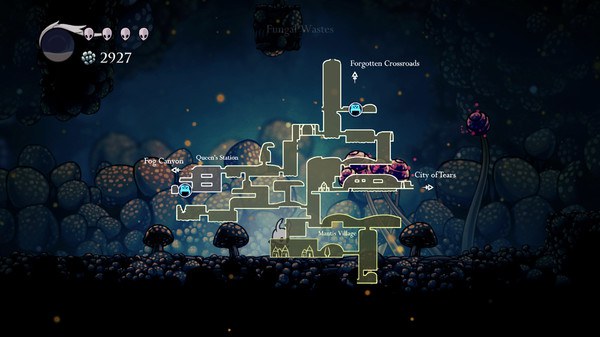
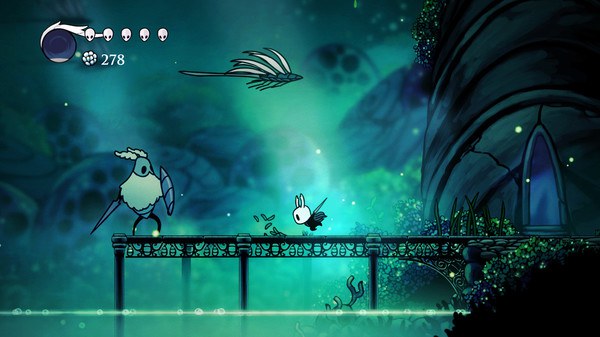
The Forgotten Crossroads do not immediately reward the descent with a clean destination. Their branching passages promise movement in several directions, while the early encounters make travel feel active rather than ceremonial. The Knight has entered somewhere larger than the town, but the player does not yet possess the knowledge to treat that space as a route with a known beginning, middle, and end. A corridor can invite exploration and still leave the next step uncertain.
This uncertainty makes the opening’s loneliness more than a mood imposed by empty scenery. The player must supply attention that a guide or party would otherwise provide: noticing entrances, remembering where a passage bends, and deciding which unexplored direction feels worth the risk. Even small discoveries belong to the player because nobody is present to confirm that the chosen route is correct. The landscape is not simply vacant; it withholds the social reassurance of shared progress.
A descent defined by the space left behind
Dirtmouth’s position at the beginning matters because it gives the underground a point of comparison. Returning to the surface means returning to a place with visible boundaries and modest comforts, but not to a lively homecoming. The town’s stillness persists as a reminder that the Knight’s journey has no obvious community waiting to celebrate each step. The contrast makes the Crossroads feel less like an attraction reached from a bustling hub and more like a region the Knight has entered alone.
The opening thus makes loneliness a question of scale and connection. Dirtmouth is quiet enough to feel abandoned, the well makes leaving a deliberate act, and the Crossroads turn that departure into uncertain navigation. None of these details needs to announce a grand tragedy. Together, they shape a more immediate feeling: the player has crossed into a world that will not explain its routes or accompany its traveler. Hollow Knight begins its descent by making that solitude part of the space itself.
Primary work & further reading
Primary work: Hollow Knight. Character and story readings are editorial interpretations. The publisher reference below identifies the work and its premise.