Zagreus returns to the House of Hades again
Each escape attempt sends Zagreus back to a house that remembers what happened. The repeated return turns defeat into a form of conversation, letting persistence change the mood of home even when it does not change its walls.
Coverage: Covers repeated returns to the House of Hades, persistent dialogue, and Zagreus’s defiance; no successful escape or family revelations.
The return is part of the rhythm
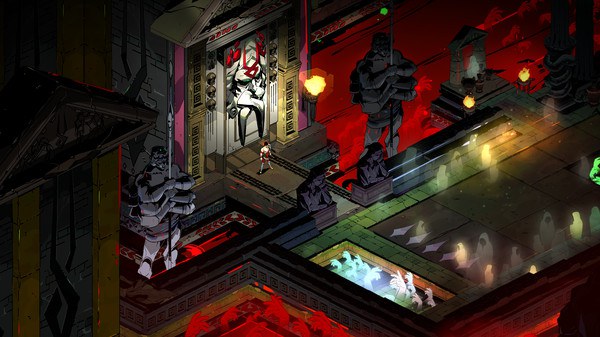
In Hades, a run does not end at the moment Zagreus falls. It ends when he wakes in the House of Hades, swims out of the blood pool, and steps back into a household that has already noticed his absence. That reset could make defeat feel like a simple penalty. Instead, the return is staged as an arrival: familiar rooms, familiar faces, and new remarks make the aftermath playable. Zagreus has failed to get farther from home, but he has returned with an experience the house can respond to.
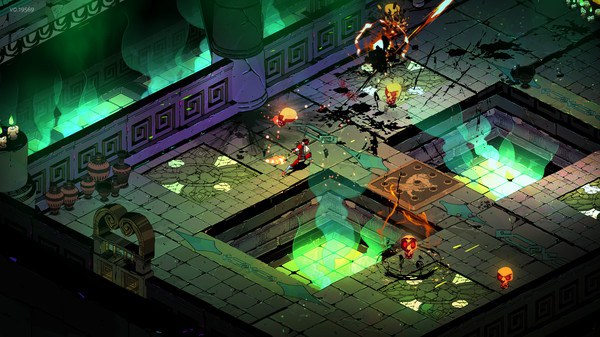
The structure gives each attempt two kinds of movement. In the Underworld, Zagreus tests weapons, boons, and his own timing against enemies. At home, he resumes conversations and takes stock of how others regard his latest effort. One path is measured in chambers crossed; the other in small changes of attention. Because both are part of the same loop, a failed run still carries material forward. The house is not a menu that appears between meaningful events. It is the place where the meaning of those events is registered.
A household that answers back
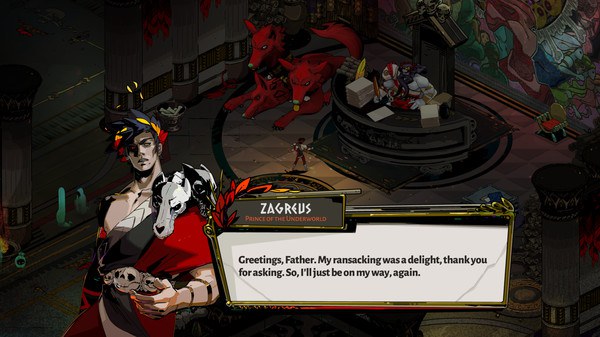
The House of Hades feels occupied, not reset. Its inhabitants have routines and opinions, and their words can shift as Zagreus keeps leaving and returning. That persistence makes the familiar setting feel alert to his choices. A new line after an attempt can acknowledge an encounter or add a different shade to an ongoing exchange. Even when the room looks unchanged, the social scene is not frozen. The house remembers enough to make repetition feel observed.
This responsiveness also prevents the player from treating dialogue as decoration around the action. Zagreus’s relationships are encountered in the same repeated space where he recovers and prepares to leave again. A conversation can give a failed run a human scale: the attempt matters because someone can comment on it, question it, or simply meet him there. Such replies do not erase the frustration of a short run. They make that frustration one event within a continuing life, rather than the final verdict on the attempt.
Defiance without a clean victory
Zagreus’s defiance is clearest in the fact that he keeps setting out. The premise frames him as trying to break free from his father’s domain, but the loop refuses to make resolve synonymous with immediate success. He can be stopped by enemies, hazards, or a demanding guardian, then return to the same place he wanted to leave. His next departure therefore carries a stubbornness earned through repetition. Persistence is not presented as a triumphant speech; it is the practical choice to rise and try again.
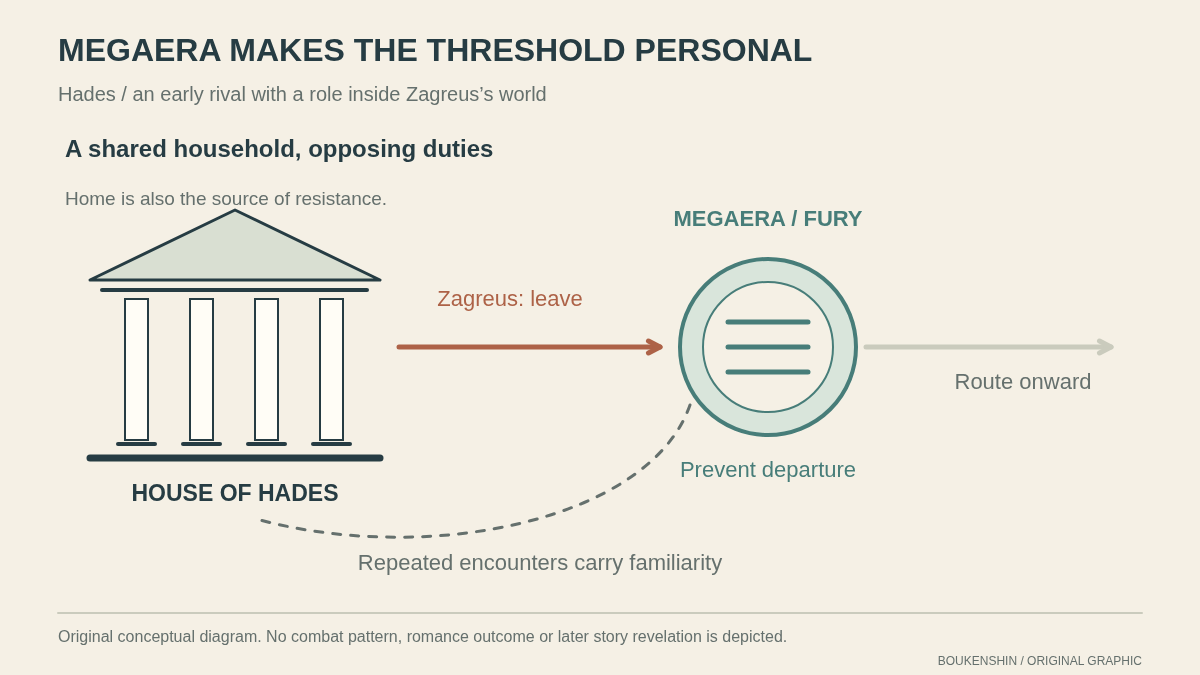
That choice gives his rebellion an unusual texture. Zagreus is not simply rejecting the House of Hades from a safe distance; he remains embedded in its daily life. He speaks to its residents, responds to their presence, and must pass through its halls every time he tries to get away. The tension between leaving and belonging does not need to be resolved for the premise to have force. His defiance remains personal because every attempt begins in a place full of people who know him.
Home becomes a record of effort
The House changes the emotional meaning of failure by giving it somewhere to land. A run that ends underground produces no outward progress toward escape, yet the return brings Zagreus back into contact with characters and systems that persist. The accumulated dialogue helps the player feel time passing through recurrence. Progress is no longer only a straight line toward an exit; it includes the growing familiarity of a place that might otherwise seem like a point of reset.
That is why “coming home” in Hades is more than a reward after combat. The phrase holds both comfort and resistance: the house is a refuge from the failed attempt, but it is also the starting ground for another one. Zagreus’s repeated returns do not soften his refusal to stay. They show what that refusal costs and what it is connected to. The game makes failure part of coming home, and in doing so gives the next departure a history.
Primary work & further reading
Primary work: Hades. Character and story readings are editorial interpretations. The publisher reference below identifies the work and its premise.