Megaera knows the prince trying to get past her
Megaera’s place among the Furies makes an early test of skill feel like an encounter with someone who belongs to this Underworld. Her presence gives the opening stretch a personal edge without reducing her to a barrier to be cleared.
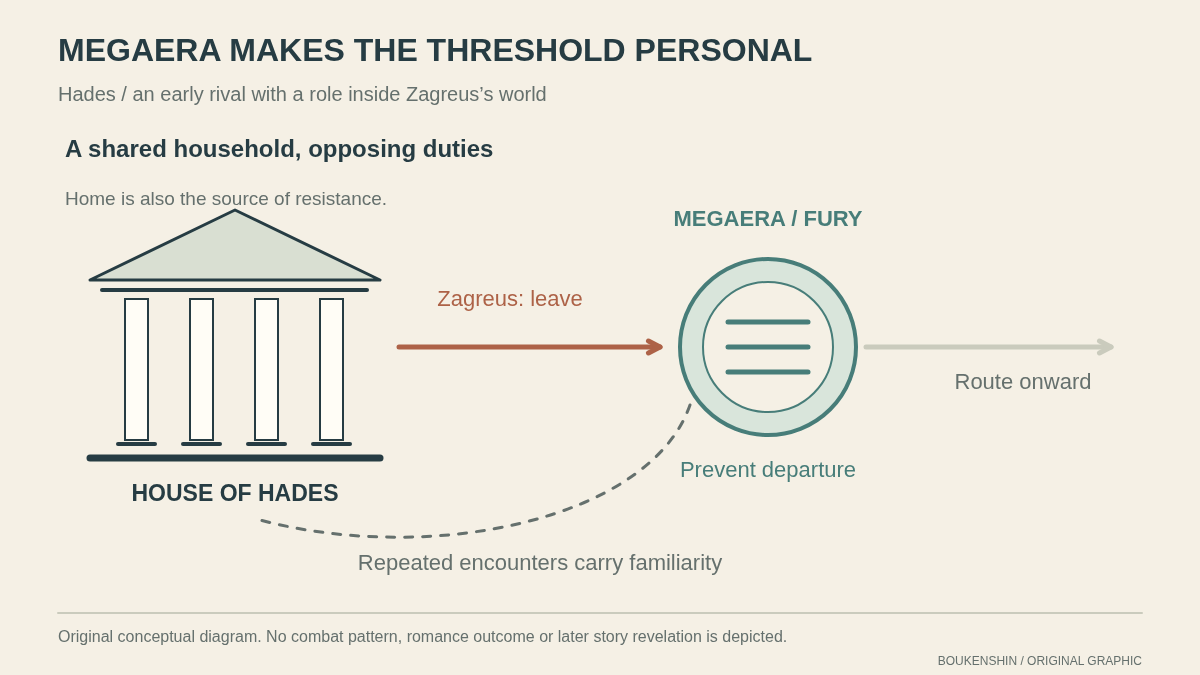
Coverage: Covers Megaera’s early role as a Fury and her encounters with Zagreus; no romance outcomes or later revelations.
The first obstacle has a face
Hades introduces its Underworld through repeated combat, but Megaera makes the first major threshold feel unusually specific. As a Fury, she is not an anonymous monster waiting at the end of a corridor. She is a person with a place in the world Zagreus is trying to leave, and her opposition carries the weight of an assigned duty. The game’s first major confrontation with her therefore asks for more than learning how to survive an arena. It establishes that escape will put Zagreus against people whose lives are already tied to the House of Hades.
Her function as an obstacle remains clear: she stands between Zagreus and the route onward, forcing the player to read attacks and respond under pressure. But the narrative framing complicates that function. Megaera’s presence suggests that the Underworld’s defenses are not merely machinery. They are staffed by characters with identities, histories, and positions in a household. The player can understand the encounter as a test while also recognizing that the opponent is not interchangeable with the hazards that preceded her.
Duty shapes the confrontation
Megaera’s role as one of the Furies gives her authority that differs from Zagreus’s. He is trying to leave; she is doing the work of preventing that departure. The conflict is immediately legible because their goals meet in the arena, but it does not require either character to become a simple symbol. The Fury’s duty helps explain why she appears there, while Zagreus’s persistence explains why the meeting keeps happening. Their opposition grows from the roles each occupies in the same world.
This arrangement lends the fight a conversational tension even before a player knows much about Megaera. Combat itself is a form of exchange: her patterns set terms, Zagreus answers with movement and attacks, and the outcome shapes what can happen next. The scene gives that exchange a personal identity, which makes learning the encounter feel like learning how this particular character presses her advantage. The fight’s significance comes not from hidden lore but from the way character and mechanics occupy the same space.
A rival within a shared world
Megaera’s connection to the House matters because she is not introduced from outside the game’s social fabric. She exists within the Underworld that Zagreus calls home, so the conflict carries an undertone of familiarity even when the two are adversaries. The game can let her be formidable without making her unknowable. Her position gives the player a concrete impression of a world where even opposition has a place in an established order.
That familiarity distinguishes her from a generic boss whose only purpose is to mark difficulty. A nameless guardian would tell the player that the route is dangerous; Megaera makes the danger belong to the story’s relationships and institutions. Her role as Fury is enough to make the encounter feel grounded. The writing need not explain every connection at once for her to register as someone with a life beyond the fight. That restraint leaves room for the player to meet her as a character through repeated play.
What the early fight teaches
The confrontation sets an expectation for Hades: important enemies can be both combat problems and dramatic presences. Megaera teaches the player to pay close attention to an opponent’s actions, but her characterization also asks the player to notice who is standing in the way and why. These lessons reinforce one another. A character-specific fight can make a mechanical challenge memorable, while the challenge gives the character’s role an immediate, embodied form.
Megaera’s early importance comes from this double function. She is a demanding first obstacle, and she is also evidence that the Underworld’s resistance has people behind it. The story does not need to make the encounter a declaration of personal hatred to make it matter. By giving Zagreus an adversary who belongs to his world, Hades makes the route outward feel socially charged from the beginning. The player learns that getting past an obstacle can mean confronting a person, not merely clearing a room.
Primary work & further reading
Primary work: Hades. Character and story readings are editorial interpretations. The publisher reference below identifies the work and its premise.