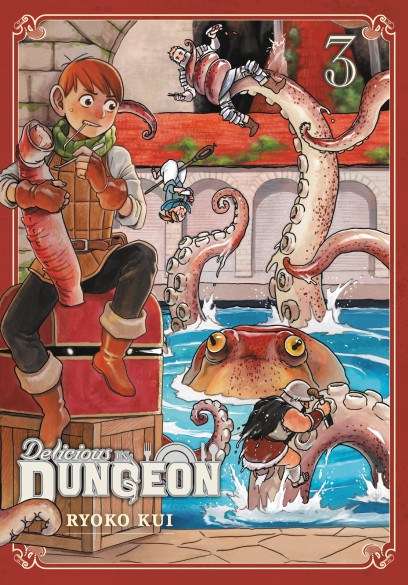
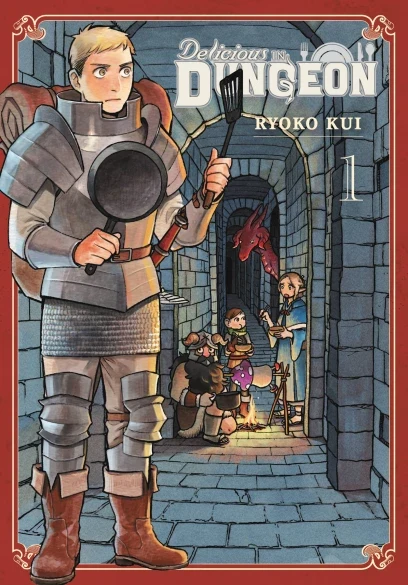
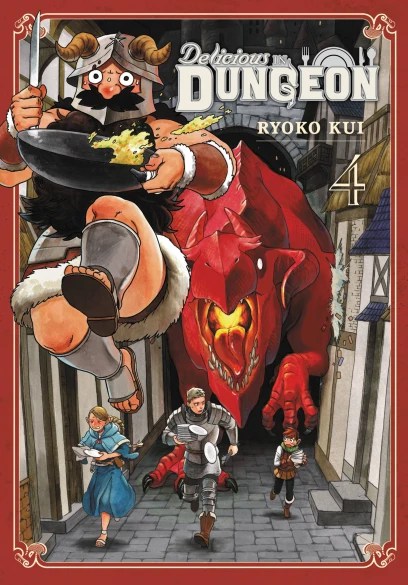
Marcille's objections give Delicious in Dungeon its argument
Marcille’s resistance to eating monsters keeps the story’s survival scheme morally and emotionally legible. Her training and objections force the party to treat adaptation as a decision, not an automatic triumph.
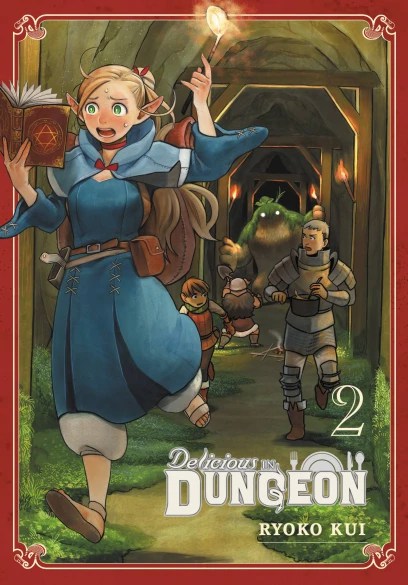
Coverage: Opening chapters only; discusses Marcille’s magical training and reactions to the party’s early monster meals, with no forbidden-magic or late lineage revelations.
Disgust makes the proposal a real choice
When Laios proposes eating dungeon monsters, Marcille’s objection is not an inconvenience the story can simply brush aside. Her revulsion gives the group’s plan a human cost: a solution can be useful and still feel difficult to accept. Because the party is hungry and must keep moving, the question is not whether her reaction is rational enough to deserve attention. It is how the group will respond to a situation in which survival presses against comfort, habit, and fear.
Marcille’s resistance also protects the comic premise from becoming weightless. If every character welcomed monster food, the meals would be little more than a parade of strange ingredients. Her reaction measures the distance between the ordinary expectations she brings and the dungeon’s demands. The humor comes partly from that collision, but it does not require her to become foolish. She sees the food as alarming because, from her perspective, the proposal is alarming. The party has to work through that response rather than pretending it does not exist.
Training shapes how she understands danger
Marcille is a trained magic user, and that background gives her a different way to contribute than Laios’s monster fascination or Senshi’s cooking practice. She is accustomed to approaching the dungeon through magical knowledge and the skills she has developed. Her objections to eating monsters place her alongside the others as someone whose expertise does not solve every problem. The expedition asks for adaptation beyond the work she has trained to do, and that mismatch helps explain why a practical answer can still unsettle her.
The story does not make the contrast a contest in which one kind of knowledge must defeat another. Marcille’s magic remains part of the party’s capabilities, even as the group takes up a plan that depends on Senshi’s know-how and Laios’s curiosity. Her perspective gives the ensemble a useful friction: expertise can be powerful without making its holder comfortable with every new demand. That tension makes the group’s choices more credible. The answer to hunger is not simply to follow whoever sounds most confident, but to make room for different kinds of knowledge and reluctance.
Group decisions carry emotional labor
Early dungeon meals are collective decisions, even when one person supplies the idea or another prepares the food. Marcille’s hesitation means the companions must account for the person who has not yet accepted the plan. This is a small but important form of group work. The party cannot assume that a clever solution becomes shared just because it is efficient. It has to make the solution understandable and tolerable enough for the people who will depend on it.
That dynamic gives Marcille a role beyond reacting for laughs. Her resistance identifies the point at which necessity alone may not persuade someone. The other characters have to balance urgency with persuasion, and the story lets the social process remain visible. A party is not a single will wearing several faces; its members bring distinct thresholds for risk and discomfort. Marcille’s objections force the group to practice coordination rather than merely announce it.
Adaptation keeps its human texture
The monster cuisine premise might suggest that survival is a matter of becoming indifferent to whatever the dungeon provides. Marcille complicates that reading. The group may adapt, but adaptation does not require everyone to feel the same way about it. A person can take part in an unfamiliar solution while still expressing unease, and the others can respond without treating that unease as a failure of character. Her presence keeps the party’s new routine from seeming effortless.
That makes Marcille central to the story’s argument about practical survival. The meals matter because they let the party continue, but the process of accepting them matters too. Her discomfort shows that a solution affects people, not just the expedition’s supply situation. The group must make choices under pressure while remaining attentive to its members’ limits. Marcille’s objections give that attention a voice, ensuring that the adventure’s ingenuity retains an emotional texture instead of becoming a mechanical answer to hunger.
Primary work & further reading
Primary work: Delicious in Dungeon. Character and story readings are editorial interpretations. The publisher reference below identifies the work and its premise.