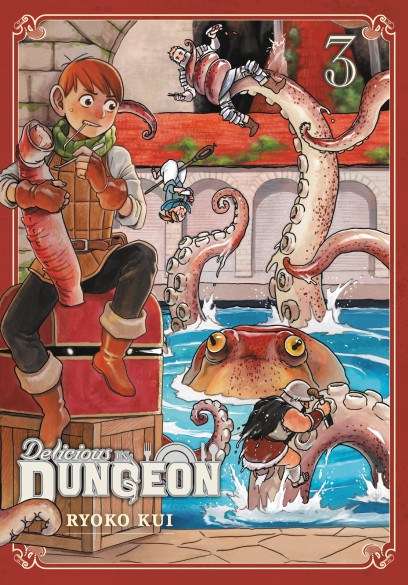
Senshi has a meal to prepare
Senshi’s cooking is built from observation, preparation, and a steady sense of what a traveling party needs. His meals make care tangible in a place where survival depends on treating ordinary work as essential.

Coverage: Opening volume and the party’s early encounters with Senshi; no later backstory or series developments.
A cook who starts with the situation
Senshi enters the party’s problem through the practical question of food. The adventurers are short on supplies, and he knows how to make the dungeon’s creatures part of their provisions. His value is not simply that he is willing to eat what others find repellent. He brings a way of working: identify what is available, prepare it with care, and make a meal that can support people who have to keep traveling. The difference between appetite and craft is visible in his calm. He does not treat every monster as an amusing dare.
That composure changes the party’s tempo. Laios is eager to explore the possibilities of monster cuisine, while Marcille’s resistance makes the emotional difficulty plain. Senshi approaches the same circumstance as a task with steps and demands. His presence makes it possible for the others to move from argument toward action, because he can translate a strange idea into something the group might actually eat. Feeding people becomes a form of leadership conducted through competence rather than orders.
Preparation is part of the care
The manga gives weight to the work that happens between finding a creature and eating it. A meal depends on more than naming an ingredient: the party must handle the situation sensibly, prepare what it has, and make use of the time and tools available in the dungeon. Senshi’s attention to these stages suggests that cooking is a discipline of judgment. He is not improvising blindly just because the setting is fantastical. The care lies partly in knowing that food asks for more than enthusiasm.
This makes his role distinct from a conventional warrior’s. Strength can win the group a moment of safety, but a meal helps restore the group for the next stretch of danger. Senshi contributes through decisions that may appear modest—what to do with what they have, how to make it manageable, when a plan is ready to serve. The story’s attention to preparation gives those decisions narrative weight. It recognizes that a party’s ability to continue depends on repeated acts of maintenance, not only on dramatic victories.
The meal makes a party out of individuals
Senshi’s work also creates a setting in which the companions must confront their differences without abandoning one another. Marcille’s disgust is not solved by declaring her wrong, and Laios’s enthusiasm does not guarantee that everyone will follow him. A meal is a concrete point of negotiation: the ingredients are real within the scene, the hunger is real, and the group must decide whether it can share what Senshi has made. He cannot compel trust, but his craft offers the others a reason to try.
That is why his cooking reads as practical care rather than sentimentality. Senshi does not need to give a speech about friendship for the meal to matter. He addresses a need the party shares, and the act of serving makes that need visible. Eating together does not erase fear or distaste, but it creates a small interval in which the group can function as a group. His care has a material form: time spent preparing, attention to what is usable, and food placed before tired travelers.
Craft suited to a dangerous place
The dungeon makes Senshi’s competence more than a charming hobby. His method meets the conditions of the journey: limited provisions, unfamiliar creatures, and the need to continue after each encounter. The fantasy premise could invite spectacle alone, but Senshi’s steady attention to cooking insists on the value of work that keeps a body going. He treats sustenance as something worth learning and doing well, even when the source of the meal is unsettling.
Through him, the story gives survival a domestic scale. There may be danger in the corridors, but the party also needs someone who can turn a pause into recovery and available resources into dinner. Senshi’s craft does not make the expedition safe; it makes the expedition more livable. That is the quiet force of his role. By feeding people through disciplined preparation, he turns care from an abstract feeling into one of the party’s most necessary skills.
Primary work & further reading
Primary work: Delicious in Dungeon. Character and story readings are editorial interpretations. The publisher reference below identifies the work and its premise.