Strawberries let Celeste separate progress from perfection
Strawberries turn the route through Celeste into a series of optional questions. Their detours invite ambition, but the main climb remains meaningful when a player chooses to pass one by.

Coverage: Discusses strawberries as optional collectibles and their early-game relationship to route choice; no late-game rewards or ending details.
The main route is already an achievement
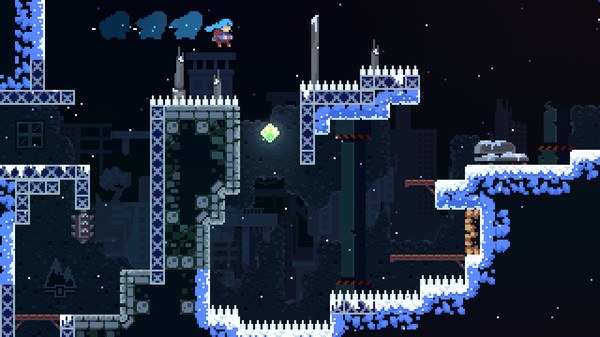
Celeste’s strawberries sit away from the most direct route through many rooms. Their placement changes how a player reads a space: the exit points toward continued progress, while a berry may draw the eye toward an awkward ledge, a narrow passage, or a risky detour. That separation gives the collectible its meaning. The game does not make every berry a toll the player must pay to keep climbing. It offers an extra challenge beside the forward route.
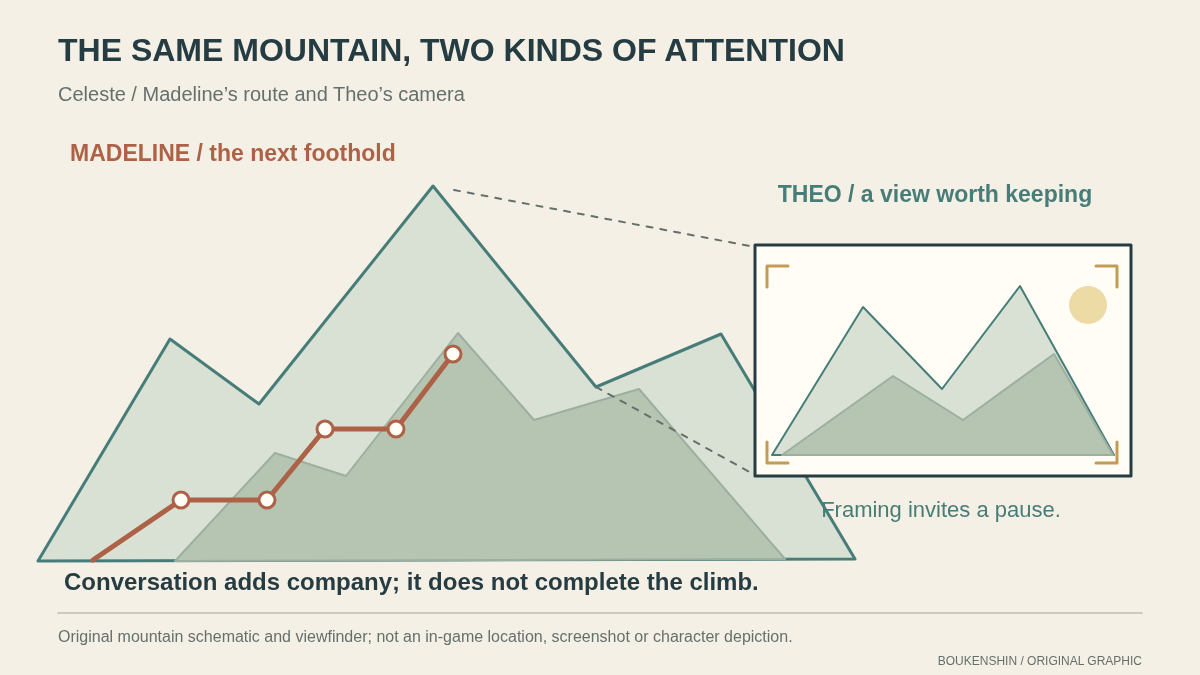
This structure is useful for anyone deciding how much to pursue. Reaching the next room advances the climb; taking a detour tests whether the player wants to spend more time exploring the current one. Those goals can coexist, but they do not have to. A player who skips a berry has not misunderstood the level. The game’s layout makes clear that progress and collection are related forms of engagement, not identical measures of success.
A berry asks a question about risk
The optional route often requires more than noticing the collectible. The player must judge how to reach it and whether the return path is manageable. A detour can lead toward a berry and then demand a careful movement sequence to get back to the main route. The challenge is not simply to touch a bright object; it is to understand the little pocket of space around it and decide whether the extra movement is worth attempting.
That choice changes the feel of a familiar room. The main path may be a lesson in reaching the exit, while the berry route asks for an additional interpretation of the same geometry. Can Madeline gain enough height? Is there a safe surface to land on? Does the return require spending a dash that the player needs elsewhere? These questions make the collectible a compact exercise in planning. The berry is optional, but the route toward it is designed to be considered.
Treat attempts as information, not a verdict
A player can approach a berry by first identifying the intended landing surfaces, then trying one movement at a time. If the route fails, the result may reveal that the jump needs a different starting point or that the dash should be saved for the return. Because rooms reset quickly, an attempt can be informative without becoming a long detour away from the climb. Still, not every berry will feel equally accessible. Some optional routes ask for patience and sharper control than the main path.
This is where the game’s separation of goals becomes practical. If repeated tries are making the room less enjoyable, leaving the berry behind is a sound decision. If the route has become an interesting puzzle, the player can stay and work on it. There is no need to turn one collectible into a test of personal worth. The choice is about the kind of challenge the player wants at that moment, not about proving that every obstacle must be conquered.
Completion can include a deliberate detour
The strawberries make Celeste’s notion of progress more spacious. Moving forward matters, but so does the freedom to pause for a side challenge when curiosity outweighs the cost. Since the collectibles are presented as optional, the player can set a personal boundary: take the berries that make a room more engaging, leave the ones that turn it into a slog, and continue the ascent. That boundary is not a failure of commitment. It is a way of choosing what the game’s movement asks of you.
This flexibility gives the collectibles a role beyond filling a tally. They let players practice the same movement vocabulary under a different kind of pressure, with no need to mistake complete collection for the only valid finish. The main route preserves momentum; the detour rewards exploration and willingness to try. Celeste’s design makes room for both. A berry can be worth reaching, but the decision to keep climbing can be just as deliberate—and just as much a sign of progress.
Primary work & further reading
Primary work: Celeste. Character and story readings are editorial interpretations. The publisher reference below identifies the work and its premise.