Theo has his own reasons to climb Celeste Mountain
Theo arrives with curiosity that contrasts with Madeline’s concentrated struggle. His camera, easy humor, and willingness to talk make companionship part of the mountain’s texture without turning him into a solution to her climb.
Coverage: Covers Theo’s early encounter and conversations with Madeline; no later rescue or ending events.
A different reason to be on the mountain
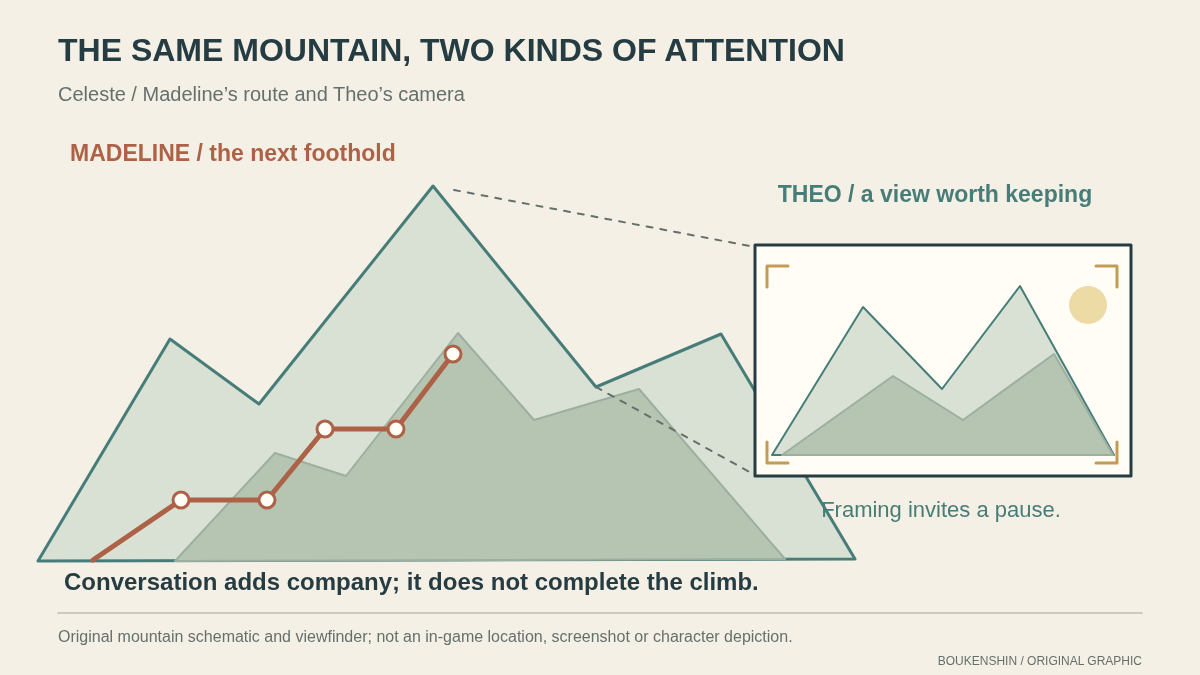
Madeline approaches Celeste Mountain with the weight of a personal undertaking. Theo’s early presence introduces a second attitude toward the same place. He is curious, sociable, and interested in taking pictures. The camera makes that curiosity tangible: he looks for moments and views worth capturing, while Madeline is busy negotiating the next difficult stretch. Their different priorities give the encounter a gentle friction without making either character wrong.
That difference prevents the mountain from having only one emotional register. For Madeline, it is a demanding route tied to an inward struggle. For Theo, at least in the early conversations, it is also a place to explore and share. His presence lets the story show that the environment can invite attention as well as endurance. The contrast is not a contest over who understands the mountain better. It is a reminder that two people can occupy the same landscape while noticing different things.
The camera changes what counts as looking
Theo’s camera suggests a habit of framing the world. A photograph turns a stretch of mountain into something to stop for, select, and remember. That sits beside Madeline’s more immediate way of seeing: the route ahead is made of hazards and footholds to solve. His interest in images can make the scenery feel less like a barrier and more like a subject with its own appeal, even when the climb remains difficult.
The camera also gives Theo a recognizable attitude without requiring him to dominate the scene. He has a way of approaching the mountain that is distinct from Madeline’s, but the object does not make him a guide who knows the route or a device that explains the story. Instead, it marks his attention as outward and playful. The early exchanges draw energy from that difference: Madeline’s seriousness meets someone who can respond to the setting with openness and a little humor.
Conversation makes room for company
Theo’s ease in conversation gives Madeline someone to speak with on the climb. Their exchanges bring ordinary social texture into a story centered on a strenuous personal goal. He can be friendly without claiming to understand everything she is experiencing, and she can remain guarded or focused without making the interaction meaningless. The scene’s warmth comes from the fact that they meet as people with different temperaments, not as a problem and its ready-made answer.
That matters because companionship here is not a shortcut through the platforming or the conflict. Theo does not make Madeline’s next move for her. The conversations instead widen the sense of what the climb contains: not only solitary effort, but brief encounters in which another person’s presence changes the mood. The game can keep Madeline’s journey hers while letting the player feel that she is not sealed off from everyone around her.
A companion is not a cure
Theo’s role in the early chapters is strongest when read on this scale. His curiosity, camera, and conversational style offer a counterpoint to Madeline’s intensity. That counterpoint can make the climb feel less lonely, but it does not resolve the conflict that brought her to the mountain. Treating him as an instant source of answers would flatten both characters: Madeline would become a problem for someone else to fix, and Theo’s own lightness would turn into a function rather than a personality.
Instead, their early connection offers a modest form of support: attention shared for a moment, a conversation that breaks the rhythm of solitary movement, and the recognition that another person is making a different kind of journey nearby. The camera embodies that second attitude particularly well. It pauses to notice what Madeline has little time to admire. On a mountain defined by hard movement, Theo’s presence makes looking and talking feel like meaningful parts of being there.
Primary work & further reading
Primary work: Celeste. Character and story readings are editorial interpretations. The publisher reference below identifies the work and its premise.