Madeline's mountain is also a conversation with herself
The climb gives Celeste a physical shape for an inward struggle without reducing Madeline to a diagnosis. In the early mirror-side conflict, the mountain becomes a place where conflicting impulses gain movement, voice, and consequence.
Coverage: Covers the mountain premise and the early mirror-side conflict; no later chapters or ending events.
A goal turns inward pressure into motion
Madeline’s decision to climb Celeste Mountain supplies the story with a clear outward aim: keep moving upward through difficult terrain. Yet the premise makes that aim feel more complicated than a simple test of stamina. The mountain is tied to what she carries within herself, and the ascent places that burden into the same space as the physical challenge. Each stretch of climbing asks her to act while confronting discomfort rather than waiting for it to disappear.
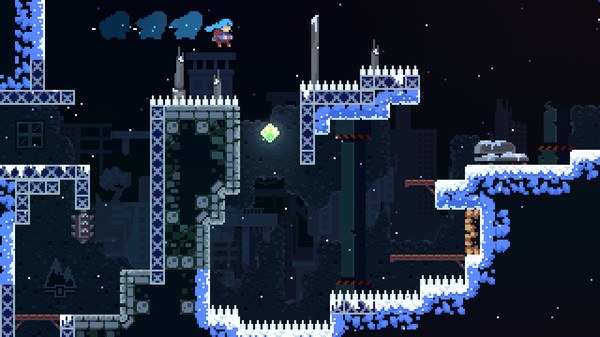
That pairing gives the platforming narrative force. Madeline’s body must jump, dash, and cling through rooms that demand concentration. Her struggle is not merely explained in dialogue and then set aside while the game becomes an obstacle course. Movement makes persistence visible. The player experiences the effort of trying again, while the story gives that effort a personal context. The mountain reads as a setting where private conflict can no longer remain abstract.
The mirror-side presence refuses a simple label
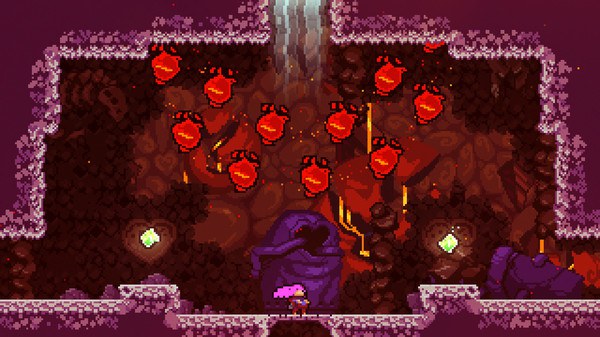
The early mirror-side conflict gives Madeline’s inner division a dramatic form: a version of her appears who can interrupt the climb and act against her. It would be easy to read that figure as a villain to defeat, but the conflict gains more tension when treated as a confrontation between parts of a person that do not agree about what the climb requires. Madeline wants to continue; the other presence resists and challenges that determination. Their disagreement turns an internal pressure into an encounter with consequences.
The story’s choice to give this conflict a body matters. Madeline cannot settle it by naming a feeling once and moving on. The other figure occupies space, changes the immediate danger, and makes the mountain’s route feel less secure. At the same time, the figure remains bound to Madeline’s own story rather than becoming a separate external antagonist. The scene asks the player to hold both facts together: there is real opposition, and that opposition belongs to the person doing the climbing.
The climb complicates the idea of bravery
Because Madeline has chosen a hard ascent, it may initially seem that courage means pressing forward no matter what. The mirror-side conflict makes that idea less stable. A force that blocks her can also be understood as expressing a fear of exposure, failure, or the costs of continuing. The game does not need to make that resistance wise in every moment for it to be meaningful. It shows that determination and self-protection can pull in opposite directions inside the same person.
This makes Madeline more interesting than a protagonist whose only obstacle is a lack of confidence. She has to move through a world that demands persistence while also reckoning with the part of herself that sees danger in persistence. The story’s emphasis falls on how she responds to that disagreement, not on a claim that resolve can simply silence it. Her climb becomes a negotiation over what it means to keep going when the impulse to stop has a voice and a presence.
A mountain is a setting, not a cure
Celeste uses an arduous journey to make personal struggle visible, but the metaphor need not be treated as a universal account of mental health. Madeline is a particular character in a particular story. The platforming gives her conflict shape and pace; it does not make every player’s experience equivalent to hers. The mountain can suggest that difficult feelings accompany action, without turning the game into a formula in which effort alone fixes what hurts.
That care keeps the premise grounded. Madeline’s story is compelling because the physical climb and the inward conflict press on one another. A hard jump is still a hard jump, and the mirror-side presence is still a distinct threat within the early chapters. But neither strand cancels the other. The mountain is at once a place she has to cross and a frame for the argument she is having with herself. The result is not a tidy lesson about overcoming every doubt; it is a portrait of a climber learning to act while divided.
Primary work & further reading
Primary work: Celeste. Character and story readings are editorial interpretations. The publisher reference below identifies the work and its premise.