The first dash and the next attempt in Celeste
Celeste introduces its central movement tool as both a burst of possibility and a limit to understand. Its early rooms make failure quick, visible, and useful, turning each attempt into a small act of reading.
Coverage: Covers movement and obstacle design in the opening chapters only; no late-game events or ending discussion.
A small move changes the room
Celeste begins with a compact set of actions: Madeline can jump, dash through the air, and cling to climbable surfaces. The dash is the most startling of these because it converts a brief input into a clear, directional burst. A gap that looked too wide becomes crossable; a ledge that seemed out of reach becomes a question about timing and angle. The move does not erase the platforming problem. It gives the player a new way to describe it.
That distinction matters. The game does not introduce a sprawling command list and ask players to memorize it before they can act. Instead, a room can teach through its shape: a safe ledge, an empty gap, a wall, then a landing place. The dash’s limited availability before Madeline touches ground or another refreshing surface keeps it from becoming a universal answer. Players learn to ask where the move begins, where it ends, and what must happen before it is available again.
Obstacles teach by showing their edges
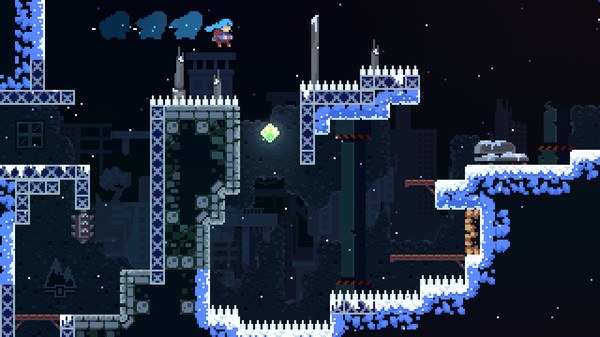
The early chapters make hazards legible. Spikes occupy visible surfaces; gaps have defined boundaries; moving elements announce their motion. A failed crossing often reveals a specific misreading: the jump began too late, the dash went in the wrong direction, or Madeline reached a wall without enough room to climb. That clarity keeps the obstacle from feeling like a surprise rule imposed after the attempt. The player can look again and revise a concrete decision.
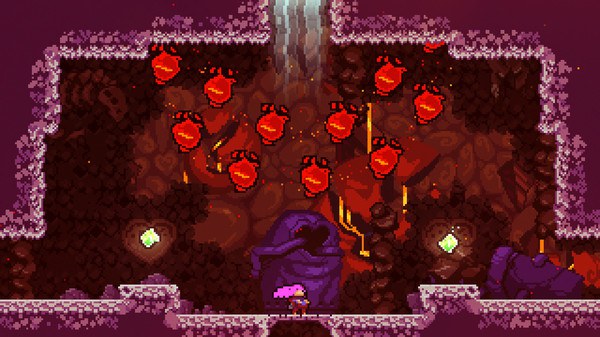
The rooms also vary the meaning of familiar geometry. A wall can be a destination, a temporary resting point, or a resource that has to be reached before a climb runs out. The dash changes how Madeline approaches that wall, but the wall itself helps explain what the dash can and cannot do. This is why the movement vocabulary feels expressive despite its simplicity: the same few verbs combine differently when space, height, and danger change.
A retry is part of the sentence
When Madeline falls or hits a hazard, Celeste returns her to the room quickly. That short interval changes the emotional scale of failure. A mistake can sting, especially when a sequence has several linked moves, but the next attempt arrives before the error has time to become a long interruption. The player can preserve the useful part of the failure—the angle that was wrong or the ledge that was missed—and try again while the room is still clear in memory.
This rapid return works because rooms are organized as readable problems rather than long endurance tests. The checkpointing and compact spaces let players focus on one piece of movement at a time. A difficult crossing may still require repeated attempts, and the game does not guarantee that every player will solve it immediately. But repetition becomes a method: act, see the result, adjust. The design makes learning feel like something the player does, not a lecture delivered by a tutorial.
The promise is effort with direction
A practical way to approach an unfamiliar room is to identify the next safe surface before committing to a dash. That does not mean planning every input in advance. It means giving the movement a purpose: reach the wall, clear the spike-lined corner, or land on the platform that restores a route forward. If an attempt fails, change one decision at a time. Moving the launch point and changing direction simultaneously can make it harder to tell which adjustment helped.
Celeste’s first dash therefore promises neither effortless ascent nor a single correct rhythm. It promises that the game will make its challenges understandable enough for practice to matter. Madeline’s movement remains constrained by space and timing, but each room offers evidence about those constraints. The player climbs by turning that evidence into a better attempt. At the scale of the opening chapters, that is the game’s quiet contract: difficulty can be sharp, yet progress can still be learned.
Primary work & further reading
Primary work: Celeste. Character and story readings are editorial interpretations. The publisher reference below identifies the work and its premise.