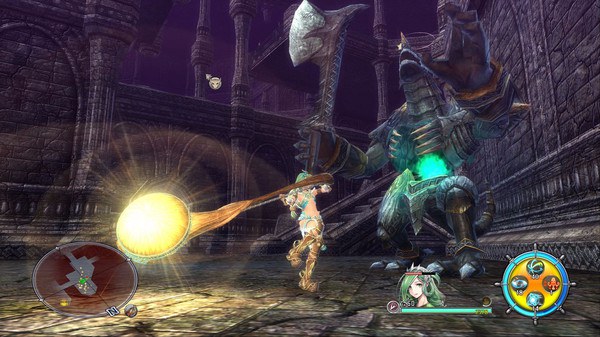
Laxia and Sahad bring different lives to Seiren
Laxia and Sahad respond to the shipwreck from different positions, and their early cooperation gives Ys VIII a believable social texture. Their practical differences show why survival requires more than one kind of strength.

Coverage: Covers Laxia and Sahad’s early characterization and cooperation after the shipwreck; excludes later personal revelations.
Two survivors, two starting points
The shipwreck places Laxia and Sahad in the same crisis without making them feel interchangeable. Laxia arrives with the bearing of someone accustomed to a more structured world, while Sahad’s sturdy, practical manner suggests a life shaped by direct labor and experience. The contrast is legible before either becomes a simple representative of a social class. They are individuals whose first responses to danger carry different habits.
That difference makes the castaway party feel uneven in a productive way. A group assembled by disaster would not share one temperament or one standard of competence. Laxia’s reserve can make her seem guarded beside Sahad’s plain-spoken presence, while his physical confidence does not automatically give him the same relationship to planning or refinement. The game’s early characterization gains texture from allowing these distinctions to coexist.
Practical cooperation does not require sameness
Seiren demands tasks that are too immediate for the survivors to wait until they agree on everything. People need to be found, the settlement needs to function, and expeditions require a party able to face danger. Laxia and Sahad can contribute within that shared work despite their contrasting backgrounds. Their cooperation begins with what must be done, not with an instant conversion into close friends or a declaration that their differences no longer matter.
This makes the group’s bonds more convincing. Cooperation in an emergency often comes before full understanding: people test one another through action, and competence can earn trust where shared assumptions cannot. Laxia’s composure and Sahad’s directness offer different resources to the party. The game lets them belong to a common effort without smoothing their edges into a single group personality.
Their contrast gives survival a social dimension
The island’s hazards could make the early story a string of combat and navigation problems. Laxia and Sahad help widen that frame because their differences raise a quieter question: what does it take for people from separate lives to share responsibility? The answer is not that one must imitate the other. Instead, Seiren gives them a practical reason to make room for abilities and perspectives that did not originate in the same environment.
That social dimension matters for the village, which depends on more than the strength of the person who leads each expedition. A settlement must accommodate people with different expectations and ways of acting. Laxia and Sahad are useful precisely because they do not make the community feel preassembled. Their presence suggests that survival means learning how to work across difference, not discovering that everyone was secretly alike all along.
Unevenness keeps the party human
The early party’s uneven character also helps the adventure avoid a tidy heroic hierarchy. Adol may be the central explorer, but the people around him bring distinct histories and temperaments into the work of surviving. Laxia and Sahad each have their own presence, and their cooperation demonstrates that a party can share an immediate purpose while remaining a collection of separate people.
Their contrast is therefore more than a character-design shorthand. It gives the shipwreck consequences beyond lost luggage or unfamiliar geography: it throws people into dependence before they have chosen one another. As they contribute to the same effort, the group begins to form through practical trust. Ys VIII’s early castaways feel believable because their common crisis makes cooperation necessary without making difference disappear.
Primary work & further reading
Primary work: Ys VIII: Lacrimosa of Dana. Character and story readings are editorial interpretations. The publisher reference below identifies the work and its premise.