Adol's silence leaves room for Ys VIII's island
Adol’s restrained presence gives Ys VIII space to make Seiren’s landscapes and its castaways carry the conversation. His perspective guides discovery while leaving the player room to decide what kind of adventurer he is.

Coverage: Covers Adol’s role and environmental discovery in the early island chapters; excludes later story revelations.
A protagonist who guides without defining
Adol is the center of Ys VIII’s movement, but he is not written as a constant commentator on what the player sees. His role is clear: he explores Seiren, helps the shipwrecked passengers, and leads the party through dangers that would stop a less capable traveler. Yet the game leaves much of his interior presence understated. That restraint makes him a protagonist shaped as much by action and attention as by spoken self-description.
This does not mean Adol is literally mute or without characterization. Rather, the game gives him room to function as a stable point of view. He can take the lead without forcing every discovery through a strongly prescribed reaction. Players supply some of the curiosity that a more talkative hero might verbalize, and the island becomes something they encounter alongside him rather than a stage he explains for them.
The island becomes the loudest voice
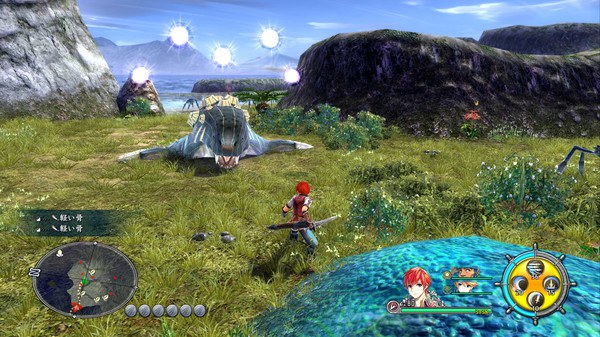
Seiren’s environments do much of the work that dialogue might perform in another adventure. The castaways arrive with the familiar practical concern of survival, but the island quickly exceeds that first impression. Its terrain invites questions through what it reveals and conceals: routes open beyond the shore, natural obstacles complicate travel, and ruins sit within a landscape that seems older and less predictable than the immediate crisis.
Adol’s relative quiet lets those details hold attention. The player must look at the route ahead, notice the difference between a safe approach and a dangerous one, and decide what the island’s arrangement might mean for the next expedition. Discovery is not merely a line of exposition delivered by the hero. It becomes an activity the player performs, which suits a character whose identity is built through exploration.
The castaways supply contrasting voices
The people Adol encounters give the story much of its spoken texture. Their different temperaments and backgrounds make the village more than a backdrop, and their reactions to the shipwreck keep survival from feeling like a purely mechanical objective. Adol’s steadiness is especially useful in this company. He can serve as a dependable center while other characters express uncertainty, ambition, humor, or impatience more openly.
That arrangement also prevents restraint from becoming emptiness. Adol’s character emerges in how he responds to others and in the labor he accepts: he searches, protects, and returns to the settlement with people who need help. These choices are specific even when the game does not spell out an elaborate inner monologue. The supporting cast gives him something to answer, while his relative openness lets the player read the shape of that answer.
Player-shaped presence has a clear purpose
A largely player-shaped adventurer can feel detached if the world around him has nothing worth noticing. Ys VIII avoids that problem by giving Seiren strong physical presence and surrounding Adol with castaways whose needs make his choices consequential. He remains a recognizable hero through competence and initiative, but the game does not close off the space between those actions with a single, emphatic personality.
The result is a useful balance: Adol is defined enough to lead and open enough to share. His silence leaves room for the player’s attention to become part of the adventure, while the island and its people make that attention matter. By the time the village begins to feel like a community, the hero’s character has registered through the work of helping it form.
Primary work & further reading
Primary work: Ys VIII: Lacrimosa of Dana. Character and story readings are editorial interpretations. The publisher reference below identifies the work and its premise.