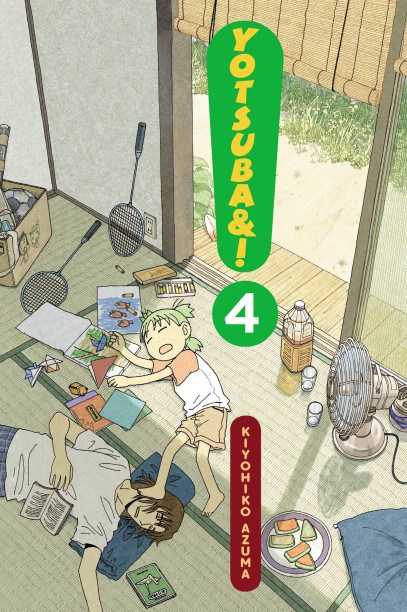
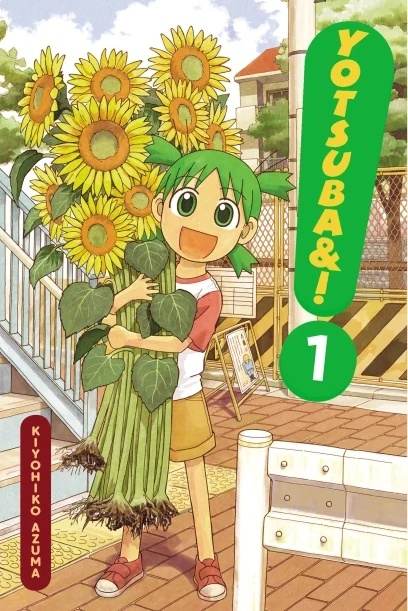
Yotsuba's panels make looking around feel like an event
Yotsuba&! turns the ordinary act of noticing into a formal pleasure. Its panels give room to reactions, pauses, and surroundings, so small discoveries can carry the momentum that another manga might reserve for a major event.
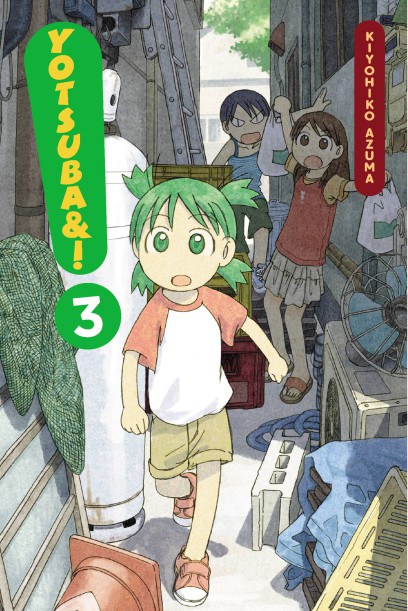
Coverage: Discusses the series’ visual pacing and everyday neighborhood discoveries without plot-specific revelations.
Time belongs to the act of noticing
Yotsuba&! often draws attention to the time between one event and the next. A character looks, reacts, or takes in what is nearby, and the sequence gives that response enough space to register. This pacing changes the reader’s measure of what counts as movement. Progress does not always mean a new problem or a dramatic turn; it can mean that Yotsuba has noticed something, or that the people around her have had time to answer her presence.
The effect depends on contrast. Yotsuba’s vivid reactions can make a moment feel newly charged, while a quieter panel allows the setting to remain present around her. The manga does not have to announce that an ordinary detail matters. By holding the image long enough for the reader to see it alongside the character, the page makes looking part of the action. The event is modest, but its duration gives it weight.
Backgrounds make ordinary space legible
The surroundings in Yotsuba&! help establish the scale of its comedy. Rooms, streets, and the everyday spaces between people are not interchangeable blank stages. Their presence gives characters somewhere to move and something to notice, while helping the reader understand how a small encounter fits into a lived-in environment. A scene can feel grounded before any character explains what the place means.
That grounding also makes Yotsuba’s perspective more vivid. Her attention picks out the world as an active field, not a decorative layer behind the dialogue. The reader can register the difference between what she is focused on and all the surrounding detail that remains available to see. This visual relationship produces a gentle kind of humor: the world is ordinary enough to be recognizable, yet full enough that a child’s interest can find a fresh point of entry almost anywhere.
Panel rhythm gives reactions room
The manga’s page rhythm often lets a reaction unfold rather than compressing it into a quick visual cue. A look or gesture can carry its own beat, particularly when Yotsuba and an older character understand a situation differently. The panel sequence invites the reader to move through that difference. The resulting comedy has timing, but it is not dependent on a punchline delivered from outside the scene; the timing comes from watching two ways of seeing meet.
This rhythm makes quieter moments active. A pause can hold anticipation, allow a response to land, or keep attention on the small gap between what a character expects and what occurs. The reader participates by looking from one panel to the next and adjusting their understanding with the characters. Such pacing is especially suited to everyday discovery because it resists the assumption that a scene must hurry toward a climax. The page lets a minor change in attention become enough.
Discovery without spectacle
Many adventure stories make discovery legible through scale: a distant destination, an extraordinary obstacle, or a revelation that changes the map. Yotsuba&! can make discovery legible through sequence instead. The reader watches an ordinary setting become newly interesting as Yotsuba encounters it. The panels do not need to turn the neighborhood into a fantasy landscape. They give the character’s interest enough room to alter how the reader looks at what was already there.
That form supports the series’ larger pleasure in daily life without claiming that every day must contain a major adventure. The panels make looking around feel like an event because they grant attention a visible shape: the setting remains, the character notices, and the page lets the moment breathe. By the end of a small sequence, something has changed—not necessarily the world, but the reader’s sense of what it contains. The manga’s quiet argument is that ordinary space rewards a close look when the page knows how to give it time.
Primary work & further reading
Primary work: Yotsuba&!. Character and story readings are editorial interpretations. The publisher reference below identifies the work and its premise.