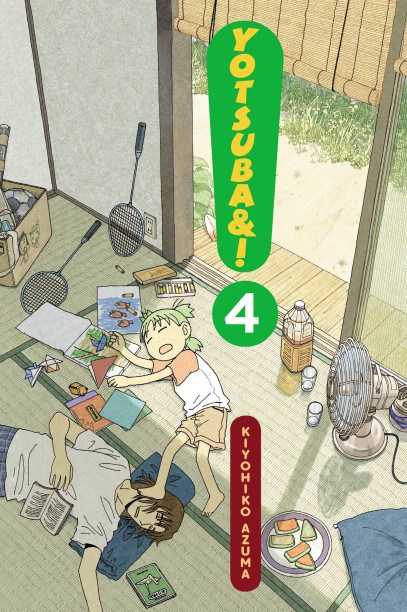
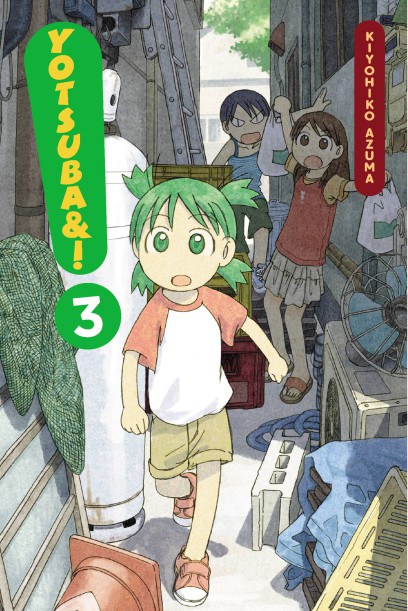
Yotsuba arrives in the neighborhood
Yotsuba’s arrival in a new neighborhood turns relocation into a chance to encounter the familiar world afresh. The manga’s opening finds adventure not in distance traveled, but in the attention a newcomer brings to ordinary surroundings.

Coverage: Covers the opening neighborhood arrival and its everyday discoveries; no later developments.
A new address, an unfamiliar map
A move usually looks like a task measured in boxes, rooms, and the labor of getting settled. Yotsuba&! shifts that measure. When Yotsuba arrives in her new neighborhood with her father, the place is not yet a home in the emotional sense; it is a collection of streets and nearby people waiting to be encountered. That difference gives the opening its energy. The story treats arrival as an invitation to look around, rather than a pause before the “real” action begins.
Yotsuba’s unfamiliarity matters because the neighborhood is ordinary to the people who already live there. A child who has not learned which details deserve to be ignored can make a small encounter feel newly significant. The comedy grows from that mismatch: the setting does not transform, but her way of meeting it does. The opening therefore makes discovery less about finding a hidden wonder than about recognizing how much a familiar place can hold when nobody has yet explained it away.
Attention sets the journey’s scale
The word “expedition” suggests a long route and a destination, yet the manga’s central scale is the size of a child’s attention. Yotsuba encounters the surroundings with the seriousness of someone for whom each new thing may change the day’s possibilities. A street can become more than a way between buildings; a person can become more than a neighbor’s name. Such moments do not need to build toward a grand revelation. Their value lies in the time the story gives them.
This perspective also prevents the new neighborhood from becoming a simple backdrop. It has its own social texture, and Yotsuba’s arrival brings her into contact with people who already have routines and relationships. She does not understand everything at once, which gives the reader room to notice how the everyday world is organized around her. The opening’s movement is thus both outward and social: each encounter adds a little more shape to the place she has entered.
A child’s logic meets adult life
Yotsuba’s curiosity is not presented as a tidy method for learning. She asks, reacts, and acts from a child’s frame of reference, which can be funny precisely because it does not match the assumptions of adults. The manga lets that difference generate scenes without making the child’s view either foolish or magically wise. She may misread the meaning of a situation, but her attention still exposes how much adults take for granted.
Her father’s presence gives the opening a grounding counterpoint. A move requires practical care, and the adult world cannot simply vanish because a child has found something interesting. The pleasure comes from seeing that responsibility coexist with play. Yotsuba has room to approach the new place on her own terms, while her father remains part of the structure that makes this freedom possible. The result is neither a fantasy of unbounded independence nor a lecture about settling in.
Arrival as a way of seeing
The opening’s small scale is a formal choice with an argument behind it. If the story made relocation chiefly a problem to solve, the neighborhood would be valuable mainly as a destination reached. Instead, the arrival itself becomes material for comedy and observation. The reader’s attention is redirected from the abstract fact of moving to the specific experience of beginning again somewhere ordinary. That shift gives the series a distinctive starting point without relying on spectacle.
By the time the neighborhood begins to feel less like a blank map, its change has happened through attention and contact. Yotsuba’s expedition is not a claim that every errand hides a grand adventure; it is a demonstration of how a newcomer can make daily life visible. The opening resolves its central tension by letting the place become familiar without losing its capacity to surprise. Moving day becomes an expedition because Yotsuba treats arrival as the start of looking, not the end of travel.
Primary work & further reading
Primary work: Yotsuba&!. Character and story readings are editorial interpretations. The publisher reference below identifies the work and its premise.