Walking across the body of the Bionis
Colony 9 is more than a safe place at the edge of an enormous map. Its position on the Bionis makes ordinary travel feel like movement through a living body, shaping how the game connects shelter, scale, and danger.
Coverage: Covers the Bionis setting and early Colony 9; no later revelations.
A home with a body beneath it
The Bionis is not simply a giant landmark looming behind the adventure. People live upon its body, and that premise changes the meaning of a familiar game-world structure: a settlement is not just a point on a map, but a small human arrangement on an immense living surface. The scale is difficult to hold in mind. The world can feel like terrain for exploration while also reminding us that its terrain belongs to something larger than any settlement or traveler.
Colony 9 makes that contradiction tangible. Its walls, houses, and routines give it the reassuring order of a home, yet its location on the Bionis folds the extraordinary into the everyday. Residents do not need to treat their world as a spectacle at every moment. They have places to work and reasons to gather. That ordinary life gives the setting weight: the Bionis is not scenery staged for the player’s amazement, but the ground on which people have made a community.
Colony 9 makes safety feel constructed
The opening area establishes a useful tension between protection and exposure. Colony 9 is a defended settlement, and its boundaries imply that safety has to be made and maintained. Beyond them lies a landscape where wildlife may become dangerous and where the player has room to wander. The settlement’s security therefore reads as a local achievement, not a promise that the entire world has been tamed.
That distinction matters because the colony’s familiarity can make danger feel personal. A threat outside the walls is not merely an obstacle on the route to the next destination; it bears on a place with residents and recognizable rhythms. The game’s shift between inhabited space and open ground lets the player feel how much a community depends on its edges. Colony 9 is a refuge, but its refuge is situated within a world that cannot be reduced to the needs of its inhabitants.
Vertical geography changes the sense of distance
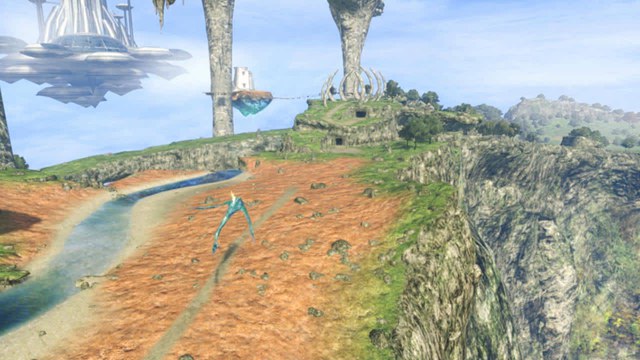
The Bionis gives the landscape a vertical dimension that conventional maps often flatten. Routes rise and fall across the giant body, making height part of the player’s understanding of place. Looking across an area can reveal how its spaces relate, while actually reaching them requires dealing with changes in elevation. The map is not simply a list of destinations arranged side by side; it suggests a body whose contours shape movement.
This geography also gives exploration a bodily rhythm. A long journey is measured not just by how far a destination lies across the screen, but by the effort of moving through slopes, heights, and openings in the terrain. The setting’s premise is present in those practical details. The player’s route is a path across a vast creature, even when the immediate task is only to cross a field or reach a landmark. Scale becomes something navigated rather than merely announced.
The landscape joins the intimate to the immense
The unusual setting could have remained a visual conceit, but Colony 9 helps connect it to the human scale of daily life. A settlement occupies only a small part of the Bionis, yet it can still feel like a whole world to its residents. That contrast gives the game’s expansiveness a quieter dimension: distance matters because people have homes, habits, and reasons to stay close to one another, not because the map is large for its own sake.
The Bionis therefore turns geography into a way of thinking about dependence. People build shelter on a body they do not control, and their local sense of belonging exists within a scale they cannot master. Colony 9 makes that arrangement legible without requiring every moment to explain it. Its roads and defenses are human-sized answers to an immense setting. The world feels vast because the lives within it remain particular, grounded, and vulnerable.
Primary work & further reading
Primary work: Xenoblade Chronicles. Character and story readings are editorial interpretations. The publisher reference below identifies the work and its premise.