Learning Liberl through a junior Bracer's jobs
Trails in the Sky makes Liberl’s geography feel inhabited by letting Bracer requests connect travel with local concerns. Small jobs give towns and recurring faces a place in the kingdom’s political landscape without turning world-building into a lecture.
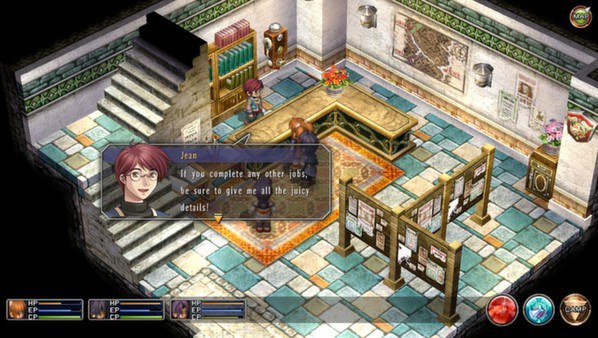
Coverage: Discusses Bracer requests, community travel, and recurring NPCs in Trails in the Sky FC; no late-story revelations.
The Guild makes travel answer a need
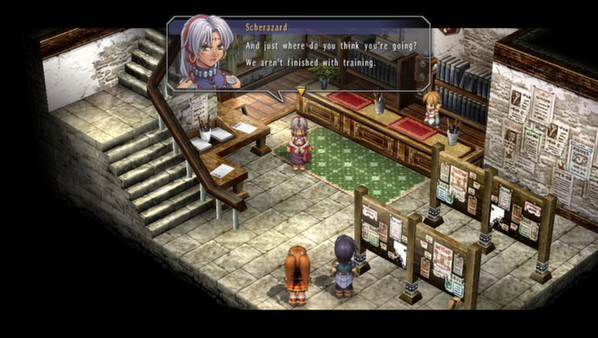
In Trails in the Sky FC, a Bracer request gives a journey a human reason to begin. The Guild is a place citizens can approach for assistance, and its work spans practical problems that can call for very different kinds of response. That premise makes travel feel less like a tour arranged for the player and more like movement between people who have a stake in what happens around them. A road matters because someone needs help on the other side of it.
This framing also gives the game a useful way to introduce its world without stopping the story for a textbook explanation. The player learns about Liberl by taking part in the structures that organize daily life. A local concern points outward; reaching another community makes the distance between places tangible. The Guild’s role as a service organization places the protagonists between ordinary citizens and the larger kingdom, letting each request expose one small part of how the whole society functions.
Local problems reveal local priorities
The requests matter as world-building because their concerns are not interchangeable decoration. A community’s immediate problem suggests what it needs, what it fears, or what kinds of responsibility fall to the Guild. The game can make a place feel distinct through the work that reaches its Bracers. This is a quieter kind of political map than a chart of borders and offices, but it is persuasive: politics is also the distribution of safety, labor, and attention among people who live in different places.
The scale is important. The early story does not need every task to reshape the kingdom in order for it to contribute to the setting. A small problem can show how a local institution responds, who is expected to help, and how much depends on people being willing to travel. These details accumulate into an understanding of Liberl as a network of communities rather than a backdrop. The player’s route becomes a route through distinct needs, each of which gives geography a social meaning.
Returning faces make a town more than a stop
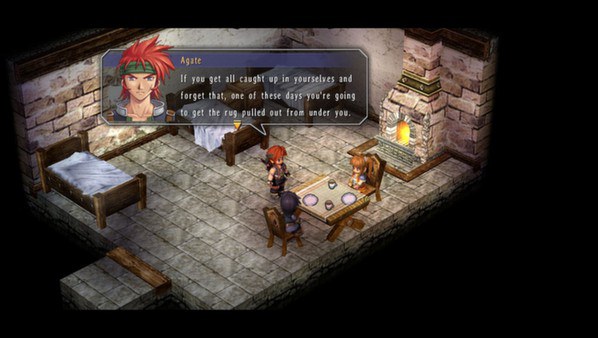
Recurring NPCs deepen that network by giving a location continuity. A town is not merely the place where the party collects an assignment and leaves; it includes people whose ordinary routines remain part of the world. Recognizing a familiar face can make the setting feel as though it continues beyond the protagonists’ immediate attention. The pleasure comes from encountering a person as a person again, not from treating every conversation as a clue to a larger plot.
This continuity also lends weight to travel. When the protagonists move on, they leave a community with its own concerns and relationships, rather than clearing a stage that exists only for the current chapter. The game’s broad attention to NPCs encourages the player to take the local scale seriously. People may add a detail, a point of view, or a small change in tone to the place they inhabit. No single exchange has to bear the whole burden of realism; the cumulative impression does the work.
A political map drawn at walking pace
Liberl’s small jobs build a political map by making the player encounter the kingdom from the ground up. Requests establish the Guild as a bridge between citizens and action; travel shows that communities are connected but not identical; returning NPCs make each stop feel inhabited over time. Together, these elements make politics legible as lived experience. The player understands the kingdom not only through institutions, but through the people who depend on them and the distances between them.
That approach suits the Bracer role. The protagonists are not introduced as rulers surveying a territory from above. They move through the territory in response to individual needs, and their work gradually gives those places shape. The result is a setting that feels political without requiring every errand to become a grand affair. Trails in the Sky makes local responsibility the means by which a larger world comes into view: Liberl becomes a map of relationships because the characters keep showing up where help is needed.
Primary work & further reading
Primary work: Trails in the Sky. Character and story readings are editorial interpretations. The publisher reference below identifies the work and its premise.