Xenoblade Chronicles’ chain attacks turn readiness into a party plan
A full Party Gauge opens a controlled sequence in Xenoblade Chronicles: Definitive Edition. Planning a useful chain means reading the party formation, available Arts and enemy state before spending that stored opportunity.
Coverage: Spoiler-light: this guide discusses combat systems without major story revelations.
A full gauge is an option, not an order
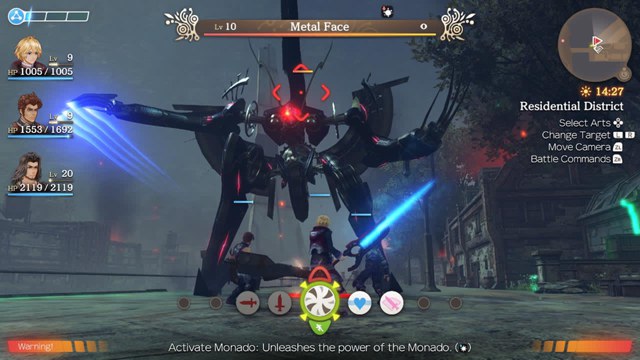
Nintendo’s official Definitive Edition overview describes filling the Party Gauge to trigger a Chain Attack, letting companions attack in quick succession. The instruction booklet for Xenoblade Chronicles explains the decision in more detail: a full gauge lets the party interrupt enemy actions temporarily and select Arts in formation order. That means the gauge stores a chance to reorganize combat for a short sequence; it is not merely another damage button. [1] [2]
Before activating it, look at what the current battle is asking of the team. Is a dangerous enemy preparing an attack? Is the target close to defeat, or does it still have enough health for a longer sequence to matter? Are the party members in an order that gives you useful Arts at the right moments? These questions turn a reflex into a plan. The answer may still be “use it now,” but the choice has a reason.
Read the formation before choosing an Art
The manual says each character acts according to the party formation, and that regular Arts become available when a Chain Attack begins even if they were cooling down. Talent Arts have a separate condition: their cooldown must already be complete when the sequence starts. That makes the pre-attack moment a quick inventory check. Notice which Arts are ready, where each character appears in the order and whether a particular status or combo is worth extending. [2]
Colour can help connect those choices. Nintendo’s booklet says that using Arts of the same colour consecutively can improve their effectiveness and the possibility of extending the chain, while Talent Arts can connect regardless of colour. In practice, this makes the best sequence dependent on the actual palette, not a memorized universal rotation. A useful first pass might preserve a same-colour run where it makes sense, then use a Talent Art as a bridge when the party’s available options would otherwise break the pattern. [2]
A worked example: finish a combo or save the gauge?
Imagine a party has filled its gauge while an enemy is still standing and a Break-to-Topple sequence is underway. Starting a Chain Attack immediately can pause enemy actions and let the group select Arts, but it may also interrupt the player’s attention to the combo already developing. Nintendo’s Definitive Edition guide describes Break followed by Topple as a sequence that can stop an enemy from attacking or defending, creating an opening for damage. If the target is vulnerable and the party has a useful set of Arts, the chain can be a deliberate payoff. [3] If one needed combo Art is not available in the turn order, it may be better to let the normal fight continue briefly and preserve the option for a clearer opening. The game does not make that choice automatically; it depends on the current party and enemy.
Treat the sequence as both offense and coordination
Because the chain temporarily interrupts enemy actions, its value is not only the total damage shown at the end. It can also give you a short window in which to choose attacks without responding to every live action. That makes target selection and party readiness important: a chain spent on a nearly defeated enemy may end a fight cleanly, while spending it early against a durable foe might create space to organize attacks. This is a tactical inference from the official description of the mechanic, not a guarantee that every enemy action or outcome will favor the player. [2]
The booklet also notes that party affinity raises the chance of a Chain Link, and that chain attacks themselves raise affinity and Tension. A sequence can therefore support the group’s future coordination as well as its current attack. Still, affinity is not a substitute for selecting sensible Arts. Build the turn around what is available, use colour links when they fit, and treat any extension as a bonus rather than a certainty. [2]
A simple check before committing
Use a short checklist: gauge full; target worth the sequence; regular Arts reviewed; Talent Art availability checked; character order understood; and one intended benefit named. That benefit might be damage, a safer pause, a useful combo opportunity or progress toward stronger party coordination. If you cannot name one, keep fighting and observe what changes. Nintendo describes chain attacks as an important way to put companions to work, and the manual shows why they reward preparation: once begun, the party’s options are briefly yours to arrange. [1] [2]
Primary work & further reading
Primary work: Xenoblade Chronicles: Definitive Edition. Character and story readings are editorial interpretations. The publisher reference below identifies the work and its premise.