Read the orbment line before choosing your quartz
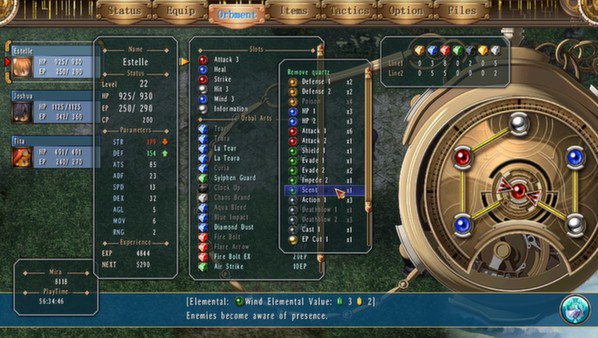
In Trails in the Sky FC, quartz placed in orbment slots affects both a character’s stats and which arts their orbment lines can produce. Learn how to check line totals, compare them with the spell list, and weigh art access against the character’s other needs.
Coverage: Covers FC orbment slots, quartz, elemental values, and arts access. Avoids later-series systems and story revelations.
Start with the character’s orbment lines
In Trails in the Sky FC, arts are not spells a character learns once and keeps forever. Quartz goes into an orbment’s slots, and the elemental values on each line determine which arts that line qualifies to use. When an art is missing from a character’s spell list, inspect the current layout before searching for a new spell or changing the whole party. The menu’s spell list displays the requirements you need to compare against the line totals.
Lines matter: their values do not all pool together across the orbment. A quartz on one branch cannot make up for a shortfall on another just because the character has enough of that element somewhere else. So when you are checking a wanted art, follow the relevant line and compare its displayed totals with the spell’s requirement. That gives you a concrete goal for rearranging quartz and avoids counting pieces in the wrong place.
Read elemental values, not quartz counts
Quartz contributes elemental value as well as its other effects, so two pieces of equipment are not interchangeable just because both occupy a slot. Earth and Time are separate elements; equipping one of each does not satisfy a requirement for two of either. Check the displayed element totals on the relevant line, then use the spell list to see whether those totals qualify for the art you want. That comparison is more reliable than trying to memorize recipes.
For example, suppose the spell list shows an art requiring more Earth value on a particular line than your current setup provides. Adding Time quartz will not close that Earth gap, even if it adds another elemental value to the orbment. You would need to adjust the quartz on that line so its Earth total meets the displayed requirement, while checking what stats or other arts the change affects. The menu makes this a readable tradeoff rather than a guessing game.
Give each character a setup that fits
Orbments have character-specific slot constraints, so a layout that works for one party member may not transfer cleanly to another. Estelle’s versatile orbment gives her room to serve several roles as the party develops. Olivier is a more dedicated caster, so it makes sense to consider what arts and support he can provide when arranging his quartz. These differences shape the practical question: which character can reach a desired art without sacrificing something the party relies on?
Imagine the party needs a particular art for an upcoming stretch. Check the spell list on Estelle and Olivier, then compare each character’s line totals and open slots with that art’s requirements. If Estelle can reach it while keeping quartz that support her flexible role, she may be the convenient choice. If making that change would pull her away from a useful job, Olivier’s caster-focused setup may be a better fit. The choice is about the current party configuration, not a universal best build.
Account for quartz that change stats
Not every quartz decision is about arts. Action quartz increases speed, while HP quartz affects HP, so changing either can alter how a character performs even when the art list stays the same. Before replacing a quartz to meet an elemental requirement, check whether its action or HP benefit is part of the character’s current role. A line total may improve while the character loses a useful stat advantage; deciding whether that exchange is worthwhile is part of setting up the orbment.
Make adjustments toward one visible target at a time. First identify the art you want in the spell list, then check its elemental requirements against the correct line and note any character-specific slot limits. Try a quartz change that addresses the missing element, and review both the new line totals and the character’s stats. If the art remains unavailable, recheck the line and element rather than counting all equipped quartz together. That process helps turn preparation into a deliberate choice about what each character contributes.
Primary work & further reading
Primary work: Trails in the Sky. Character and story readings are editorial interpretations. The publisher reference below identifies the work and its premise.