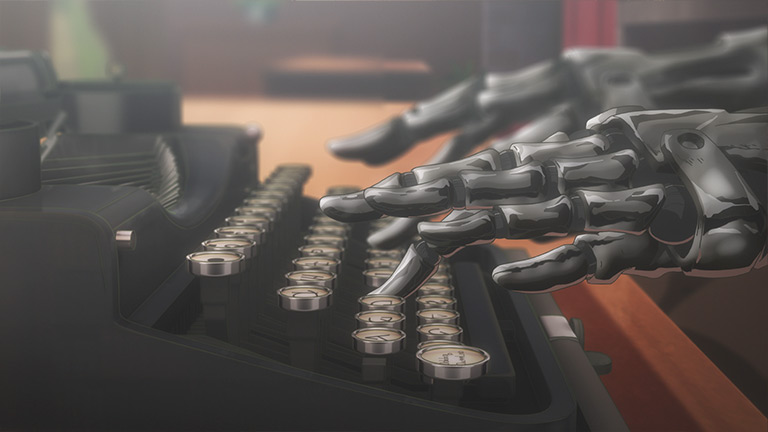
Violet has to learn what a letter cannot say literally
In the early TV series, Violet’s work as an Auto Memory Doll turns transcription into a difficult act of listening. Her apprenticeship asks what language can carry when a client’s words fall short of what they feel.

Coverage: Early TV-series premise and workplace adjustment; no film ending or late reunion details.
A job built around other people’s words
The postwar premise gives Violet a task that sounds mechanical: she travels as an Auto Memory Doll, writing letters for people who cannot, or do not know how to, express themselves on paper. At first, the job seems to reward exactness. Hear a sentence, record it, deliver the result. But the series makes that apparent simplicity the problem. A letter is not a container into which a speaker’s words can be poured unchanged. It is a message shaped for someone who is absent, and that distance gives every choice of phrasing weight.
Violet approaches this work with the discipline of someone trained to obey clear commands. A client’s request can appear to her as a set of instructions, and she is inclined to preserve what is said rather than infer what is meant. That makes her capable and frustrating in equal measure. The gap between a client’s spoken language and their intended letter is where the profession begins. Her early mistakes are not failures of intelligence; they reveal that listening requires judgment, including the judgment to recognize when literal accuracy would misrepresent a person.
Emotion does not arrive as a usable phrase
The series treats emotional language as something Violet has to encounter in context. A feeling is not always named directly, and even when a person chooses words, those words may protect them from saying what matters. The Doll’s work therefore involves attention to hesitation, circumstance, and the relationship between writer and recipient. A request for a letter may hide a wish for forgiveness, affection, or recognition. Those meanings cannot be added at random; Violet has to learn how to find them in what the client is willing to share.
That distinction keeps the story from presenting empathy as a magic talent. Violet does not simply become good at reading people because she wants to understand them. She must see how a message can fail when its language is technically correct but emotionally misplaced. Each assignment gives her a practical question: what must the recipient understand, and what form of expression can help them understand it? The answer belongs to the people asking for the letter. Violet’s developing sensitivity matters because it serves their intentions, not because it makes her the authority on their feelings.
The postwar world makes correspondence matter
Violet’s work takes place in a society trying to communicate across the aftermath of war. The series introduces a world of changing routines and expanding connections, where correspondence can bridge distances that ordinary conversation cannot. A letter takes time to travel and cannot be revised in response to the recipient’s face. That delay makes a writer’s decision more exposed: once the message leaves, the words must stand in for a person who is not there to explain them.
This setting gives the profession a meaning beyond clerical service. The Auto Memory Dolls translate private intention into a form that can circulate through the new social world. Violet’s own history as a soldier makes the change especially sharp. She has been accustomed to language as command and action as obedience; now she must work in a civilian setting where a sentence can soothe, wound, or reopen a relationship. The contrast helps explain why the opening premise is not simply about learning a trade. It is about what human beings ask of language when direct force no longer answers the need before them.
Learning to write means learning to pause
Violet’s growth begins in the space between receiving a request and producing a page. She has to pause long enough to ask what the person is trying to accomplish, rather than treating the first instruction as the whole task. That pause is not a rejection of precision. It is a more demanding kind of precision, one that considers the intended reader and the emotional effect of the message. Her work shows that careful wording depends on attention before it depends on typing.
The early story’s argument is that a letter cannot say what its writer cannot yet articulate unless someone helps uncover the shape of the need. Violet is that helper, but she begins without understanding how much the role asks of her. By taking each commission seriously, she learns to hear beyond a sentence without pretending to own its meaning. The job becomes a way for her to meet people where language falters. That is why her education as a Doll is also an education in human expression: she must discover that words become faithful not by remaining literal, but by carrying a person’s intention across the distance between them.
Primary work & further reading
Primary work: Violet Evergarden. Character and story readings are editorial interpretations. The publisher reference below identifies the work and its premise.