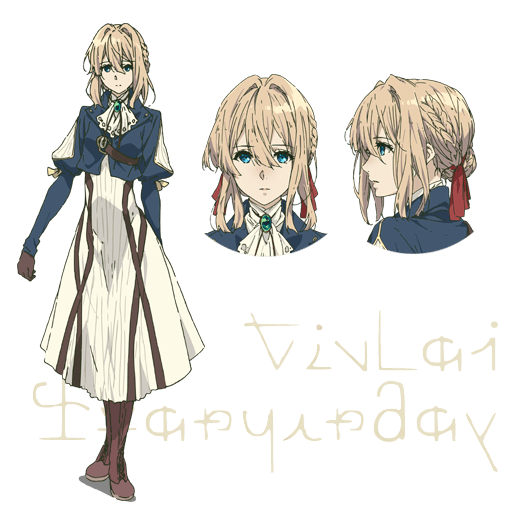
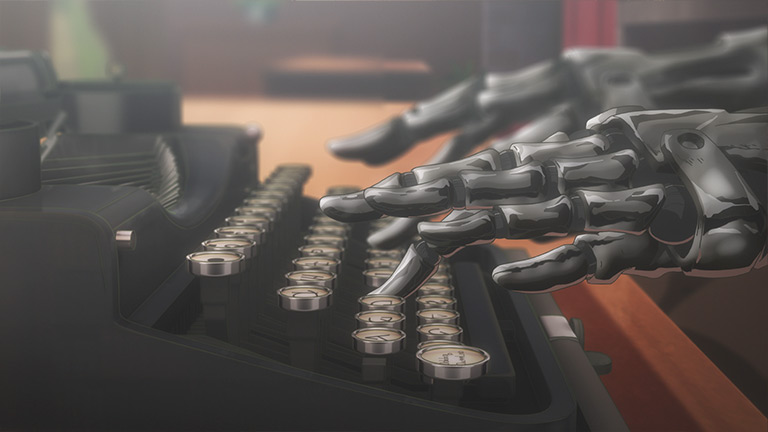
Violet's hands at the typewriter
Violet’s prosthetic hands and disciplined bearing make writing visible as a bodily task. The anime’s attention to motion turns the space between machine-like precision and emotional expression into part of her character, without reducing either side to a simple metaphor.
Coverage: Early TV-series imagery and Violet’s work as an Auto Memory Doll; no late-series or film events.
Writing is something the body does
Violet Evergarden could treat typing as a transparent step between thought and finished letter. Instead, the anime gives the act a physical presence. Violet sits at a typewriter and works with a measured, deliberate rhythm; the movement of her hands and the alignment of her posture make the labor legible. A sentence does not appear by itself. It is produced through contact, timing, and repeated decisions, so the viewer can watch the effort that turns speech into a durable object.
That emphasis matters because Violet’s profession depends on making other people’s words available to someone absent. The typewriter is not a neutral prop that happens to be nearby. It marks the point where an overheard intention becomes a document that can travel. By drawing attention to the movement required to create that document, the series makes her work feel embodied rather than abstract. The physical rhythm of typing gives expression a pace: each line advances through a sequence of actions, and that sequence gives Violet time to attend to what she has been asked to convey.
Prosthetic hands complicate mechanical precision
Violet’s prosthetic hands are a visible part of her life after war, and the series does not need to turn them into a technical lecture for them to matter. Their presence places her body in the same visual field as the typewriter’s keys and mechanisms. Both are associated with controlled movement, yet the comparison does not make Violet less human. It directs attention to how much purposeful work a seemingly simple action can contain. A carefully struck key is a small, clear gesture; a page of writing is the accumulation of many such gestures.
The visual connection between prosthesis and machine also resists an easy equation between precision and emotional coldness. Violet’s movements can appear exact, but exactness is not the same as understanding. At the start, she can perform an action with discipline without grasping the feeling the action is meant to carry. The series lets those qualities sit side by side. Her hands can type with control while her reading of a person remains incomplete, reminding the viewer that expressive skill is not guaranteed by physical skill. The body can execute the motion before the mind understands its human stakes.
Posture shows how Violet enters a room
The attention to Violet’s posture extends beyond the desk. Her upright bearing and composed movements give her a formal presence in spaces where other people may be distressed, hesitant, or unsure what to ask of her. That difference shapes an encounter before a letter is written. She approaches each assignment with the seriousness of someone prepared to receive instructions, and the visual restraint makes her early difficulty with emotional nuance easier to read. She is present, but presence alone does not mean she knows how to respond.
The anime’s staging makes that learning visible through contrast. A client’s ordinary gestures can carry uncertainty or grief, while Violet’s controlled manner holds steady. The point is not that she should imitate every emotion she sees. Rather, she has to recognize that another person’s body and words may communicate more than a direct request. Her attention must widen beyond the page. When a scene lets posture, expression, and the work surface share the frame, the task of composing a letter becomes part of a larger act of observing the person who needs it.
Expression grows through control, not its opposite
It would be tempting to read Violet’s character development as a movement away from mechanical precision toward free emotional expression. The visual language is more interesting than that. The qualities that initially make her seem rigid also give her the concentration to do demanding work. Her composure lets her stay with a client’s request; her disciplined hands make a message tangible. What she lacks is not control itself, but an understanding of what the controlled act is meant to serve.
Typing therefore becomes a form of physical acting. Each motion expresses Violet’s current relation to the task: her care, her limits, and her changing attention. The anime asks viewers to notice that a person can be exact without yet being perceptive, and that learning to perceive does not require abandoning exactness. As Violet works, precision gains a human purpose. The page remains a product of keys and hands, but it becomes meaningful because she is learning to treat it as a meeting between people. Her body does not simply perform the job; it gives the job a visible form in which discipline can grow into expression.
Primary work & further reading
Primary work: Violet Evergarden. Character and story readings are editorial interpretations. The publisher reference below identifies the work and its premise.