Letters have to travel in Violet Evergarden
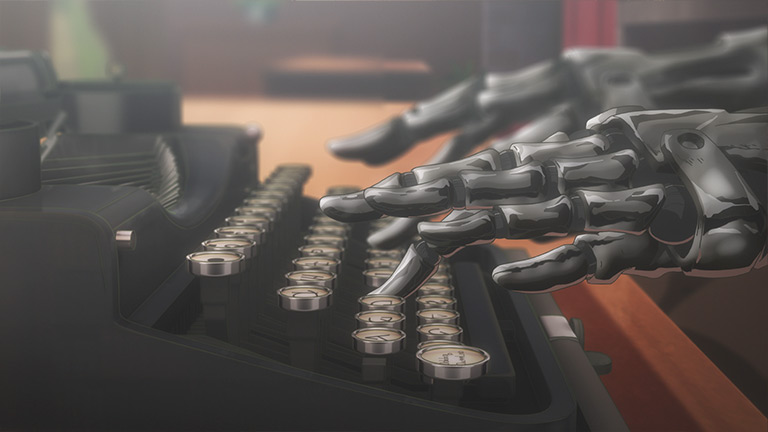
In the series’ early workplace premise, correspondence links places that cannot share a conversation. Travel and delivery turn emotional distance into a material problem, while Violet’s role as a hired writer shows how expression can be entrusted to another person and still belong to its sender.

Coverage: Early TV-series premise of Auto Memory Doll work, mail, and travel; no late episode tragedies.
A message has to cross real space
The work of an Auto Memory Doll depends on a basic fact: a letter begins in one place and must reach someone elsewhere. That journey gives correspondence a physical scale. A client speaks to Violet in person, but the person meant to receive the message is absent. Between them lies distance that has to be crossed through paper, transport, and time. The series’ attention to travel makes this more than a convenient premise for sending Violet to new assignments. It gives the act of communication a route.
Travel also changes how a message feels. A conversation offers immediate reactions: a listener can interrupt, misunderstand, or respond. A letter cannot offer that exchange while it is being written. The writer has to imagine the recipient and shape the message before knowing how it will land. The delivery journey makes that uncertainty visible. Words leave the sender’s control as they move through the world, carrying an intention toward a person who may read them under different circumstances.
Mail turns absence into a working system
The postal setting gives the story a practical answer to separation. People cannot always meet, but there is a system through which they can send something that stands in for their presence. The CH Postal Company connects the intimate act of writing with an organized public service. A letter can be personal without being private in every stage of its journey: it must be prepared, handled, and delivered. The ordinary work of the company is what lets a personal message travel beyond the person who first formed it.
That arrangement also puts limits on what correspondence can do. A letter cannot remove distance, force a reply, or guarantee that its reader will understand the sender as intended. The series’ premise becomes more affecting when these limits stay in view. Mail offers a chance to reach someone, not certainty of reunion or resolution. Violet’s role is valuable precisely because the result is uncertain. She helps a client make an attempt that can cross space, while the recipient remains free to respond in ways no writer can control.
Delegating expression does not erase authorship
When clients hire Violet to write, they entrust her with a task that is deeply personal. The words on the page may pass through her hands, but the message is meant to express the client’s intent. This creates a delicate division of responsibility. Violet supplies skill with written form; the client supplies the need and the relationship that make the message matter. The letter is neither merely hers nor a mechanical transcript of someone else’s voice. It emerges from a process of listening and translation.
The series treats that delegation as a source of ethical pressure. If Violet clings only to the literal wording, she may fail to express what the client means. If she assumes too much, she risks replacing the client’s intention with her own. Her task is to work within that tension: ask what the message is for, notice what the speaker’s words leave unclear, and find a form that can be sent in the client’s name. The fact that the letter travels without its writer makes this care essential. Once delivered, the page must speak for someone who is no longer present to correct it.
The train makes connection a process
The image of a train carrying letters and people gives visible motion to what might otherwise remain an invisible exchange. A train travels through landscapes and between settlements; mail moves as part of that passage. The association encourages viewers to think of connection as a process rather than a sudden emotional breakthrough. A message must be composed, carried, received, and read. Each stage takes place apart from the others, and each leaves room for uncertainty.
That process clarifies Violet’s place in the story. She is one participant in a chain that begins with a person who needs to speak and continues toward someone who may be far away. The journey cannot make her responsible for every outcome, but it does make her craft consequential. Her writing can help intention survive the distance between sender and recipient. The early premise finds hope not in the idea that distance disappears, but in the more modest possibility that people can build a route across it. A train does not shorten every separation; it makes the act of reaching out possible, and the letter gives that journey a human purpose.
Primary work & further reading
Primary work: Violet Evergarden. Character and story readings are editorial interpretations. The publisher reference below identifies the work and its premise.