What Mob's percentage counter is counting toward
The percentage counter gives Mob’s feelings a visible shape without turning them into a simple measure of danger. Its rising total makes each pause, silence, and small frustration carry suspense, while leaving the emotional meaning of the eventual release open.
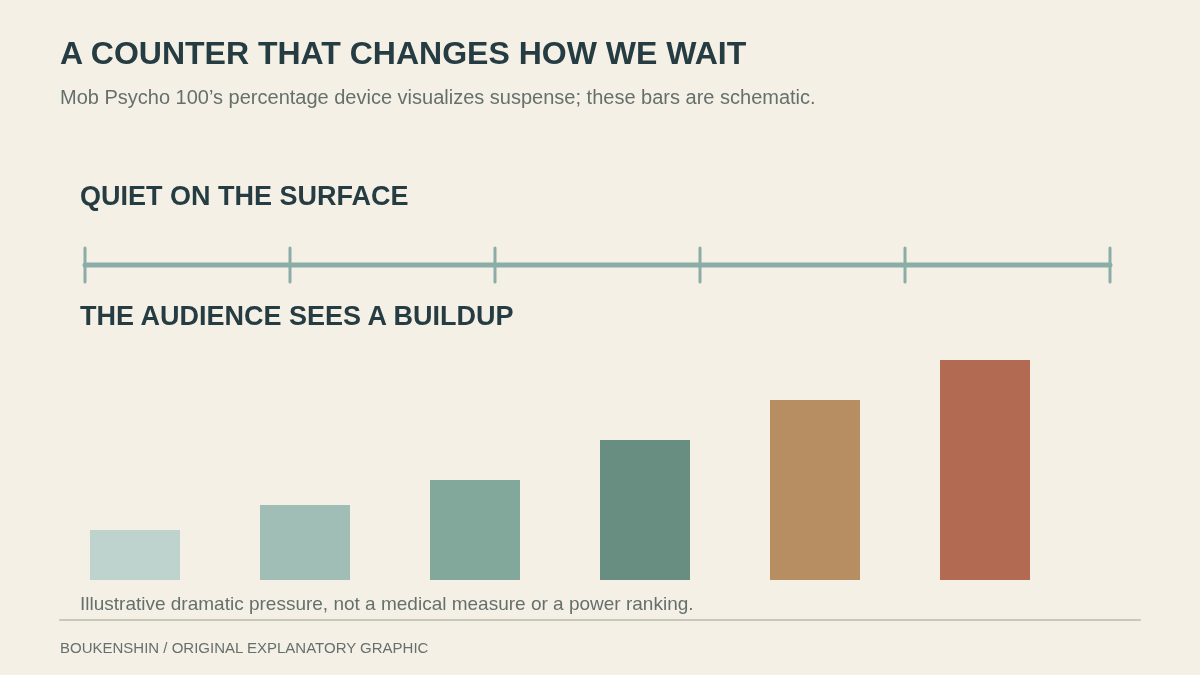
Coverage: Early anime use of Mob’s percentage counter and emotional buildup; no later transformations or arc outcomes.
A number makes an inward process visible
Mob’s percentage counter is a compact visual answer to a storytelling problem: how can an audience sense a character’s accumulating emotion when the character rarely announces it? The number gives that inward process an outward form. Instead of relying only on facial expression or explanatory dialogue, the anime can show a count changing as pressure builds. The device is legible at a glance, and its simplicity invites the viewer to watch for movement even when Mob himself appears still.
That legibility does not make the counter a literal emotional instrument with a single stable reading. A percentage suggests measurement, but the story uses it as a dramatic convention, not a clinical diagnosis or a complete account of Mob’s inner life. Its power comes from the gap between what it can show and what it cannot. We can see that something is gathering; we still have to attend to the situation and Mob’s responses to understand what that something means.
Stillness becomes active dramatic time
Ordinary scenes can acquire suspense because the counter makes waiting visible. Mob may listen, endure an awkward encounter, or hold back a response while the audience tracks the number’s movement. A quiet beat is no longer empty space between more dramatic events. It becomes time in which the viewer asks whether the feeling is settling, growing, or approaching a point where Mob can no longer keep it contained.
The device also changes the pace of emotional scenes. A jump in the display can make an apparently small moment register as significant; a long stretch without a release can make restraint feel effortful. The viewer is trained to notice the buildup rather than treating Mob’s calm surface as proof that nothing is happening. This is suspense made from attention. Its subject is not only what Mob might do, but the effort required to remain composed while something within him changes.
Repression is a reading, not a diagnosis
Because Mob often keeps his reactions subdued, the counter can invite viewers to describe him as repressing emotion. That interpretation captures part of the tension, but it should not flatten the character into a diagnosis. The anime presents a boy who has reasons to value control and who can struggle to express what he feels. A rising number makes those struggles dramatic; it does not provide a medical explanation for them or reduce his personality to a hidden pressure gauge.
The device is most interesting when it refuses to do all the interpretive work. The same climb in the counter can prompt different questions depending on what Mob is facing: is he hurt, frustrated, overwhelmed, or responding to something else? The audience must read the surrounding scene, not simply wait for the number to reach a preset meaning. That ambiguity respects the complexity of emotion. Mob is not a machine whose display tells us exactly what he will do; he remains a person whose feelings need context.
Suspense leads toward consequence, not spectacle alone
The counter’s promise is that a buildup will matter. When the number nears its limit, viewers anticipate a change in the scene and watch earlier moments in retrospect, searching for what pushed Mob toward that point. This structure can make a release feel powerful because it has been prepared through smaller signs. The buildup has made the audience attentive to Mob’s experience before the more visible consequence arrives.
Yet the counter’s real contribution is not simply to advertise an explosive event. It gives the anime a way to dramatize the distance between composure and feeling, and to make that distance perceptible without constant explanation. We watch a quiet character become legible through accumulation, while recognizing that no number can exhaust what he feels. The device turns restraint into suspense because it asks us to attend to what is happening beneath the surface—and to see that attention as part of understanding Mob.
Primary work & further reading
Primary work: Mob Psycho 100. Character and story readings are editorial interpretations. The publisher reference below identifies the work and its premise.