Papyrus's puzzles make ambition endearing
Papyrus’s early Snowdin appearances turn puzzle-making into a comic form of self-presentation. His elaborate confidence and wish to join the Royal Guard give his traps a purpose beyond simply stopping the player.
Coverage: Covers Papyrus and his puzzles in opening Snowdin; excludes later developments.
A puzzle is a stage
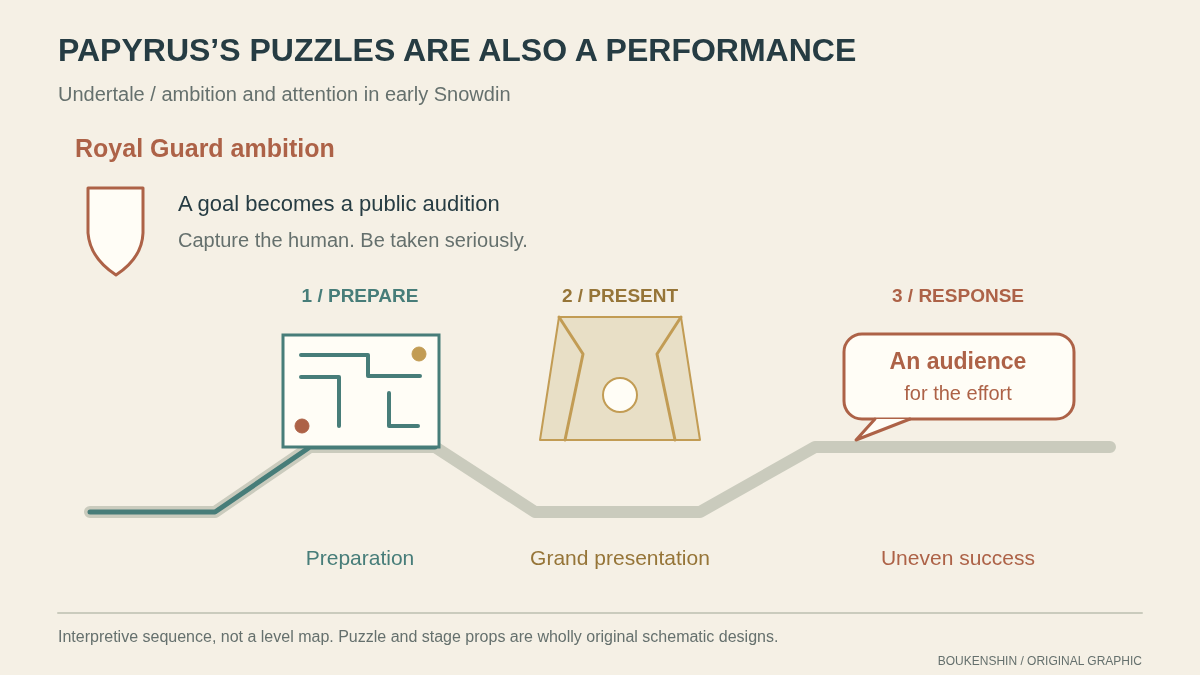
Papyrus’s Snowdin puzzles are built to be encountered. Their placement turns a stretch of travel into a sequence of occasions where the player can notice his effort and respond to it. The obstacles are not anonymous locks in a dungeon; they carry the unmistakable feeling of someone arranging a performance. Papyrus wants the human to see that he has planned something. Even when the puzzle’s practical challenge is modest, its presentation lets his personality take up space.
That theatrical quality makes the player’s role part of the joke. To move forward, the player has to engage with a contraption made to impress, inconvenience, or capture the human. The setup asks for attention to the person behind the puzzle, not just its solution. Papyrus is trying to make an impression, and the game lets the player experience the mismatch between his grand self-image and the comic scale of his devices. The humor comes from investment, not from the absence of effort.
Preparation reveals what he wants
Papyrus’s wish to join the Royal Guard gives his puzzle-making a clear social aim. He is preparing for a role in which capturing a human would matter, and the obstacles let him rehearse the part. The puzzles are therefore not simply signs that he likes riddles. They are practice for a future he imagines with conviction. Each attempt to stop the player becomes a small audition: Papyrus can demonstrate ingenuity, seriousness, and the kind of initiative he believes the Guard should value.
The result is endearing because his ambition is visible even when his execution invites laughter. He does not treat the goal as a private fantasy he is embarrassed to reveal. He puts it into the world through traps and schemes, accepting the possibility that they may not work as intended. That makes his comic failures feel active rather than pathetic. Papyrus keeps trying because the pursuit itself matters to him. His puzzles are evidence of a person practicing toward a desired identity, in public and with more confidence than polish.
Comedy comes from the gap
Papyrus’s performance depends on a gap between the importance he gives his plans and the effect they have. A puzzle can be announced with the spirit of a major test while the player experiences something that feels awkward, transparent, or unexpectedly easy to navigate. The contrast does not make Papyrus foolish in a flat way. It shows how generously he invests in the performance: he wants the encounter to matter, so he supplies it with ceremony and confidence.
The game’s humor also lets the player see that the puzzles are meant for someone, not merely placed for everyone. Papyrus has an audience in mind, and the human is standing in the role he has prepared. That explains why his obstacles feel personal without making them cruel. He wants recognition and success, and the player’s passage becomes the occasion for both hopes. The joke is directed at the overblown staging, but it also makes room for the sincere desire underneath it.
Aspirations shape the encounter
Because Papyrus wants the Royal Guard position, the Snowdin puzzles carry a dimension of self-definition. He is not only trying to catch the human; he is acting out what he thinks a capable guard should do. That performance lets the player understand his ambition through behavior instead of a résumé of traits. We see confidence in the way he presents a challenge, and hope in the fact that he continues to invent them. His personality emerges from a goal pursued in an unusually public, playful form.
The opening Snowdin encounters make Papyrus’s puzzles endearing because they preserve both sides of him at once. They are comic obstacles, but they also reveal effort, pride, and a sincere wish to be taken seriously. Their uneven success does not cancel the ambition that produced them. Instead, the gap between his grand presentation and the puzzle in front of the player makes his determination more legible. Papyrus is funny because he performs so earnestly; he is appealing because the performance points toward something he genuinely wants.
Primary work & further reading
Primary work: Undertale. Character and story readings are editorial interpretations. The publisher reference below identifies the work and its premise.