Nobles and commoners share Class VII's classroom
At Thors, inherited rank and earned ability share the same classroom, but they do not carry the same assumptions. Jusis and Machias make Class VII’s social experiment feel less like a slogan than a daily negotiation.
Coverage: Covers the opening of the first Trails of Cold Steel, focusing on Thors and early tensions between Jusis and Machias.
A classroom assembled against habit
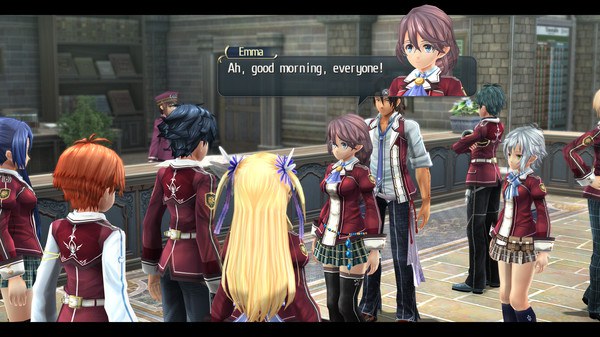
Thors Military Academy gathers students from different regions and social positions, and Class VII makes that mix unusually visible. Its members are not simply learning the same curriculum; they arrive with different ideas about who belongs in a room, whose confidence is natural, and what authority ought to look like. The class is an institutional attempt to put those ideas in contact. That makes its arrangement meaningful before anyone has resolved a disagreement: students who might otherwise meet only across a social boundary must now share lessons and responsibilities.
The experiment is imperfect by design. A shared uniform can make classmates look equal without erasing the households, resources, and reputations they bring with them. The academy can require proximity, but it cannot order mutual trust into existence. Early Class VII therefore works as a compact portrait of Erebonia: the larger social divide is present in miniature, not magically solved by the school’s good intentions. The classroom gives the divide a place to become personal.
Jusis and Machias make the divide specific
Jusis and Machias give the class’s social tension its sharpest early expression. Jusis is a noble; Machias is a commoner whose resentment of aristocratic privilege is not an abstract political position. Their friction makes inherited status difficult to treat as harmless etiquette. Jusis’s bearing and assumptions can read as evidence of a world that has long accommodated him, while Machias’s anger carries the pressure of people who have had to argue that such accommodation is unfair.
Neither character is reducible to a representative label. Jusis’s nobility does not make every judgment he offers automatically false, and Machias’s grievance does not make every response proportionate. The useful tension lies in the gap between a person and the social meaning others attach to him. Each can see the other as proof of a system before seeing him as a classmate. The conflict is convincing because the game lets that shortcut shape their interactions instead of explaining it away as a misunderstanding.
Shared work changes the terms of argument
Class VII’s common tasks matter because they put practical demands beside ideological convictions. Students have to function as a group, and that need offers a different measure of each other than rank does. A classmate’s usefulness, judgment, or willingness to cooperate can complicate an easy caricature. This does not mean teamwork dissolves political disagreement. It means the characters encounter evidence about one another that cannot be neatly filed under “noble” or “commoner.”
The arrangement also refuses to make social harmony effortless. Cooperation can be necessary before it is warm, and completing a task together does not require anyone to abandon a conviction. That distinction keeps the school’s ideal credible. If every disagreement disappeared as soon as students shared a classroom, Class VII would feel like a lesson designed to prove its own answer. Instead, the academy creates conditions in which its students must keep deciding whether they can work together while still disagreeing about what the country owes them.
The experiment begins with attention
The opening portion of the game gives Thors a modest but important purpose: it puts people who might otherwise remain symbols into each other’s everyday view. Jusis and Machias do not settle Erebonia’s class conflict, and the class’s presence cannot guarantee that they will understand one another. What it can do is make avoidance harder. The argument of Class VII begins with this forced attention, with the possibility that repeated contact might expose the limits of each student’s first impression.
That is why the class’s social composition feels like more than a premise. It establishes that political divisions have ordinary consequences: who is trusted, who is presumed arrogant, and who feels obliged to speak for a whole group. Thors can stage an alternative, but the students have to give it substance through conduct. The opening leaves the arrangement unfinished in the most productive way. A shared room is not equality itself; it is where equality becomes a question classmates must answer together.
Primary work & further reading
Primary work: Trails of Cold Steel. Character and story readings are editorial interpretations. The publisher reference below identifies the work and its premise.