Samurai Champloo makes anachronism a storytelling rhythm
Samurai Champloo’s historical setting shares the screen with hip-hop’s sound and visual grammar. That collision does more than add modern style: it gives the series a flexible rhythm for connecting wandering, conflict, and the experience of the present.

Coverage: Discusses the series’ stylistic approach and opening premise, with no later plot revelations.
The past is a setting, not a sealed container
Samurai Champloo places its wandering characters in an Edo-period setting, yet its style refuses to treat the past as a sealed world whose meaning depends on historical purity. Contemporary musical and visual sensibilities enter openly. The effect is not a claim that the period literally sounded or looked this way. It is a choice about how a modern audience can encounter a historical landscape without being asked to mistake atmosphere for documentary evidence.
That choice shifts attention away from reconstruction as the sole measure of seriousness. The setting still supplies roads, social pressures, and the forms of danger that shape the characters’ movement. But the series lets the viewer experience those conditions through an unmistakably present-day sensibility. The historical frame becomes a space for storytelling rather than a display case. Its anachronisms keep reminding us that the past on screen is being shaped for someone watching now.
Hip-hop supplies a grammar of interruption
Hip-hop is part of that shaping, not a decorative layer added after the story has already taken form. Its beats make room for breaks, repetition, sudden emphasis, and shifts between continuous motion and sharp interruption. Those qualities suit a series built around travel and episodic encounters. The characters can move from one setting to another, while the sound helps each arrival feel like a new beat in a larger composition.
The music also changes the meaning of pauses. A cut, a held expression, or a moment when movement stops can feel active rather than empty because the rhythm gives silence a place in the phrase. In that sense, musical influence becomes an editing principle. It encourages the show to treat action as a sequence of entrances and breaks, not as one unbroken line of historical adventure. The viewer feels the episode’s pulse as well as its events.
Anachronism makes movement visible
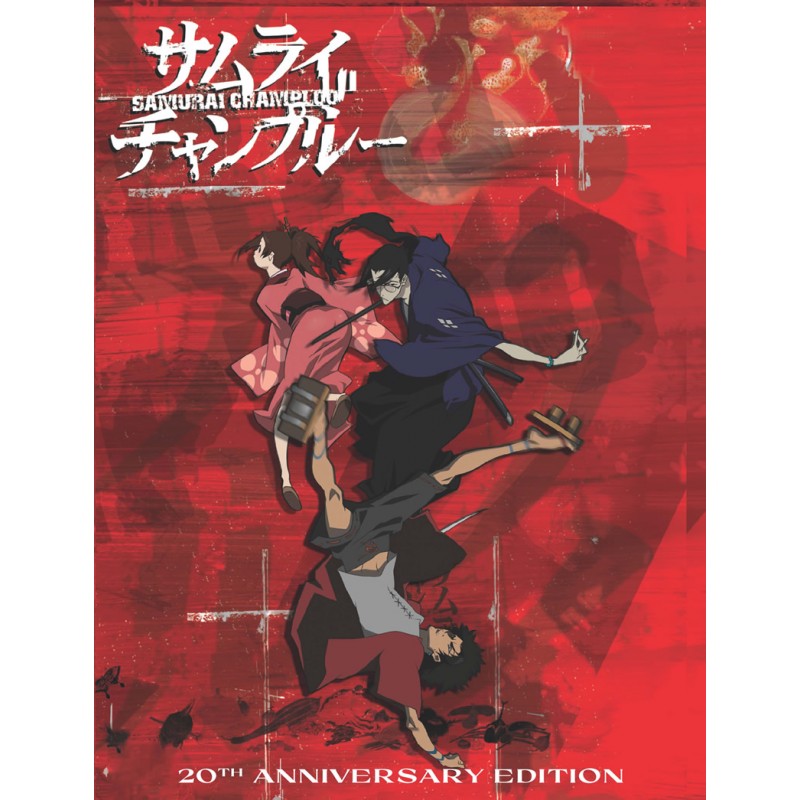
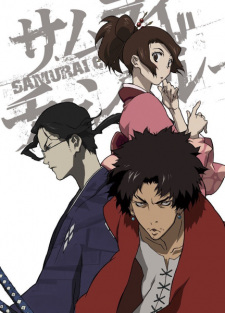
The collision between period imagery and contemporary rhythm draws attention to movement itself. Mugen’s loose fighting and Jin’s measured discipline already create different physical tempos; the series’ larger style lets those differences sit inside a world that is itself out of step with expectations. The contrast does not have to be explained as a puzzle. It is sensed in the way sound, image, and action refuse to settle into one historical register.
That refusal gives the show room for tonal shifts. A serious threat can sit beside a comic beat or an abrupt stylistic flourish without requiring the story to adopt a single solemn posture. The result is not that every moment becomes casual. Rather, the series can change its emphasis quickly, much as a musical phrase can turn on a break. Anachronism makes the viewer alert to those turns and keeps the journey from becoming a smooth, predictable procession through period scenery.
A present-tense way to approach history
The series’ style works best when understood as a meeting between a historical setting and a modern storytelling rhythm. That meeting preserves the texture of the journey while avoiding the promise that viewers are receiving an unfiltered window onto the past. Hip-hop, editing, and action all make the constructed nature of the experience legible. The show invites us to follow its choices rather than mistake them for neutral access to another era.
This is why its anachronisms feel structural. They organize how the story moves, how scenes gain emphasis, and how different characters’ energies register against one another. The past offers a world for travel; the present supplies a rhythm through which that travel can be felt. By keeping both audible, Samurai Champloo makes historical adventure less like a museum walk and more like a composition in motion—one whose meaning comes from the friction between its parts.
Primary work & further reading
Primary work: Samurai Champloo. Character and story readings are editorial interpretations. The publisher reference below identifies the work and its premise.