Fakir's severity creates uncertainty around protection
Fakir’s sternness gives Princess Tutu’s early relationships an edge: his guarded manner may protect others, but it also makes trust difficult. The tension lies in how care can look like control from the outside.
Coverage: Early character portrayal only; no later revelations about authorship or ending.
A protector who keeps people at a distance
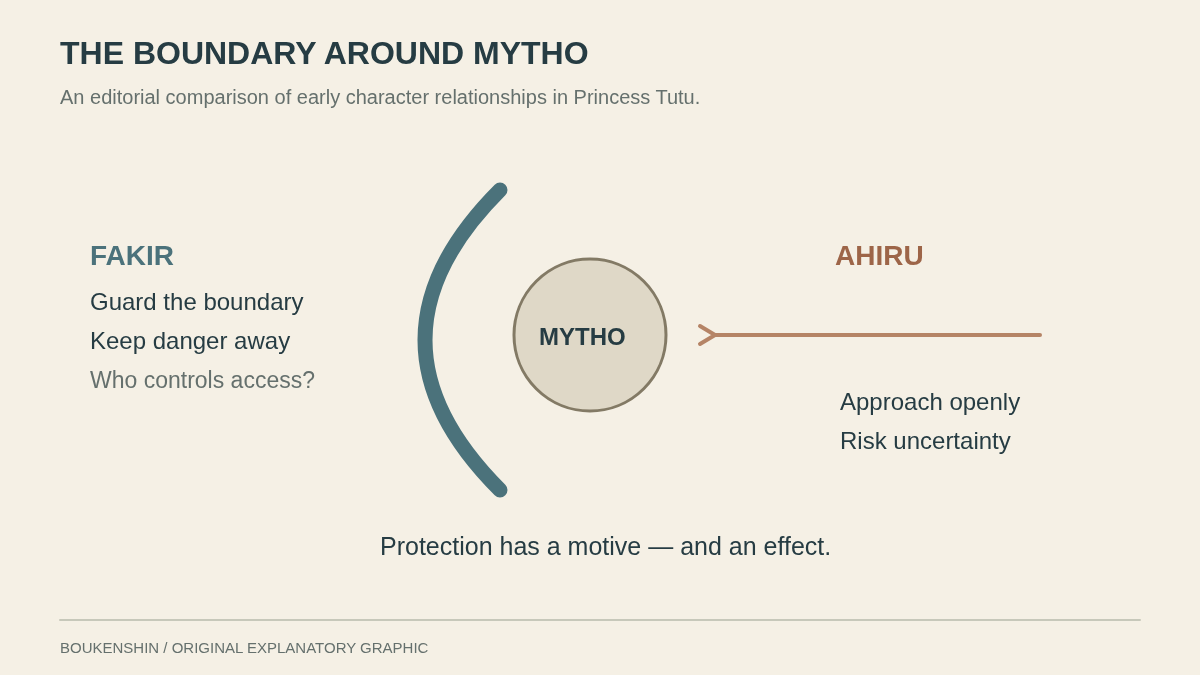
Fakir’s early presence is marked by severity. He can seem brusque where another character might offer reassurance, and his guarded manner sets him apart from Ahiru’s open concern. That contrast makes him difficult to read. He appears to be watching over Mytho, yet his way of doing so does not invite easy trust. The audience has to hold two impressions at once: he may be acting from concern, and he may still be making the people around him feel shut out.
The ambiguity is more interesting than a simple label of coldness. A severe manner can establish boundaries, signal vigilance or keep private feelings hidden. It can also prevent someone from receiving help or asking questions. Princess Tutu’s early characterization lets Fakir’s actions and their effects sit together. Even if a protective motive is present, the way protection is delivered matters to the people who have to live under it.
Protection can resemble control
To protect someone is to make decisions about danger, access and what the other person should be allowed to face. That gives protection a built-in risk: it can slide toward control, especially when the person being protected has little say. Fakir’s sternness brings this problem into view. His conduct can read as an effort to guard Mytho, while also creating the impression that Fakir wants to manage the situation on his own terms.
This tension does not require the story to settle whether Fakir is right. It invites a more useful question: what does his protection cost in openness? When a character keeps others at arm’s length, they may be safer from one kind of threat but less able to share what they need. His severity gives care a hard surface, making it unclear whether others should accept it, challenge it or do both.
A contrast with Ahiru’s approach
Ahiru offers a revealing counterpoint. Her concern for Mytho is emotionally direct, even when she lacks the skill or certainty to know what will help. Fakir’s manner is more closed and guarded. The contrast is not a contest in which softness automatically wins and severity automatically fails. Rather, it shows two different ways of responding to vulnerability: one risks awkwardness by moving closer, while the other appears to manage risk by holding the line.
That difference gives the early relationships friction. Ahiru’s willingness to approach can seem naïve beside Fakir’s caution, but caution can also become a wall. The two styles expose each other’s limits. Warmth does not guarantee good judgment; strictness does not guarantee effective care. Reading Fakir in relation to Ahiru keeps him from becoming a stock obstacle. He represents a genuine uncertainty about what responsibility looks like when someone is difficult to reach.
Trust requires more than good intentions
Fakir’s severity asks readers to distinguish motive from impact. A person may want to prevent harm and still communicate in a way that discourages trust. That does not make protection worthless; it means protection is relational. The guarded person’s intentions cannot be the only measure. Those receiving care need room to respond, and the protector’s actions need to be legible enough that care does not feel indistinguishable from command.
In the early story, Fakir’s sternness therefore creates productive uncertainty. It keeps the question of his concern alive without turning his demeanor into proof of virtue or malice. Protection can be necessary and uncomfortable at once. His character matters because he makes that discomfort visible: care may begin with keeping danger away, but a relationship also depends on whether the person being guarded can approach the one doing the guarding.
Primary work & further reading
Primary work: Princess Tutu. Character and story readings are editorial interpretations. The publisher reference below identifies the work and its premise.