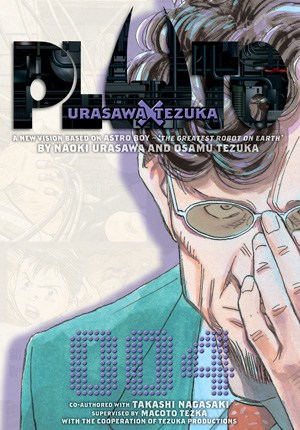
Gesicht investigates the death of a robot
In Pluto’s opening investigation, a detective who is himself a robot must read a crime scene shaped by public fear and private loss. Gesicht’s work makes the question of machine emotion part of the evidence.
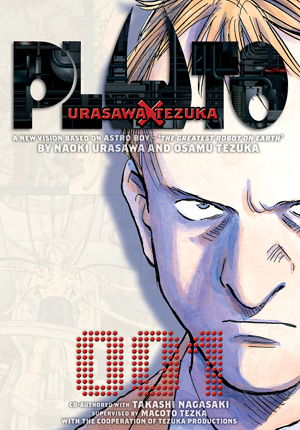
Coverage: Opening volume only: covers the murders of Mont Blanc and a robot-rights figure, the horn-like clues, and Gesicht’s investigation; does not identify the culprit or reveal concealed identities.
A detective who cannot stand outside the case
Gesicht enters Pluto’s opening volume with the habits of a practiced investigator: he observes, asks questions, and follows a pattern across crimes that initially seem separate. Yet his profession comes with an unusual complication. He is a robot, and the victims under investigation include advanced robots like himself. The case is therefore not a detached puzzle about unfamiliar beings. It is a threat within the society he serves, and potentially to Gesicht personally.
That position changes the meaning of his authority. Gesicht can work for Interpol and apply its methods, but his status also makes him evidence of the world’s uneasy compromise. Humans and robots coexist in the story’s idealized society, while legal rights and social acceptance remain subjects of dispute. His badge grants him a role; it cannot guarantee that everyone he questions sees him as a person. The investigation tests what that distinction costs in practice.
The crime scene turns violence into a message
The first volume connects the destruction of the powerful Swiss robot Mont Blanc with the murder of a prominent figure in a robot-rights organization. The victims appear to belong to different parts of public life: one represents extraordinary robot capability, the other the political struggle over robot standing. The strange arrangement of their remains, including makeshift horns, gives the crimes a repeated visual signature. Gesicht has to treat that repetition as a clue without assuming its meaning too soon.
The images make the murders feel staged for an audience. Their horror lies not only in what has been destroyed but in the care with which the aftermath has been arranged. That choice invites questions about hatred, spectacle, and the difference between attacking a machine and attacking a being that others recognize as vulnerable. Gesicht’s police work must recover a motive from a scene designed to be seen, while the public’s reaction becomes part of the problem he is trying to understand.
Robot grief is treated as a social question
Pluto does not make emotional recognition a simple test in which a robot displays sadness and everyone accepts its humanity. Instead, grief sits inside an argument about who is entitled to mourn and which losses count as losses. Mont Blanc’s standing as a great robot gives his destruction broad significance, but the series also points toward the possibility of relationships and ordinary attachments beyond public fame. The case asks whether mourning depends on the victim’s usefulness or on the fact that someone has been lost.
Gesicht is compelling in this setting because he cannot answer that question from a position of safety. His investigation depends on seeing robots as individuals whose deaths deserve attention, even when social assumptions reduce them to equipment or threats. He does not need to deliver a speech for the conflict to register. Every time he treats a robot’s history as relevant evidence, his professional method pushes against the idea that a machine’s inner life is automatically negligible.
Procedure becomes a form of recognition
The opening investigation gains force from Gesicht’s restraint. He has a case to solve, not a public argument to win, so recognition arrives through acts of attention: distinguishing victims, tracing connections, and taking a suspicious pattern seriously. The police framework may be imperfect, but it gives him a way to insist that these deaths be examined rather than dismissed. His method turns dignity into a practical demand: look closely enough to establish what happened.
That is why the detective premise matters beyond its mystery. Gesicht is both an investigator and a member of the threatened group, so the work of gathering facts also exposes the limits of the society around him. The question is not simply whether a robot can feel grief. It is whether the people who control the investigation can recognize grief when its owner is made of metal. In the opening volume, Gesicht’s answer begins with the case itself: a robot’s death warrants the full seriousness of an investigation.
Primary work & further reading
Primary work: Pluto. Character and story readings are editorial interpretations. The publisher reference below identifies the work and its premise.