Yosuke Hanamura wants to be more than the new kid
Yosuke’s humor helps him make a place for himself in Inaba, but it also exposes how hard he works to keep that place. His partnership with the protagonist and his connection to Junes reveal the insecurity beneath his easygoing social manner.
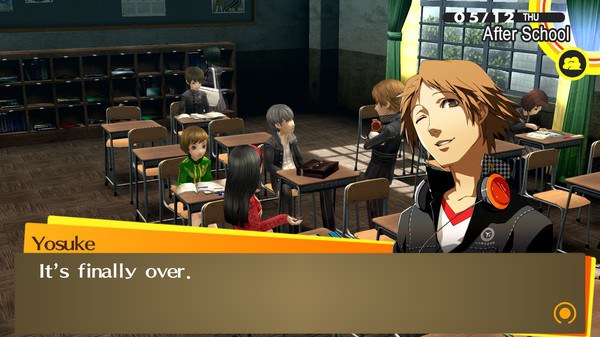
Coverage: Covers Yosuke’s early characterization, his partnership with the protagonist, and his connection to Junes; avoids late identity claims and later revelations.
The outsider who wants an audience
Yosuke arrives in Inaba as someone whose social position is still being negotiated. His family’s connection to Junes makes him visible, but visibility does not guarantee that classmates will treat him as one of their own. He can talk easily and make a joke, yet those skills do not cancel the awkwardness of being associated with a business that changes the town. His outsider status is not a lack of contact; it is the feeling that contact might still leave him at the edge.
That distinction helps explain why Yosuke’s humor often feels like more than comic relief. A joke can lower the pressure in a conversation and invite other people to respond, giving him a quick way to test whether he is welcome. It can also let him decide how a moment will be read before someone else decides for him. His performance suggests a young man who wants company badly enough to keep trying, even when he worries that the company may be temporary.
Junes gives belonging a public address
Junes makes Yosuke’s social position visible in the town’s physical life. It is his family’s store and a popular meeting place, so he cannot separate his name from a business people have opinions about. The store’s convenience and social pull sit beside the pressure it puts on local merchants. Yosuke therefore occupies an awkward middle ground: he benefits from being connected to a place people use, while also inheriting resentment directed at what that place represents.
His connection to the store can make ordinary attempts at fitting in feel complicated. Spending time with peers is not wholly separate from the public meaning of his family’s work, and he cannot simply become an anonymous student in the crowd. This is why his desire to belong reads as a question of being accepted as himself. The setting continually reminds him that other people may approach him with an idea about Junes already in mind.
Partnership turns investigation into companionship
The protagonist’s early partnership gives Yosuke a relationship that does not depend solely on his local reputation. They encounter the strange events together, and their shared investigation creates a practical reason to trust each other. The bond is built through action: one person is not merely an audience for the other’s jokes, and neither can solve the danger simply by staying on the sidelines. That arrangement lets Yosuke contribute, while also giving him a companion who sees more than his public association with Junes.
The partnership also brings out the difference between being socially fluent and feeling secure. Yosuke can help set the tone, but the investigation asks him to face situations that cannot be made safe with a quick laugh. His friendship with the protagonist suggests that belonging grows through shared responsibility, not just charm. The humor still matters; it makes space for connection. But the stronger bond comes from showing up when the situation demands more than a good line.
The fear of being ordinary is a fear of being unseen
Yosuke’s worry about being ordinary gives his social energy an anxious edge. Wanting to matter can sound like vanity if it is detached from the conditions that shape him, but his position in Inaba makes that desire understandable. He is surrounded by people and yet feels marked by a narrow public identity. The fear is not only that nothing special will happen; it is that nobody will look closely enough to find a distinct person in the first place.
That insecurity makes his jokes poignant without turning them into a secret code. They are part of how he reaches for recognition, but the game lets the need itself remain visible beneath the performance. His early character arc is compelling because it does not ask humor to prove he is carefree. Instead, humor becomes one method of managing the risk of rejection. Yosuke’s partnership offers a better answer: he can belong through mutual attention and effort, even while the town’s opinions remain difficult to control.
Primary work & further reading
Primary work: Persona 4 Golden. Character and story readings are editorial interpretations. The publisher reference below identifies the work and its premise.