March 7th, Dan Heng, Natasha: three turns and one Skill Point pool
Skill Points turn a party’s separate turns into a shared planning problem. Understanding when a basic attack can carry the next moment, when a skill deserves the resource, and how ultimates fit around that choice makes ordinary battles easier to read.
Coverage: Explains ordinary character basic attacks, skills, ultimates, and the shared Skill Point pool; includes a hypothetical three-turn example.
One pool connects separate turns
In ordinary combat, each character can use a basic attack or a skill on their turn, while the party draws from a shared pool of Skill Points. A basic attack generally restores a point; a skill generally spends one. That shared resource changes the meaning of an individual action. The question is not only which move is strongest for the character acting now, but what the rest of the team will be able to do after that choice.
Think of the pool as a team budget rather than a score to maximize. Spending a point may be worthwhile because it advances a plan, supports a teammate, or answers a dangerous moment. Saving one can matter just as much if another character is about to need their skill. The interface makes each turn look like an individual opportunity, but the resource rule connects those turns. A good decision looks ahead far enough to keep the next useful action available.
Basic attacks make room for priority
Basic attacks are not simply the lesser option a player uses when the pool is empty. Because they restore Skill Points, they can be a deliberate contribution to the party’s next turn. Choosing one may mean accepting a smaller immediate effect so another character can use a more important skill soon. That is a meaningful trade: the acting character still participates, while the team recovers flexibility.
The right choice depends on what the battle asks for. If a character’s skill is central to the current plan, spending a point may be easy to justify. If the moment is stable, a basic attack can preserve resources for a teammate whose turn follows. Neither action is automatically responsible or wasteful. The useful habit is to ask who benefits most from the next point, then decide whether the current turn should spend it or help restore it.
Ultimates sit beside the budget
Ultimates add another layer because they use their own energy rather than consuming a Skill Point when activated. Their timing still belongs in the same broader plan: an ultimate may help control a dangerous moment, contribute damage, or support the team, while the regular turn choices continue to determine the shared pool. Treating the ultimate and the skill economy as one decision can make combat harder to read, so it helps to separate the questions.
First consider whether the ultimate is useful now, given the situation and its effect. Then consider what the character’s ordinary turn will cost the party. Using an ultimate does not erase the need to plan around the shared points. This distinction keeps the resource picture clear. The pool governs the ordinary skill-versus-basic choice across the team; energy governs when an ultimate becomes available. They interact in the flow of a fight, but they are not interchangeable currencies.
Three turns with March 7th, Dan Heng and Natasha
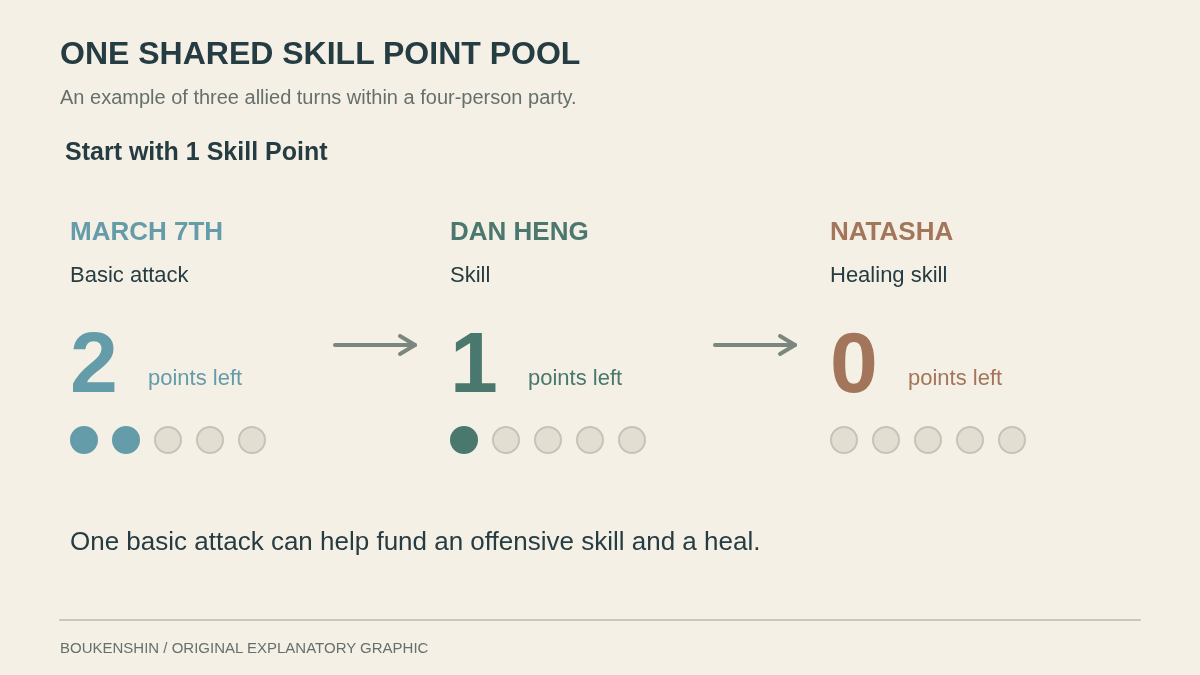
Consider the next three allied turns in a four-person party, with March 7th, Dan Heng and Natasha about to act in that order. Suppose only one Skill Point remains. March can use her basic attack to bring the pool to two. Dan Heng can spend one on his skill, leaving one. Natasha can then spend the remaining point to heal an injured ally with her skill. This is a hypothetical stretch of a battle, rather than a claim that these characters always act in this order. It shows exactly what March has contributed: her basic attack helps fund both an offensive skill and a healing skill.
Now change the situation: Natasha’s teammates are healthy, but someone needs March’s shield before an incoming attack. March can spend the initial point on her shield instead. Dan Heng may then need to use a basic attack to restore a point; Natasha can also attack normally if healing can wait. The damage dealer has accepted a quieter turn to make the defensive plan possible. If Natasha’s ultimate is ready, its party healing uses Energy rather than a Skill Point, which gives this particular team another option. None of these choices requires treating basic attacks as failed turns. Watch whose skill the party needs next, and use the other turns to make that action affordable.
Primary work & further reading
Primary work: Honkai: Star Rail. Character and story readings are editorial interpretations. The publisher reference below identifies the work and its premise.