Honkai: Star Rail skill points work like a team budget
Honkai: Star Rail gives the whole team a shared pool of Skill Points. That turns each character’s Skill into a group decision: the best rotation is not simply the one that lets every character use their most expensive action.

Coverage: Covers the general battle system; no story spoilers.
Count the pool, not just one character’s turn
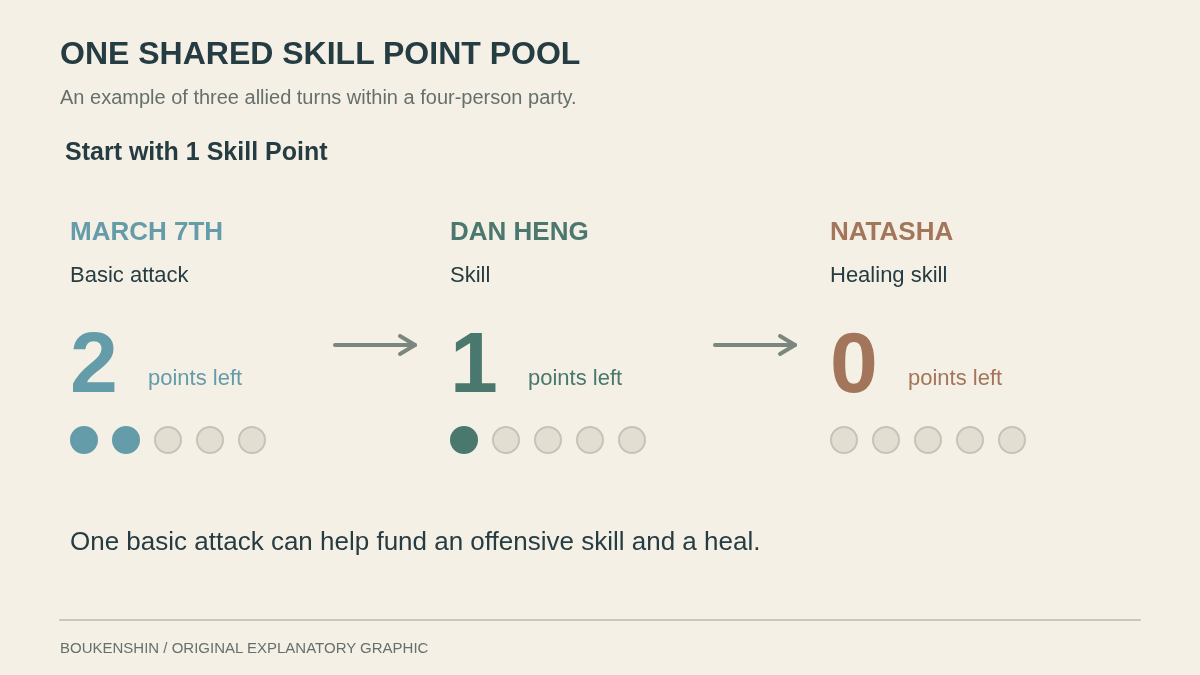
The HoYoWiki’s Base Mechanism tutorial describes Skill Points as shared by the team: using a Skill consumes them, while a Basic ATK can recover them. This makes a turn rotation a small economy. One character may want to spend every turn, while another can meet the immediate need with a Basic ATK and leave a point available for a teammate whose Skill changes the fight more substantially.
Think of a point as a team resource with an opportunity cost. Spending it now is worthwhile when the action meaningfully improves damage, safety, or control. If it merely repeats an effect you already have covered, holding the point may let another teammate act when their turn arrives. The game’s turn order makes that coordination visible: each action changes the options available to everyone who follows.
A simple worked rotation
Imagine a four-character team begins with a limited pool. The first character’s Skill applies a needed debuff; the second character’s Skill would add damage, but a Basic ATK still contributes while restoring a point; the third character needs a Skill to protect the team; the fourth can finish with either action. A sensible sequence may be Skill, Basic ATK, Skill, then decide based on the remaining pool and enemy state.
The example is deliberately abstract because characters have different costs, effects, and build priorities. Its lesson is to identify which actions are essential this turn before spending. If the defensive Skill prevents a likely knockout, preserve its point first. If the enemy is nearly defeated, the damage Skill may be the decisive use. The pool is not a score to hoard; it is a constraint that helps rank the team’s immediate needs.
Break timing changes the calculation
The same official tutorial links matching an enemy’s weakness to reducing Toughness; reaching zero triggers a Weakness Break effect and delays the enemy’s action. That means a Skill Point decision can have value beyond its direct damage. If a matching attack is likely to finish the Toughness bar, it may interrupt the opponent’s next action and create breathing room for the team. If the bar is still far from zero, a different defensive or damage choice may matter more.
Weakness Break is not a reason to spend automatically. The HoYoWiki notes that Break state has a duration and that Toughness returns at the beginning of the target’s turn. Consider when the break occurs relative to your other actions and the enemy’s next turn. The timing is part of the payoff: a point spent to break before a dangerous action can be more useful than the same point spent after that action has already happened.
Review the rotation by its bottleneck
When a fight goes badly, replay the sequence as a budget problem. Did the team run short before the character with the necessary Skill acted? Did a Basic ATK recover a point at a moment when it could have supported a later turn? Did you chase Toughness damage without a plausible break before the enemy acted? Those questions identify a fix more precisely than “use more Skills.”
Character kits and encounters vary, so this framework does not dictate one universal rotation. It gives you a way to read the shared system: spend when an action changes the situation, recover when another action can do the job, and consider whether an attack’s element advances a likely break. Planning around the team pool keeps each character’s turn connected to the others instead of treating four individual rotations as unrelated.
Primary work & further reading
Primary work: Honkai: Star Rail. Character and story readings are editorial interpretations. The publisher reference below identifies the work and its premise.