Jarilo-VI builds its conflict above and below ground
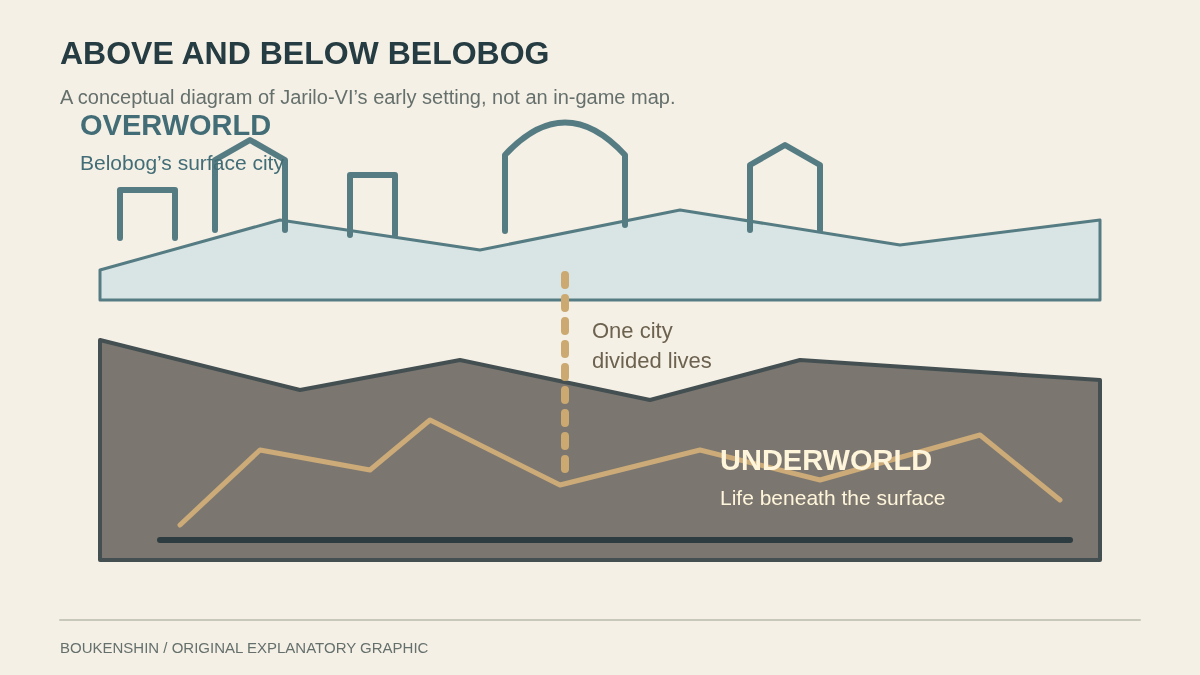
Jarilo-VI gives its central divide a physical shape. Belobog’s exposed streets and the Underworld’s constrained spaces make the distance between communities tangible, so the planet’s conflict is encountered through movement and perspective as much as through explanation.
Coverage: Covers the early Jarilo-VI story and the Overworld–Underworld divide; excludes the final boss and later political outcomes.
The city makes order visible
Belobog’s Overworld presents itself as a place where survival has acquired an official shape. Its walls, streets, and civic routines make protection visible, and the city’s public spaces imply that people can gather within an organized community. The cold surrounding the settlement gives this order a practical urgency. Safety is not an abstract ideal when the environment itself seems hostile; it is something that architecture and institutions promise to provide.
That promise also shapes how the player first encounters the conflict. The Overworld’s relative openness encourages a view from streets and public places, where authority and civic identity have a visible presence. The city can make its arrangements feel natural because they are built into the route through it. Walking through Belobog is therefore not neutral scenery between story events. It introduces a way of seeing the planet: stability appears as something carefully maintained and publicly represented.
Descent changes the scale of the problem
The Underworld gives that stability a second perspective. Reaching it means moving into spaces with a different atmosphere and a more immediate sense of constraint. The vertical divide between upper and lower communities is not only a piece of geography; it affects what the player sees, how people describe their circumstances, and which parts of Belobog feel central. The trip below makes it harder to treat the city’s public image as the whole story.
The change in setting works through accumulated detail rather than a single explanation. The Underworld has its own places and community, and the people there speak from within that life rather than as distant figures in an upper-city account. The player has to adjust to a new social frame. What had seemed like a unified settlement now reads as a divided one, with different conditions and different access to the places where decisions are made. The descent makes inequality spatially comprehensible.
Distance organizes what each group knows
The separation between Overworld and Underworld also creates unequal perspectives. People living in different parts of Belobog encounter different routines and pressures, so they do not describe the planet from the same position. The story’s early conflicts gain texture when the player listens across that divide. A community’s account of its own needs can sound different from the story told about it by people living above, even when both are speaking about the same city.
This is why the journey between levels matters as much as the labels attached to them. Crossing from one zone to another exposes gaps in access and familiarity. The people above and below are not simply two sides waiting to be sorted into a moral diagram; each setting gives the player evidence about what daily life demands. The game asks the Trailblazer to encounter those perspectives in place. Understanding Belobog requires more than learning that a divide exists. It requires noticing how that divide filters information and shapes whose experiences are easy to see.
A divided map resists easy judgment
Jarilo-VI’s design makes it tempting to search for one location that explains the whole conflict. The Overworld looks like the city’s official face; the Underworld makes the costs of separation harder to ignore. But neither setting can stand in for every person who lives there. The story builds tension by moving the player between them, letting geography complicate any impression formed from a single vantage point.
That movement gives the early planet story its argument. Belobog’s conflict is not merely about what happens at one landmark or who occupies a particular position. It is also about a community split across spaces that encourage different accounts of safety, responsibility, and belonging. By making the player travel between the Overworld and Underworld, the game turns that split into something felt rather than simply named. Jarilo-VI becomes readable as a shared home whose parts have grown difficult to see from one another.
Primary work & further reading
Primary work: Honkai: Star Rail. Character and story readings are editorial interpretations. The publisher reference below identifies the work and its premise.