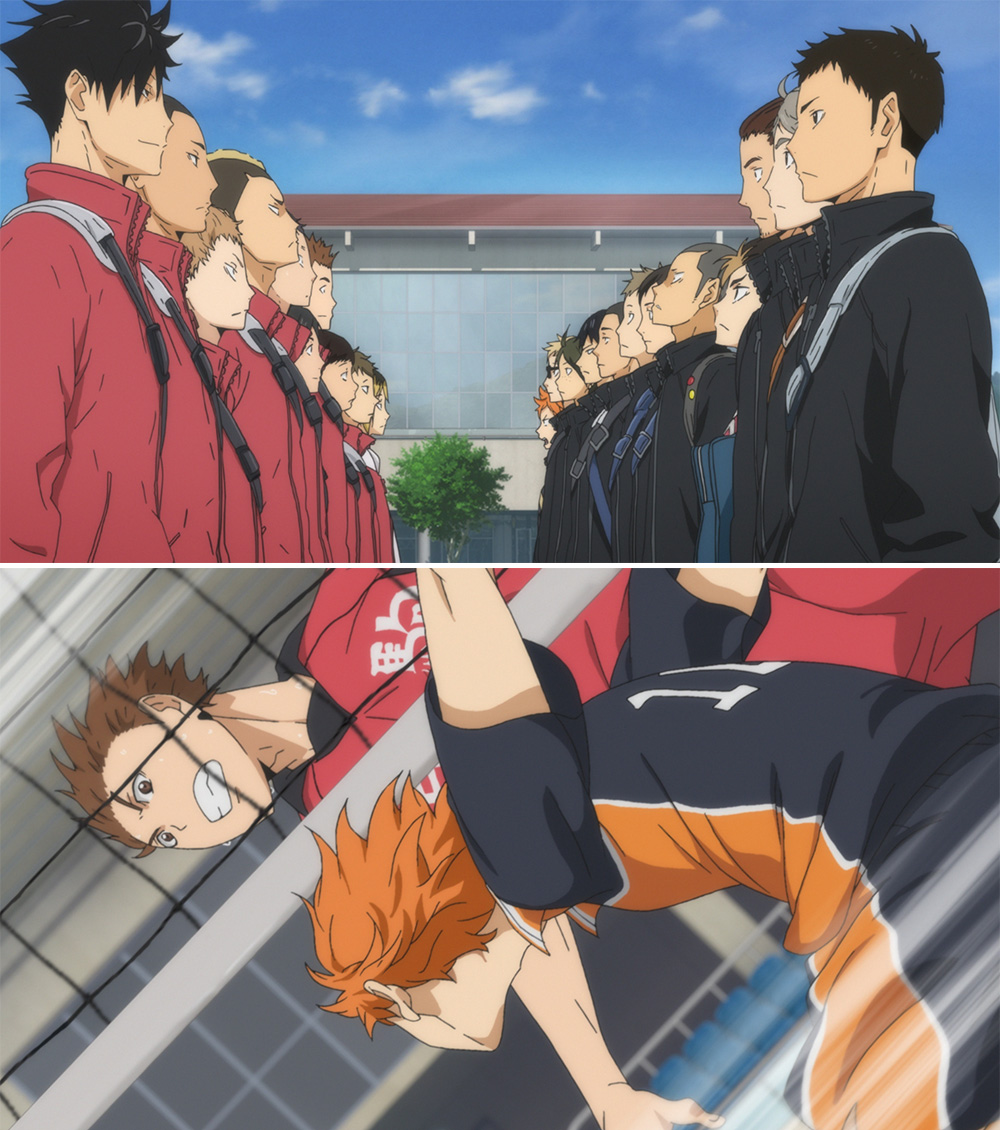
Hinata's height makes observation part of his ambition
Hinata’s early challenge is not simply reaching higher. His size makes every point of contact a question of timing, space, and attention, turning his ambition into a habit of studying what the court allows.

Coverage: Covers Hinata’s introduction, his arrival at Karasuno, and the team’s early formation; no later tournament outcomes.
A small player sees the court as a problem to solve
Hinata’s height is immediately legible as a constraint in volleyball, where the net divides space and makes reach visible. His first inspiration comes from seeing a short player succeed, but admiration alone cannot erase the difference between watching a spike and producing one. The gap gives his ambition its shape: he wants the impact of an attacker while lacking the physical advantage that seems to make that role natural.
The series makes that gap productive. Hinata cannot rely on a broad margin for error, so he has to attend to details other players may take for granted: where a ball will descend, how an approach builds momentum, and when a jump can meet the play. His energy is not a substitute for thought. It is the force that keeps him returning to those questions after his body has already made the effort.
The jump is only useful when it meets the ball
Hinata’s leaping ability gives him a dramatic presence, but the story does not treat height off the floor as a complete skill. A jump matters only in relation to the ball, the net, and the movement around him. When Hinata arrives too early or too late, effort becomes visible without becoming effective. This distinction keeps the spectacle grounded: athletic potential is a beginning, not proof that he has mastered attacking.
That emphasis also makes technique feel like an answer to a specific body. Hinata’s approach and timing must help him make the most of a brief window at the net. He is not being asked to become a taller player by sheer will. Instead, he has to learn how movement can create opportunities his standing reach does not offer. The ambition is therefore practical: find a way to be present at the right place and instant.
Observation turns imitation into learning
Hinata begins with an image of what he wants to become, but the first successful quick does not come from mastering every part of the play. He closes his eyes and commits to the jump; Kageyama sends a precise set into the path of his swinging hand. The attack works through that division of labor. Hinata’s speed and trust matter, but the early scene gives Kageyama the task of matching the ball to them.
That limitation makes the need to learn more visible. Hinata can search for an opening in the block and throw himself toward it without yet controlling the ball’s arrival. His excitement at making contact is a discovery about what a teammate can make possible. Observation remains part of the work ahead; the opening does not pretend that enthusiasm has already given him an experienced player’s command of the court.
At Karasuno, ambition becomes a shared task
Joining Karasuno places Hinata in a team where his limitations cannot be solved alone. Volleyball requires other players to keep a rally alive and create an attack, so his own jump becomes meaningful through relationships on court. He has to learn where his movement fits into a sequence, rather than treating every rally as a private test of determination. The change is not a surrender of individual desire; it is a way to give that desire somewhere to go.
Hinata’s early character is compelling because the work of becoming an attacker stays visible. His height keeps asking him to observe, while his excitement keeps him willing to act on what he sees. The combination prevents a simple underdog reading: perseverance matters, but it has to grow alongside judgment and coordination. His ambition is most convincing when it accepts the court’s demands and looks for an opening within them. The jump begins the story; attention helps make it a skill.
Primary work & further reading
Primary work: Haikyu!!. Character and story readings are editorial interpretations. The publisher reference below identifies the work and its premise.