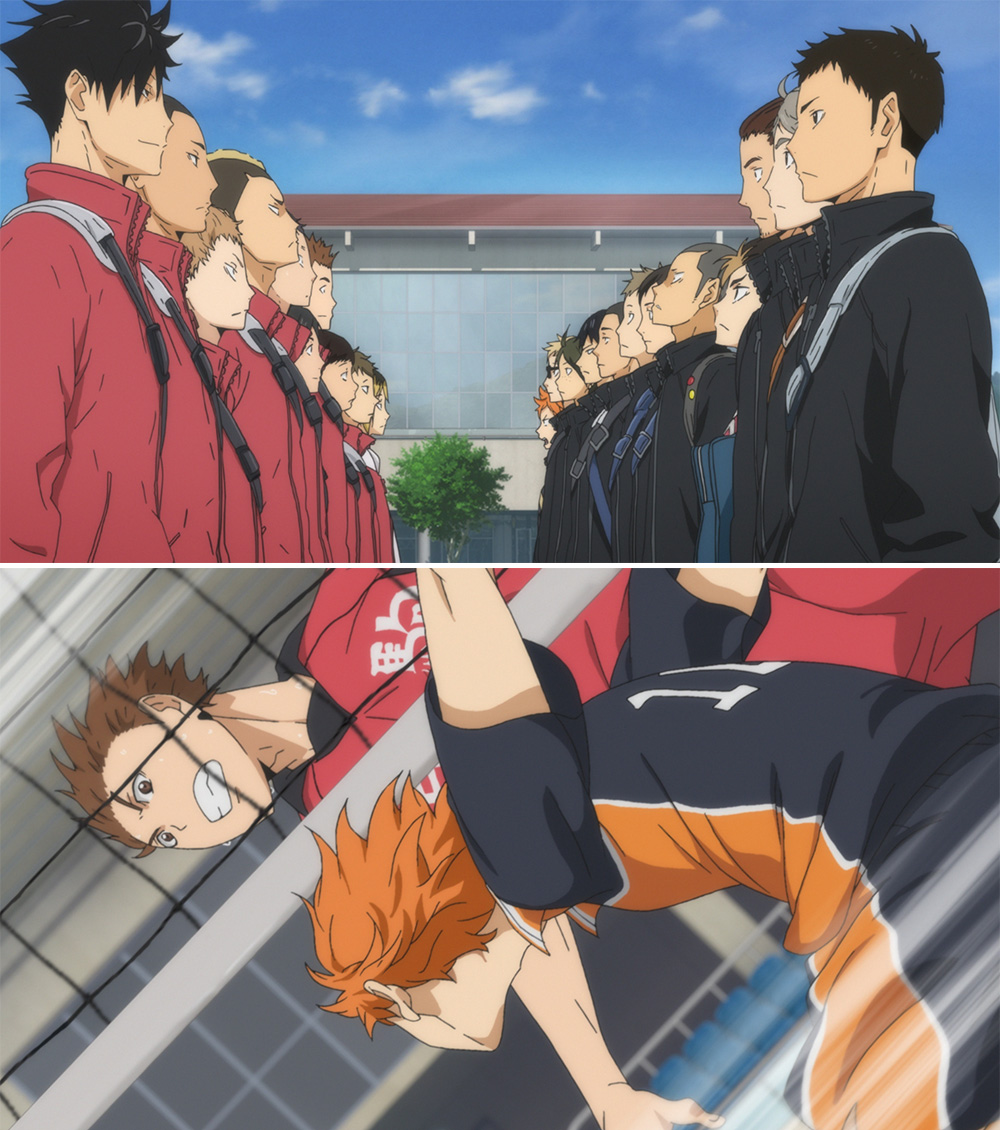
Daichi holds Karasuno's back line together
Karasuno’s early energy needs more than enthusiasm to become a functioning team. Daichi’s steady reception and practical authority give its volatile players a structure in which mistakes can be answered and rallies can continue.

Coverage: Covers Daichi’s role as Karasuno captain during the team’s early formation; no later tournament outcomes.
Stability begins with the first contact
Daichi’s contribution is easy to overlook beside the sharper spectacle of a powerful spike or a daring leap. Yet the team’s first contact with the ball often determines whether a rally can develop at all. His role in reception gives Karasuno a dependable point of continuity: an incoming ball has to be controlled well enough for someone else to act. That work does not guarantee an attack, but without it the team’s possibilities contract quickly.
The story’s attention to reception gives Daichi a kind of authority that is physical as well as social. He has to keep his position, read the ball, and give the play a stable start. This is not passive defense. It asks him to make a decision under pressure and place the ball where the team has a chance to continue. His steadiness makes the next action possible, which is a quieter but essential form of leadership.
A captain manages the conditions for play
Karasuno’s early group includes players whose intensity can pull the team in competing directions. Daichi’s captaincy matters because he understands that enthusiasm alone cannot coordinate them. A team needs roles, shared expectations, and someone willing to address behavior when it disrupts the work. He is practical about that responsibility: the court is a place where excitement must be organized if it is going to help.
His authority does not need to turn every interaction into a speech. Much of its force comes from consistency. Daichi holds himself to the demands he expects from the team, and he can bring players back to those demands when personality threatens to take over. That makes him a grounding presence without making him the story’s sole source of energy. His leadership works by helping a group with many strong impulses remain a group.
Calm is active, not effortless
It would be easy to mistake Daichi’s steadiness for a lack of strain. The series instead frames composure as something he must keep choosing. Reception demands concentration, and captaincy means he is responsible for more than his own immediate play. When a rally becomes messy or a teammate gets carried away, the work of restoring order takes attention that could otherwise go toward his own performance.
This active calm gives Daichi a useful contrast with more visibly explosive players. He does not need to match their intensity to matter. His strength is that he can keep the practical question in view: what does the team need to do next? That question has value precisely because an unpredictable moment can tempt everyone to chase a dramatic solution. Daichi’s influence narrows the chaos to actions the team can actually attempt.
Making room for a team to become a team
Daichi’s early leadership is not a promise that Karasuno will function perfectly. It is a way to make imperfect play workable. Reception can turn a difficult incoming ball into a second action; clear expectations can keep a volatile group from becoming a collection of private ambitions. Neither contribution is glamorous on its own, but together they create conditions in which players can learn to rely on one another.
That is why Daichi’s steadiness reads as more than a captain’s personality trait. It is part of the team’s practical equipment. He gives Karasuno a dependable response when the ball comes at them and a dependable standard when emotion threatens to scatter them. The team’s energy remains lively, even unruly, but it gains a frame. Daichi does not eliminate the chaos that makes Karasuno exciting; he helps make it playable, so the group can turn disorder into another chance to act.
Primary work & further reading
Primary work: Haikyu!!. Character and story readings are editorial interpretations. The publisher reference below identifies the work and its premise.