The public life of a summoner: Yuna's early pilgrimage
Yuna’s courtesy in the early pilgrimage is more than a personal manner. It helps her meet people as a summoner, steadies conversations shaped by expectation, and shows how much care her public role requires.

Coverage: Covers Yuna’s early conversations, summoner duties and relationships with her guardians during the opening pilgrimage. Avoids later revelations about the pilgrimage’s cost.
Courtesy is part of the work
Yuna’s politeness often appears in small exchanges: a measured response, a respectful greeting, attention given to someone who has approached her. Those gestures could be mistaken for a simple personality trait. In the early pilgrimage, though, they also belong to the work of being a summoner. People look to her with hopes and expectations that precede any private conversation. Courtesy lets her receive that attention without making every meeting feel like an interruption.
The care in her manner is not passive. Yuna listens, acknowledges what others bring to her and chooses a tone that can keep a conversation open. Her restraint reads as practical skill, especially when strangers address her through the role she represents. She cannot control what people expect a summoner to be, but she can shape how she meets them. That effort makes politeness a form of public labor.
A person inside the title
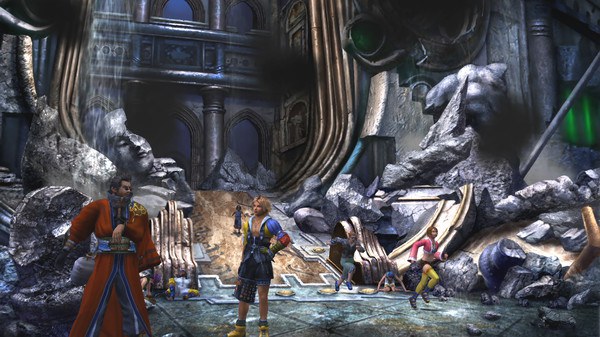
Tidus’s arrival makes the gap between Yuna’s public position and her ordinary self especially legible. He does not share the group’s familiarity with her responsibilities, so his reactions are less governed by ceremony. Around him, Yuna can be seen responding to a person rather than only receiving deference as a summoner. That shift does not erase her role; it gives the audience a clearer sense of the person carrying it.
Her exchanges with Tidus also show that politeness can create space without granting immediate intimacy. Yuna is considerate, but she does not have to disclose everything to make a conversation kind. The distinction matters because public attention can invite others to believe they already know her. Her careful manner allows warmth while keeping a boundary between the person she is and the expectations attached to her title.
Guardians carry different kinds of care
Yuna’s guardians surround her with forms of attention that are not interchangeable. Lulu’s steadiness, Wakka’s protective enthusiasm and Kimahri’s quiet watchfulness all frame the journey differently. Their presence shows that Yuna’s role is supported by a group, even as the group’s attention can reinforce how much is expected of her. Their conversations with her mix familiarity and duty: she is someone they know, and someone whose mission organizes their choices.
Yuna’s own courtesy helps those relationships stay human rather than purely ceremonial. She speaks to the people protecting her as companions, not as instruments of a public office. At the same time, the guardians’ practical concern can shape what is said around her and what she is allowed to face alone. The early journey presents care as both closeness and responsibility, with Yuna often at the point where those meanings meet.
Composure does not mean ease
Yuna’s calm manner can make her look effortlessly prepared, but the conversations around her suggest a more demanding picture. A public figure must notice how a room responds, answer people with consideration and keep moving through obligations that others may treat as natural. Her gentleness does not prove that the role is light. It shows how carefully she handles its pressures in front of other people.
That is why her politeness carries weight. It connects the summoner’s public duty to the person who must perform it one interaction at a time. Yuna’s courtesy gives strangers a way to approach her and gives companions a familiar person to travel beside. It also asks labor of her: to remain attentive and gracious while the journey defines her for others. The early pilgrimage lets that effort register without reducing her to a symbol.
Primary work & further reading
Primary work: Final Fantasy X. Character and story readings are editorial interpretations. The publisher reference below identifies the work and its premise.