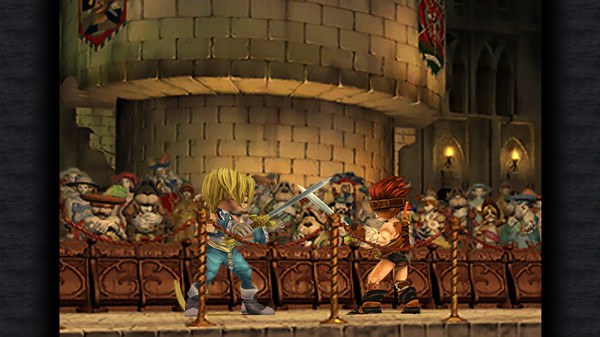
Garnet wants to leave Alexandria too
Garnet’s escape begins inside a scheme built by others, yet she is not merely its prize. The opening Tantalus plot lets her use an imposed crisis to leave the life her royal title has defined.

Coverage: Covers Garnet’s departure and the opening Tantalus scheme only; no later game events.
A princess enters someone else’s plan
Garnet’s position at the start of Final Fantasy IX is defined by a title before it is defined by a choice. As Princess of Alexandria, she belongs to a public world of ceremony and expectation. Tantalus’s plan to take her from the palace appears, on its face, to make her the object of an operation devised by other people. The word “kidnapping” carries that imbalance: someone is taken, and someone else claims control over what happens next.
But the opening gives Garnet a perspective that complicates the scheme. She is not simply waiting to be carried away. Her response to the plan reveals that she sees a possibility in the disruption, even if she cannot dictate every part of it. This distinction matters: agency does not require total control over the situation. Garnet can recognize that an outside plan might serve a desire of her own, and act within its narrow openings. The scene’s tension comes from the fact that both things are true at once—she is being pursued by a scheme, and she is trying to use it.
The title does not explain the person
Royal status gives Garnet influence and visibility, but it also places her in a role with rules she did not write. The palace can provide security and privilege while limiting how freely she moves. The opening’s focus on her departure makes that tension concrete. She is not leaving an abstract institution; she is attempting to get beyond the routines, watchers, and expectations attached to being the princess. The title tells other people how to approach her, but it cannot tell the player what she wants.
That gap between public identity and private intention makes Garnet’s choice feel more substantial than a rejection of responsibility. The story does not need to portray royal life as wholly false for her to want distance from it. A person may value her home and still feel constrained by the form her life has taken there. By letting her see an opportunity in Tantalus’s plot, the game gives her a desire that exists alongside her rank. She is not only the symbol at the center of a political household; she is someone seeking room to act.
Borrowed momentum still takes nerve
Garnet’s departure depends on other people’s momentum. Tantalus has its own performers, timing, and intentions, and the plan does not become hers merely because she wants to leave. That dependence creates genuine vulnerability. She must trust a situation she cannot fully command, and the people around her may not understand the choice in the same way she does. Her agency is therefore practical rather than absolute: she identifies a route and moves through it while the circumstances remain unstable.
The opening treats this as a meaningful kind of courage. Garnet does not wait until every risk has been removed or every participant has agreed on a shared explanation. She acts while the opportunity is available. That does not make her a master strategist, and the story does not need to pretend she controls the consequences. Her decision is compelling precisely because it unfolds under imperfect conditions. She takes a chance on movement, accepting that leaving a protected position can also expose her to danger and uncertainty.
An escape can begin before it is secure
Calling the event a kidnapping emphasizes what Tantalus intends; calling it a departure emphasizes what Garnet wants. The two descriptions pull against each other, and the opening is stronger for keeping both in view. If the episode were only a rescue from palace life, Garnet’s dependence on the scheme would disappear. If it were only an abduction, her deliberate participation would disappear. The layered reading preserves the imbalance of power while recognizing that she has a purpose of her own.
Garnet’s opening action does not settle who she will become, and it does not guarantee that freedom will arrive with the first step outside the palace. It establishes something narrower and more revealing: the royal title has not exhausted her will. She can take an opportunity offered by a plan she did not invent and make it part of her own attempt to leave. Her departure begins in constraint, but it is still a choice.
Primary work & further reading
Primary work: Final Fantasy IX. Character and story readings are editorial interpretations. The publisher reference below identifies the work and its premise.