Why Final Fantasy VI keeps changing its lead
Terra, Locke, Edgar, and Sabin each make a different kind of claim on the story. Their early arcs show how Final Fantasy VI shifts its focus to connect private motives with a struggle larger than any one hero.
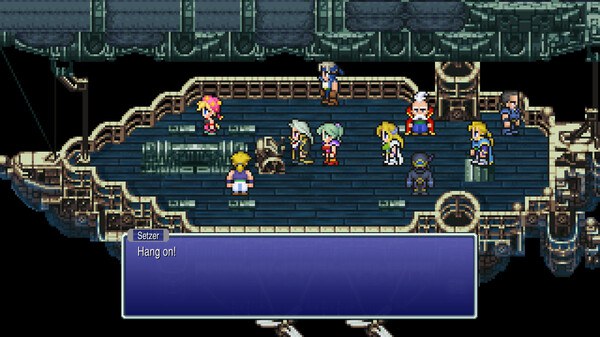
Coverage: Discusses the opening and early arcs of Terra, Locke, Edgar, and Sabin; avoids later recruitment and ending events.
Terra begins with a question, not a mission
Terra seems at first to be the obvious central figure: the game opens with her, and the Empire’s interest in her power gives the conflict an immediate human face. But she does not begin with a self-directed mission in the familiar heroic sense. She has to piece together what has happened to her and decide how to live beyond other people’s control. The story’s opening emphasis is therefore less a promise that she will command every later scene than an invitation to ask what perspective can reveal.
Her uncertainty also prevents the larger political struggle from arriving as a tidy cause already understood by its protagonist. The Empire has acted on her body and ability before she can explain either to herself. Through Terra, the conflict is felt as a question of personhood and trust. That angle is crucial, but it is not the only one the early story needs. The world’s institutions, loyalties, and ordinary choices come into focus through characters who know different parts of it.
Locke turns movement into a personal obligation
Locke’s early role gives the story a different kind of momentum. He is a thief by reputation, but his response to Terra is protective: he helps her escape Narshe when she is vulnerable and under suspicion. That action places him in the plot not as a second version of Terra, but as someone whose choices are shaped by a promise and a sense of responsibility. His past remains part of the way he acts, even when his present task is to get another person to safety.
Following Locke shifts attention from Terra’s bewilderment to the practical labor of resistance. He knows how to move between places and people, and he carries emotional stakes that make those movements more than errands. His perspective lets the game show how a private obligation can intersect with a political cause without being absorbed by it. The Empire may be the common threat, but what drives a character through danger can be specific, personal, and difficult to put aside.
Edgar and Sabin give loyalty two forms
Edgar introduces the story to rule as a public responsibility. As the king of Figaro, he has to manage his position in a world where the Empire exerts pressure on smaller powers. His early conversations and decisions make political caution visible as an active skill: survival can involve reading what an enemy expects, rather than displaying defiance at every opportunity. That approach broadens the conflict beyond a clash between brave individuals and a plainly hostile regime.
Sabin’s early arc, by contrast, places personal conviction beside the responsibilities attached to Edgar’s crown. The brothers’ separation from the throne gives their loyalty a history, while Sabin’s independent path makes clear that leaving a role is itself a consequential choice. He is not simply Edgar’s opposite, because both brothers remain connected to their shared past and to the danger facing their country. Their different positions show that commitment can mean preserving a public institution or choosing a life outside it.
A changing lead makes an ensemble argument
These shifts do more than distribute screen time among a large cast. Each early perspective corrects the limits of the one before it. Terra makes power intimate; Locke makes it a question of care and obligation; Edgar makes political maneuvering concrete; Sabin makes duty legible through a choice to depart from a royal role. The central conflict grows more particular as it passes through them, because no single character can stand for every way it touches a life.
Final Fantasy VI keeps changing its lead because its early story is built to be understood from more than one position. The change of focus does not cancel Terra’s importance, or make the others temporary supports for her. Instead, it asks the player to hold several motives together while they begin to intersect. The ensemble’s argument is that resistance becomes meaningful through people whose reasons differ. A shared danger can bring them into the same story without making them the same kind of hero.
Primary work & further reading
Primary work: Final Fantasy VI. Character and story readings are editorial interpretations. The publisher reference below identifies the work and its premise.